

These Bizarre Blue Creatures Are Covering Beaches In California
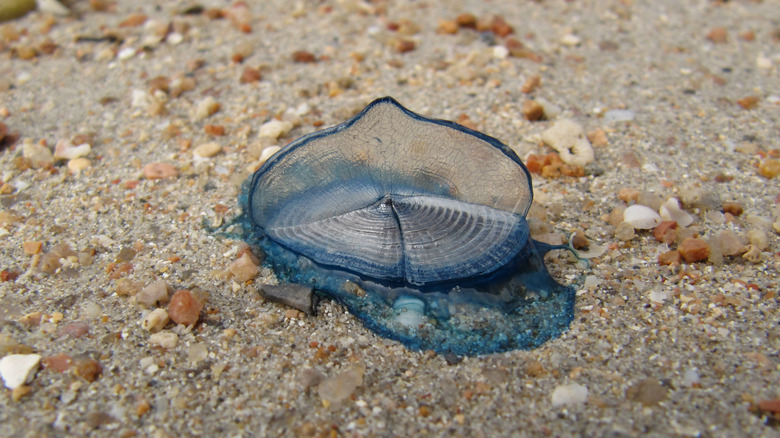
If you take a walk along one of California's beaches in the springtime, you might come across a strange, iridescent blue creature washed up on the sand. This year, you're almost guaranteed to, as 2026 has brought them by the millions to beaches all the way up the West Coast. If you found one stranded on the shore, you'd probably assume it was a small jellyfish, but it's actually something much stranger: Velella velella, colloquially known as a "by-the-wind sailor." It gets its nickname from the clear, sail-like vane that rises from its body. As they float on the ocean's surface, they use these "sails" to catch the prevailing winds, travelling vast distances by the very same forces that propelled the earliest seafaring people.
Velella have been passing along the American West Coast for millions of years. They show up in the spring, as the forces that change the seasons shift wind patterns in that direction. They travel in colonies of thousands, packed together so closely that they look like shimmering blue islands. Each velella has a circular body around three to four inches wide, and with the crop of tiny stinging tentacles that trail beneath it, they certainly appear to be jellyfish of some kind. However, velella actually belong to a completely different taxonomic class: hydrozoa. And as strange and complex as jellyfish are, hydrozoans are even more bizarre. Velella challenge our notions of what a life form can be, and 2026 is panning out to be a particularly interesting year for them.
The difference between velella and jellyfish
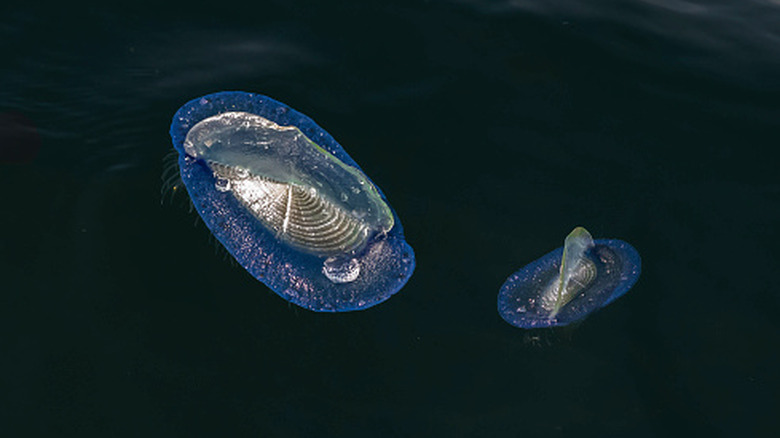
Velella are related to jellyfish, even if they aren't quite the same. Both belong to the taxonomic phylum Cnidaria, which also includes corals and sea anemones. However, velella are in the class hydrozoa while true jellyfish, such as the moon jelly and sea nettle, belong to the class scyphozoa. Hydrozoans and scyphozoans both have a complex reproductive process, though. Fertilized eggs develop into polyps, which then multiply asexually, turning into numerous medusae. The medusae subsequently produce eggs and sperm to go through sexual reproduction. The main difference between these two classes is that scyphozoans spend most of their life in the medusa stage, whereas hydrozoans spend most, if not all, of their lives in the polyp stage.
What's more, the velella you might find washed up on the beach are not individual organisms, but rather colonies of up to thousands of individual polyps, known as zooids. As the zooids clump together, they form an exoskeleton around themselves made of chitin. This gives them the appearance of being a singular organism. Each zooid within the colony becomes specialized to perform a specific role, such as making up their stinging tentacles, or filter-feeding zooplankton from the surrounding waters.
While velella are common along the American West Coast, the most famous example of a hydrozoa is surely the jellyfish look-alike, the Portuguese man-of-war. They are very similar to velella, with sail-like vanes that carry them across the ocean. However, valella are much smaller, and their stings are too weak to hurt a human.
Why so many velella are washing up in 2026
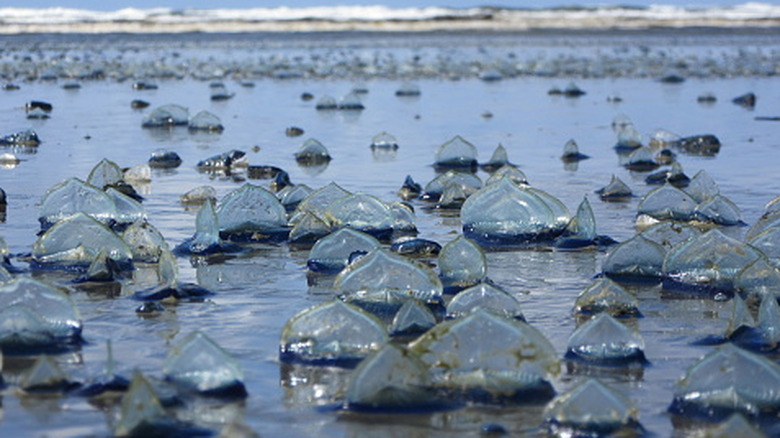
Velella show up on the beaches of California, Oregon, and Washington every spring, and that doesn't happen by chance. As winter changes to spring, the wind along the West Coast shifts direction from north to south, a transition that unfolds like a wave, causing strong sea breezes. Since velella move at the mercy of the winds, this shift inevitably leads to some groups of them getting blown all the way to the shore, where the tides can leave them beached. In 2026, however, they are showing up in numbers far greater than usual, with groups numbering in the millions left stranded on the sand. Why such an unusually high number this year?
The answer could be found in recent research conducted at the University of Washington. A study spanning 20 years of data observations and ultimately published in the journal Marine Ecology Progress Series in 2021, found that velella appear in larger numbers when coming off of a warm winter. Due to the effects of global warming, the winter of 2025–2026 was the second hottest on record in California and the hottest ever recorded in Oregon, which could explain why these western states are seeing such strong coastal winds accompanied by such astoundingly large numbers of washed-up velella. The fragile hydrozoans quickly die on the sand, and soon the beaches of the West Coast will be covered not in bright blue, but in the gray, crumbling remains of these magnificent creatures.