

The Mesmerizing 'Fire Rainbow' Phenomenon Is Easily Explained By Science
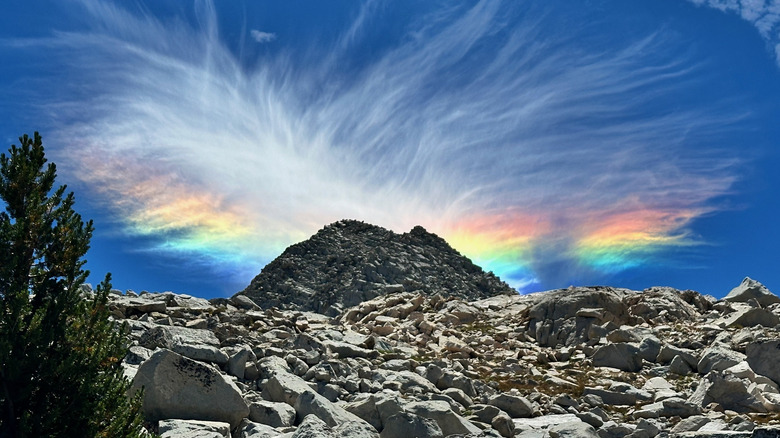
In recent years, images of so-called "fire rainbows" have bloomed in number on social media, with several thousand people sharing their shots of the brilliant sky phenomenon. Fire rainbows appear as vibrant, rainbow-colored clouds that illuminate a section of the sky, with many forming a loose "V" shape. Some people think the V shape looks like angels, and it's possible that fire rainbows could have inspired personal spiritual revelations in the past. Yet, while fire rainbows aren't really angels, they are spectacular gifts from nature. Scientists refer to the phenomenon as "circumhorizontal arcs," which appear when sunlight passes through cirrus clouds and is refracted by their ice crystals.
To understand "fire rainbows," it can be helpful to forget the term "fire rainbows" entirely. Circumhorizontal arcs contain no fire nor produce traditional rainbows. In fact, the special refraction of light occurs in the troposphere, a layer of atmosphere so high that water can only exist in the form of microscopic ice crystals. When these crystals collect together in a suspended haze, they form cirrus clouds. Unlike the cute, fluffy cumulus clouds where rain clouds (different than snow clouds) form, cirrus clouds appear as distant rows of white streaks across the far sky.
Circumhorizontal arcs occur when we look at cirrus clouds from a specific angle between us, the sun, and the clouds. Effectively, the uncountable number of crystals in a cirrus cloud act together as a dispersed lens, one which refracts sunlight into different bands of color. Similar to a cue ball hitting the wall of a pool table, light particles from the sun bounce through ice crystals in cirrus clouds, and their paths change direction. And because this refraction filters the particles' wavelengths in the process, it shifts into the warm, multicolored displays in the sky that earned the moniker "fire rainbow."
Where and how 'fire rainbows' appear
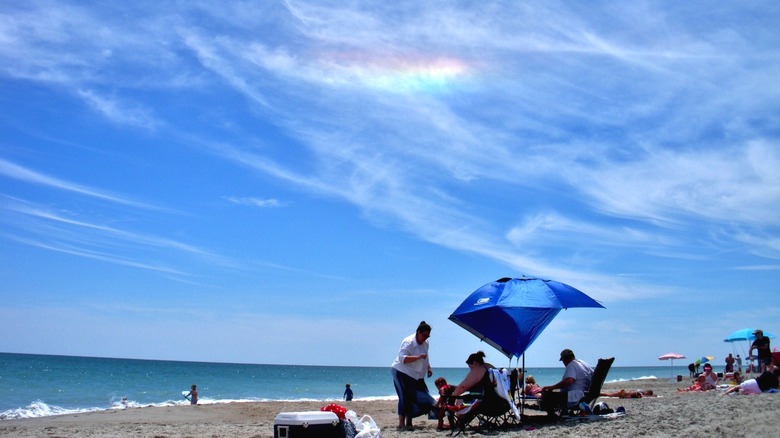
Spotting a fire rainbow, or "circumhorizontal arc," isn't a daily occurrence, much like how the "red rainbow" weather phenomenon is also exceedingly rare. Nor do circumhorizontal arcs appear just anywhere in the world. Typically, they can be observed in regions considered "mid-latitude," that is, places located between the equator and poles. For example, the Goldilocks' zone for witnessing a circumhorizontal arc in the Northern Hemisphere is below 56 degrees of latitude. That means the contiguous United States, southern Europe, and many countries in Asia have a chance of seeing a fire rainbow. For those living above 56 degrees of latitude, the sun simply doesn't climb high enough in the sky to produce a visible circumhorizontal arc. (Sorry Alaska. At least you'll still get a chance to see the Northern Lights).
The reason fire rainbows are only visible in mid-latitude areas is due to the specific conditions and angles required for one to form. For one, the sun needs to be positioned high, at least 58 degrees in the sky. The sky needs to be clear of other clouds, as well, since cirrus clouds can easily get blocked from view. Finally, the ice crystals must be thinly dispersed, and they must be generally the same size to form a collective refracting lens.
If all the conditions are met, there's a chance you'll get to see a cirrus cloud transform into a dazzling circumhorizontal arc. Depending on the angle between you, the cloud, and the sun, its colors range from warm oranges to deep blues. Thus, many observers have adopted the name "fire rainbow" to describe the multi-colored display. They aren't proper rainbows, but fire rainbows are still spectacular — and highly photogenic.