

Physics Explains Why Your Fuel Economy Suddenly Plummets Above 75 MPH

According to the Department of Energy, the average midsize gasoline-powered car reaches optimal fuel efficiency at 55 mph. Any faster and fuel economy starts to tank. The same overall trend is true for diesel and hybrid cars, as well. For example, a midsize diesel car's fuel efficiency drops by 33% when it accelerates from 55 mph to 75 mph. The reason is air resistance, which at high speeds can induce powerful pushback on an accelerating vehicle.
Long-haul diesel trucks have it even worse: Truckers spend about 10% of their fuel simply on pushing back against air resistance. Planes, too, battle against enormous opposing forces from atmospheric gases. That's why passenger planes typically cruise at around 30,000 feet where the air is thinner.
Such statistics may be hard to swallow, since so many of us have been mistakenly led to believe that with greater speed comes greater fuel efficiency. Cars are advertised with their "city" and "highway" fuel economies listed separately, and the latter is almost always higher than the former. However, fuel economy estimates are based on driving patterns more than they are air resistance, since driving in a city requires frequent stopping and starting. But on a straight road, slower speeds mean less air resistance and, in turn, greater fuel efficiency.
Why air resistance increases with speed can be understood using physics. The formula that engineers use to calculate a vehicle's aerodynamic drag force is:
drag force = (car speed)2 × (front surface area) × (drag coefficient) × (½ air density)
Because drag force is a product of car speed squared, linear rises in speed are met with greater air resistance. Put another way, as you go faster, wind resistance becomes exponentially more powerful..
Understanding air resistance: countless tiny collisions

Intuitively, driving twice as fast should result in twice as much wind resistance, and yet it doesn't. In reality, double the speed means quadruple the drag, a concept that's hard to visualize thanks to the fact that air is invisible. Even more confusing, air resistance isn't a single force but a net force from vast numbers of air particles. In other words, the strong winds we feel when driving at high speeds are actually the result of countless air particles colliding with our vehicle.
How countless? National Geographic estimates that there are around 25 sextillion molecules in a single breath of air — or 25 followed by 21 zeroes. Estimating the number of air molecules that pass over a car on the highway would require a lot more zeroes.
It's therefore impractical to add up all the electrostatic forces of every air particle collision to calculate air resistance. Instead, physicists consider the problem to be a question of thermodynamics, and they use the concept of pressure to measure it. Pressure can express the net force of gas particles' collisions against a surface, such as a car windshield. That makes pressure the perfect unit for measuring drag on a vehicle, and it, too, rises exponentially with speed. Thermodynamically, air resistance (q) can be expressed as a product of kinetic energy:
q = (½ fluid density) × (fluid velocity)2
Once again, even when expressed as a fluid, air resistance is calculated by squaring the velocity. In simple terms, steady rises in speed result in increasingly greater rises in air resistance. In any case, fuel economy plummets with speed.
When air resistance costs money
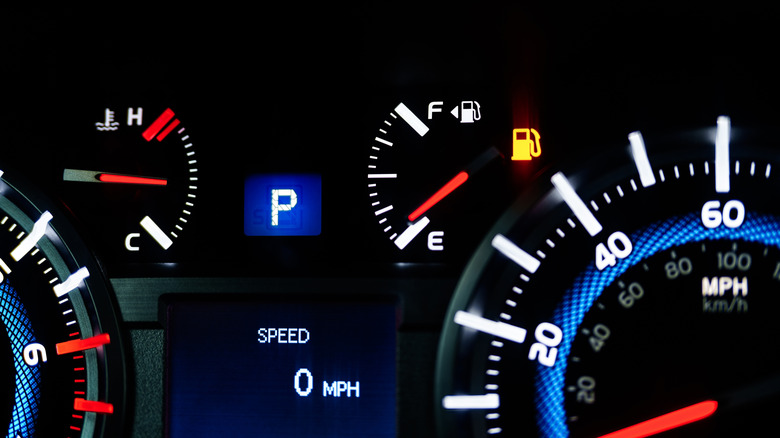
Air resistance doesn't just determine our fuel efficiency, it also sometimes determines our legal speed limits. Because the average vehicle requires more and more fuel to accelerate above 55 mph, lawmakers used this benchmark as a good maximum speed limit for two-way roads in many parts of the United States. This was especially true during the oil crisis of the 1970s, when the United States government sought ways to conserve fuel.
Of course, there are many factors that affect a vehicle's fuel economy beyond air resistance. The frictional force between a car's tires and the road also plays a role, as does wind speed and direction. Still, we're reminded of the stopping power of the air every time we have to gun it on the highway and the whoosh of wind slams our windshields. Considering the physics of driving fast, and with fuel prices on the rise, it's most likely a financially wise choice to take it slow on the road.