

Scientists Have Detected A Massive Deep-Sea Creature Off The Coast Of Australia
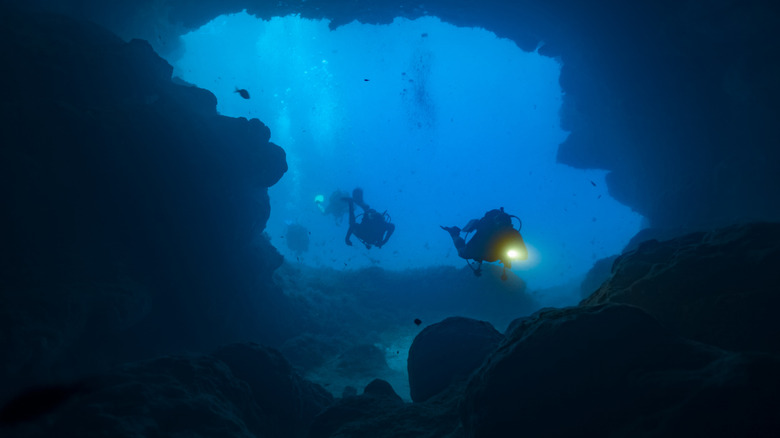
Scientists have only explored a fraction of Earth's ocean, mainly because some areas, like submarine canyons or steep-sided deep valleys, are logistically challenging to explore. Despite that, they continue to study what they can to learn more about sea inhabitants. That research has led to the discovery of the strangest deep sea creatures ever, such as the goblin shark and giant tubeworms. While conducting the first comprehensive environmental DNA (eDNA) analysis of Western Australia's Cape Range Canyon and Cloates Canyon, scientists detected that they're home to one of the most elusive and mysterious creatures: the giant squid (Architeuthis dux).
Deploying a Conductivity, Temperature, Depth (CTD) rosette and remotely operated vehicle (ROV) SuBastian from the Schmidt Ocean Institute's RV Falkor vessel, Curtin University researchers collected water samples around the canyons during a Western Australian Museum-led expedition. The findings published in Environmental DNA detail that 178 total samples of 10 liters each were collected at various depths about 1,200 kilometers north of Perth — from the surface to between 2,020 and 4,370 meters down along the seafloor. After analyzing eDNA, tiny genetic fragments left by marine life, the scientists concluded that the giant squid has been living in this part of the deep ocean. The creature's DNA was confirmed in six of the water samples collected from both of the submarine canyons.
In a press release, WA Museum head of aquatic zoology and curator of molluscs Dr. Lisa Kirkendale explained that giant squid have only been recorded off the Western Australian coast twice. There have also been no collected specimens or sightings in over 25 years. "This is the first record of a giant squid detected off Western Australia's coast using eDNA protocols and the northernmost record of A. dux in the eastern Indian Ocean," she added.
What scientists know about the legendary Architeuthis dux
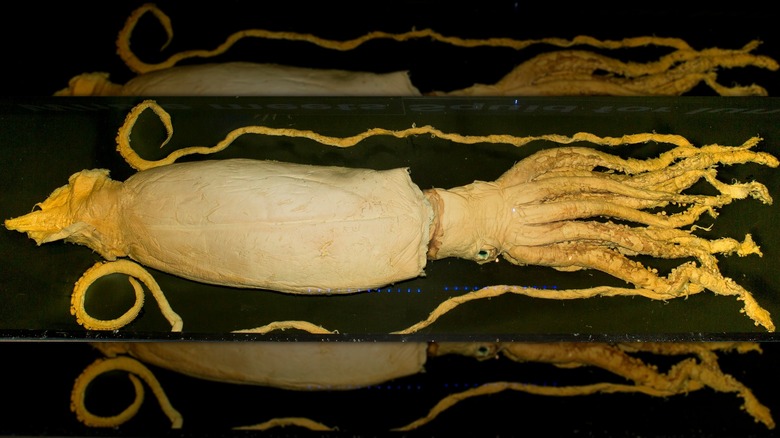
Descriptions of a huge squid have appeared in writings from ancient philosopher Aristotle and Roman author and savant Pliny the Elder, while tales of a ferocious kraken are part of Norse legend. However, Danish zoologist Japetus Steenstrup was the first to compile documented evidence of the creature, which he named Architeuthis dux, in 1857.
It's such an elusive beast, though, that it wasn't until 2004 that an almost-complete specimen was accidentally captured. After years of study, researchers determined in 2013 with DNA samples that A. dux is the only species of giant squid. Meanwhile, scientists have only been able to capture images of the animal on deep-sea cameras a few times and study pieces of washed-up remains, such as a specimen collected by Iziko Museums in 2022.
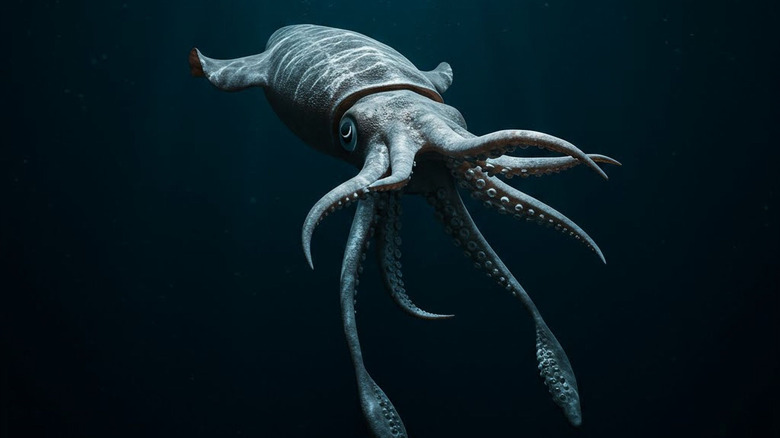
So little is known about the physical and behavioral adaptations of the giant squid because of these rare "interactions." What researchers have been able to surmise is that it's the longest cephalopod in the ocean, reaching an average 10 to 13 meters long (more than a school bus). The average weight is 200 to 280 kilograms, and they have the biggest eyes in the animal kingdom, measuring up to 30 centimeters in diameter (like a large pizza).
Based on the specimens studied, scientists have also established that the A. dux lives about five or six years. That's a huge difference from the six months to a year of most other squids. Since it has a large brain and complex nervous system like other cephalopods, it's suspected that it's just as intelligent and capable of problem-solving. More study is needed to confirm that, though, which is becoming more possible with this recent eDNA research.
The giant squid lives with other elusive and unknown species in Australia's submarine canyons
While the discovery that A. dux has made the Cape Range Canyon and Cloates Canyon its home is the biggest news to come out of the Western Australian study published in Environmental DNA, it's not the only marine species that has never been detected in these waters before. Lead author Dr. Georgia Nester said in the press release, "Finding evidence of a giant squid really captures people's imagination, but it's just one part of a much bigger picture," highlighting how little researchers know about the Indian Ocean's deep ecosystem.
Among the dozens of others are the faceless cusk eel, the slender snaggletooth, and the sleeper shark. Interestingly, the sleeper shark also fascinated scientists by appearing in the South China Sea when they dropped a cow carcass into the water. This species had never been detected that far south before, and these new findings seemingly confirm the 2025 hypothesis that its range is expanding southwest. Overall, the researchers detected more than 200 species of rare deep-sea fish, echinoderms (a variety of invertebrates with hard, spiny bodies), cnidarians (sea species like corals and jellyfish), marine mammals, and squid. Included among them were deep-sea whales like Cuvier's beaked whale and the Pygmy sperm whale.
Additionally, the scientists were unable to identify some of the eDNA. Dr. Nester explained, "We found a large number of species that don't neatly match anything currently recorded, which doesn't automatically mean they're new to science, but it strongly suggests there is a vast amount of deep‑sea biodiversity we're only just beginning to uncover." By using eDNA protocols, though, they will be able to learn more about what lives in the hidden ecosystems of the Indian Ocean, which could aid conservation and management efforts.