

Here's Why You Wake Up To Pee At Night, But Not Poop
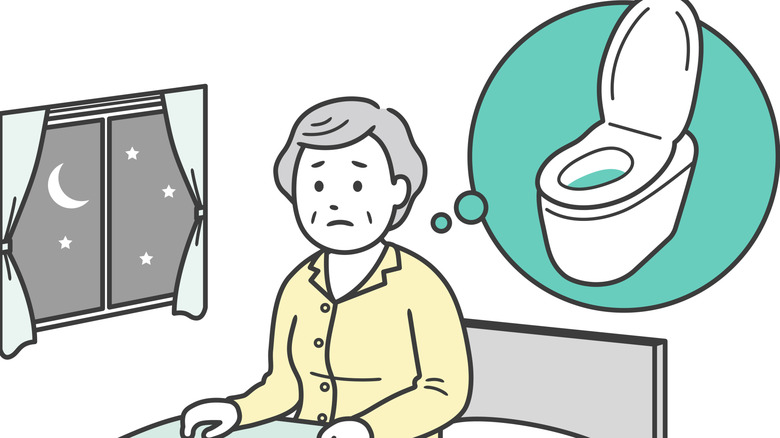
Waking up to pee in the middle of the night might be something people are too embarrassed to talk about. Like peeing in the shower, a lot of people do it, especially with older age. Despite it being annoying, it's best to get up and relieve yourself because holding in urine is bad for your bladder and overall health since it can increase the risk of infection and weaken the bladder muscles. Have you ever wondered, though, why you only wake up to pee and never to poop? As it turns out, there are a few reasons.
The first reason why you wake to pee but not poop is because the gastrointestinal system functions alongside the body's circadian rhythm. According to a study published in the Journal of Clinical Gastroenterology, the gut enters a state of rest or temporary inactivity as you sleep. Johns Hopkins Center for Neurogastroenterology director of neurogastroenterology Pankaj J. Pasricha, MD, also explained to Reader's Digest Canada, "The sophisticated, intelligent neurons in your gut that control colon contractions, which push out waste, are also influenced by your body's circadian rhythm." That's why most people don't feel an urge to poop in the middle of the night.
Meanwhile, the bladder can only hold so much of the urine that the kidneys produce, which are the other reasons you only wake to pee. Dr. Pasricha said that the bladder can only stretch so far before you get the urge to empty it. In an interview with Harvard Health Publishing, Brigham and Women's Hospital urologist Dr. Michael O'Leary noted, "The kidneys never stop making urine, and many people make urine more efficiently when they're lying flat than when they're sitting or standing."
When waking up to pee at night is concerning

Having to pee in the middle of the night happens to a lot of people. However, it's not normal for it to happen regularly because the body is supposed to be able to sleep for six to eight hours without needing to urinate. It's considered nocturia at that point, according to a paper published in Neurourology and Urodynamics. Unfortunately, about 36% of 1,000 respondents to a study published in BJU International reported experiencing this lower urinary tract symptom.
Nocturia is simply a sleep disruption rather than a disease itself. While it could be caused by regularly drinking too much before bedtime or taking diuretics or other medications, it could be the symptom of an underlying health issue. Some of these conditions aren't serious, like pregnancy and menopause. However, other conditions could be concerning and require further medical attention, from high blood pressure and heart disease to uncontrolled diabetes to an enlarged prostate. Scientists have also found and published in the British Journal of Urology International a correlation between peeing in the middle of the night with heart health issues — specifically coronary heart disease (also known as obstructive coronary artery disease).
If you experience nocturia, it's important to talk to your doctor, who will ask several questions to narrow down the cause. Treating this symptom could be as simple as restricting fluid consumption before bedtime and managing diuretics better, but there are some medications that can help when these simple changes aren't enough. When an underlying health problem is suspected, the doctor may order tests, such as a bladder scan, blood test, cystoscopy, urinalysis, or urodynamic test. Then, additional treatments can be implemented after the underlying issue is pinpointed.