

The Difference Between Thick And Thin Eggshells Is Easily Explained By Science
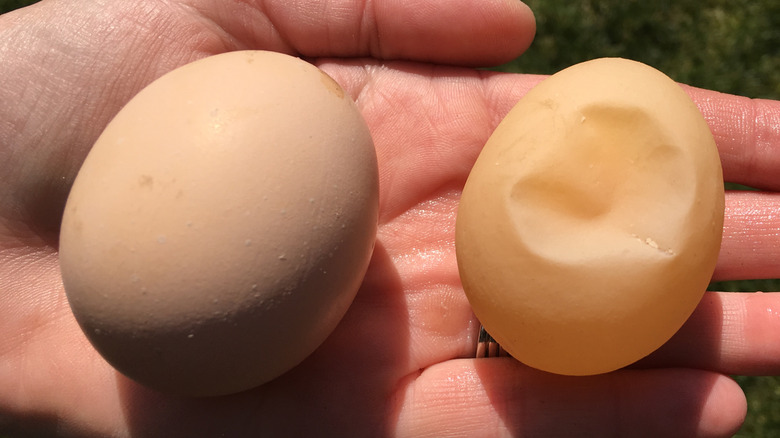
Scientific studies have determined that hen eggs are a highly nutritious part of a balanced diet. Whether your eggs are brown or white or they have orange or yellow egg yolks — neither of which affect the nutritional value — science can easily explain that too. And, there's another difference that science can explain: why the shells of some eggs are thinner than others. Two of the biggest factors that affect eggshell thickness are a malfunctioning shell gland and mineral deficiency.
As a chicken produces eggs, the shells for the eggs are made in the shell gland. This layer of muscle is lined with goblet cells and tubular glands. Unfortunately, the gland is susceptible to infection. While a malfunctioning shell gland could result in a very thin shell around the egg, an infected gland could result in an egg with no shell at all.
When the shell gland is healthy and functioning properly, neuroendocrine or ovulation factors are responsible for stimulating the secretion of calcium. Then, each egg spends 18 to 26 hours there as it takes up fluid and salts from the tubular glands before undergoing calcification. More than 90% of the eggshell consists of calcium, so a thin shell could indicate that the hen is deficient in that mineral. However, vitamin D and trace minerals — such as manganese and zinc — are also involved in the calcification process.
Environmental factors and hen age also affect the thickness of eggshells
Even when the hen's shell gland is healthy and the bird gets enough minerals for proper egg calcification, environmental factors can affect how thick the shell gets. One of these factors is a class of toxic compounds called mycotoxins which are produced by fungi and molds. These compounds have no smell and are invisible, but they can develop on the crops used in chicken feed. When a hen is exposed, it's more likely to lay eggs with thinner-than-usual shells.
Another environmental factor is stress from heat or overcrowding. If this stress occurs when the eggs are in the shell gland, it can have a significant impact on the calcification process and result in thin-shelled eggs. In the case of overcrowding, soft-shelled eggs are at a higher risk of breaking as the hens fight for nesting or roosting space.
These factors, so far, are largely avoidable for diligent farmers. One factor that isn't avoidable is the chicken's age. By the time it reaches around 3 years old, the eggs that the hen produces are larger than those it produced in years past. However, the amount of minerals used during calcification remains the same. That means the concentrated minerals are stretched over a larger surface area, resulting in a thinner-than-usual shell. To prevent that, chicken farmers often supplement the feed supply with additional calcium to help the hen develop thicker eggshells.
Age can also be a factor simply because, like with other animals, an older hen has a less efficient reproductive tract, which can cause blood and meat spots alongside thinner shells. Although letting chickens molt can mitigate this challenge some, many farmers opt to replace the older hens with younger ones.