

Not Earth, Not Venus: This Planet Has The Biggest Volcano In The Solar System
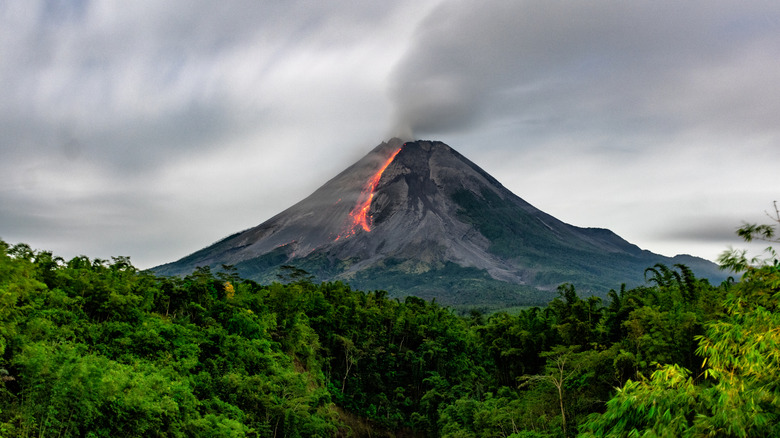
The word volcano can conjure up different images in the mind. Sometimes it paints a picture of giant fields of lava spreading down a slope. Other times the word elicits thoughts of explosions and massive clouds of ash and dust. While different types of volcanoes exist on Earth, neither our world or its neighboring planet Venus are the homes of the solar system's largest volcano. That honor belongs to our other neighbor, Mars.
A region near the Martian equator known as Tharsis Montes contains a dozen massive shield volcanoes, many of which are up to 100 times taller than volcanoes on Earth. The most massive of these is Olympus Mons, the largest volcano in the solar system. A shield volcano is a broad, gently sloping volcano that resembles a shield lying on the ground. They are built from repeated flows of erupting lava laid down over many years. Mauna Loa in Hawaii, which is the tallest mountain on Earth from base to peak, is also a shield volcano.
A tall, but wide mountain
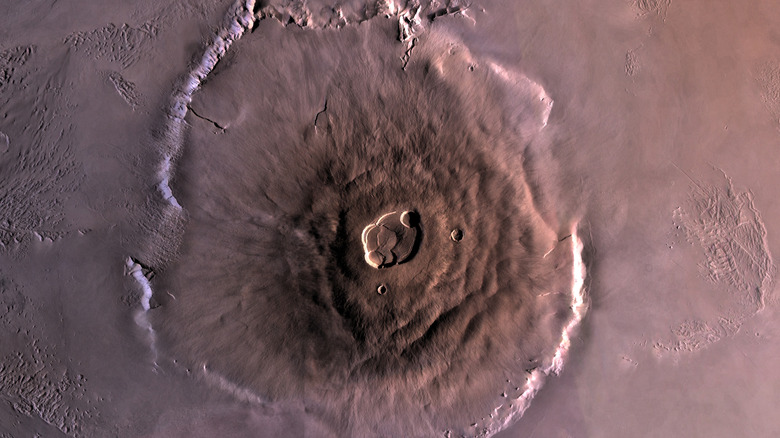
The top of Olympus Mons rises 16 miles from the surrounding plains, towering over Mauna Loa which stretches 6.3 miles from the ocean floor to its summit. Typically we measure mountain heights above sea level, making Mauna Loa only 2.6 miles high while the peak of Mount Everest is 5.5 miles above sea level. However, since Mars has no oceans, scientists use an artificial average elevation called the datum to be a sort of sea level substitute. Even when considering this, Olympus Mons is still a giant, reaching 13 miles above the datum.
While the peak of Olympus Mons is astoundingly high, someone standing on the side of the volcano would see what looked like a gentle slope of about 5 degrees. This is because Olympus Mons is simply massive in every direction, formed by repeated flows of lava that spread out over the years to cover an area roughly the size of Arizona. And unlike other parts of the Martian surface, the uppermost layer of the mountain has very few impact craters. This shows that it could be as young as 25 million years old and may still be active.
Other volcanoes in the solar system
In addition to Earth and Mars, there are several other bodies in the solar system that either have active volcanoes or evidence of past eruptions. About 90% of Venus' surface is covered by lava flows, with more than 1,000 major volcanoes dotting the planet. Scientists have also found evidence of ancient lava flows on Mercury, and Earth's moon likely also had volcanic activity in the past.
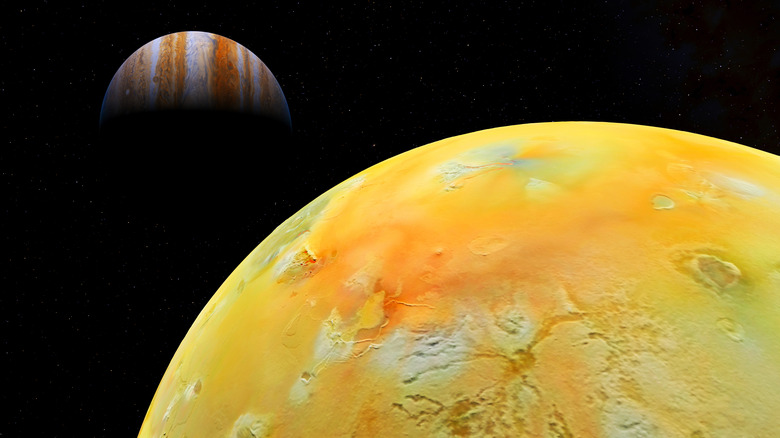
On Earth, volcanoes are driven by heat rising from the planet's core. This is also likely the cause for volcanic activity on Mars and Venus. However, there are other places in the solar system where different forces drive volcanic activity. The most prominent of these is Jupiter's moon Io. One of the effects of Jupiter's gravity is heating in the moon's interior, causing eruptions of sulfur dioxide that can reach hundreds of miles above the surface. Volcanic eruptions have also been observed on Neptune's moon Triton. Scientists think these eruptions of dust and nitrogen gas are caused by the sun heating nitrogen ice just beneath the surface.
Volcanoes are a fairly common feature in the solar system and could be present on planets orbiting other stars. While Earth is home to spectacular volcanoes and Venus is almost entirely covered by lava flows, the title for biggest volcano in the solar system, Olympus Mons, is held by our red neighbor, Mars.