

Why Plague Doctors Wore Those Creepy Long-Beaked Masks
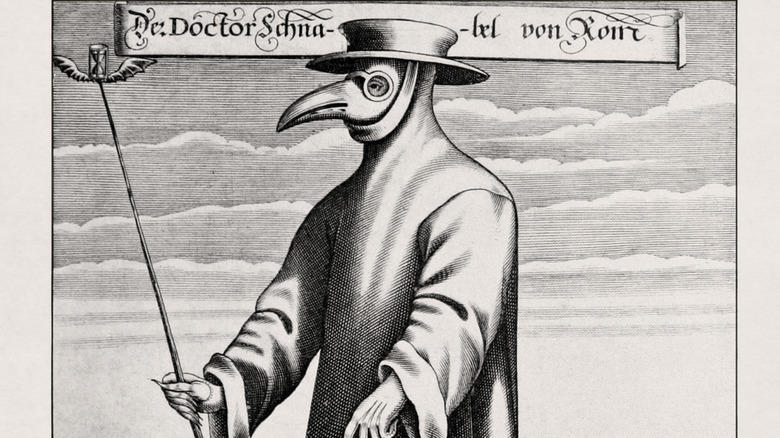
To be treated by a plague doctor of the 17th century must have been a terrifying affair. Long beak-like structures extended from leather face masks, with the only visible portion of their bodies being the eyes that peeked out from circular glass lenses. Perhaps as you were poked and prodded by the long cane that accompanied their daunting garb, you would sense a pungent smell seeming to emanate from their faces. These beaks were not simply meant to strike terror in the hearts of ailing patients and neighbors. They were stuffed with herbs and perfumes meant to serve as a protection from the "bad air" that supposedly plagued those under their care.
Before Louis Pasteur had revolutionized medicine through germ theory, the physicians of old had their own ideas of what might cause disease, many of which we would find baffling given our current knowledge. One of the most persistent such speculations was the miasma theory, which would actually remain long enough to compete with germ theory. According to this once widespread belief, diseases were a result of breathing in "bad air" and would be signified by a foul odor. One would think this would leave people in constant fear of disease contraction, as life in the 17th century is certainly not associated with pleasant fragrances. Of course, we know now that the Black Death, the resurgence of which popularized plague garb in Italy and France, was actually the result of the bacteria Yersinia pestis.
The life of a plague doctor

Being a plague doctor was considered a rather deadly profession. In fact, it was a very undesirable position, as when a plague struck an area, the local doctors tended to flee in order to avoid contracting the deadly disease themselves. This meant that many plague doctors were early in their careers or even untrained as physicians. But their duties also extended beyond the typical doctor, sometimes being tasked with autopsies and recording the dead, even occasionally serving as witnesses to wills.
Interestingly, the beaked headdresses were not actually present during the 14th-century Black Death, the deadliest disease epidemic in history. Instead, these doctors tended to keep bags containing vinegar-soaked herbs to hold in front of their noses as they examined patients. As you can imagine, this might be a hindrance as it only leaves one hand free.
But the first use of the iconic mask was not until the early 17th century and is attributed to Charles de Lorme, a physician in the French royal court. The original beak had the recorded description of a "nose half a foot long, shaped like a beak, filled with perfume with only two holes, one on each side near the nostrils, but that can suffice to breathe and to carry along with the air one breathes the impression of the drugs enclosed further along in the beak" (via Wellcome Collection). This design supposedly solved the problem of carrying a bag of fragrant herbs by providing a hands-free solution.
The evolution of personal protective equipment

Although we do not know for sure, it is possible that these odd outfits actually did provide some layer of protection. In addition to the masks, plague doctors were clothed head-to-toe. Such attire could have been a somewhat useful defense against the spread of the Black-Death-causing bacteria by providing a layer of protection from the respiratory droplets of sick patients and inhibiting the path of fleas to vulnerable skin.
Of course, as our understanding of disease has improved, so has our personal protective equipment (PPE). In 1897, the scientist Carl Fluegge revealed that diseases could spread from respiratory droplets. Such findings appeared to inspire the physician Johann von Mikulicz Radecki to create a mask made from gauze. When a pneumonic plague, caused by the same bacteria that resulted in the Black Death, spread from 1910 to 1911, the doctor Wu Lien-teh developed a more effective mask that, along with gauze, contained fabric layers and strings that kept the mask secured on the face.
The disposable face masks we are most familiar with were developed out of synthetic fibers in the late 20th century. Progress in basic biology and medical techniques has left us with a much more comfortable and much less smelly option for basic PPE than the plague doctors used. It's interesting to think about how research insights have affected fashion over the past few centuries, but we should count ourselves lucky that beaks were not a necessary trend of more recent events like the COVID-19 pandemic.