

Everyone Used It In The '80s. Science Explains Why It Grabbed Your Attention

The 1980s and '90s were a colorful time. The cartoons, commercials, ads, and clothing of the age were saturated in captivatingly-bright colors, grabbing people's attention through vibrant hues that popped. Today, we usually refer to such colors as "neons," a palette that has largely fallen out of vogue in the last few decades. Neon colors are still used in fabrics, but they're mostly just for visibility — hence sports pinnies, cleats, emergency personnel uniforms, etc. And there's a good reason why fluorescent textiles still live among our wardrobes. Scientists call these colors "fluorescent," because they convert high-energy invisible light into lower-energy light that our eyes can see.
Fluorescent colors have been drawing people's gaze for well over a century. The word "neon" was adopted from the light produced by early experiments with the noble gases, neon being one of them, argon another. Both gases can be used to produce a fluorescent light when placed in a sealed tube and connected to an electric current. The design proved to make an effective lightbulb (even though it required toxic metals), and the "golden age of neon" (~1920–1960) was defined by fluorescent-tube lighting that lit up entire cities.
The result was a brilliant red color with a starkly intense, saturated quality. It was clearly man-made, and the word "neon" that was used to describe it stuck. The unnatural-looking light later had a resurgence with the spread of vibrant new textile dyes, and the 1980s and '90s reinvented the meaning of "neon." In reality, both lights and pigments can be fluorescent, and both grab our attention. The bright, so-called "neon" clothing of the '80s was really just a trick of the light.
The chemistry and culture of our attraction to fluorescent colors
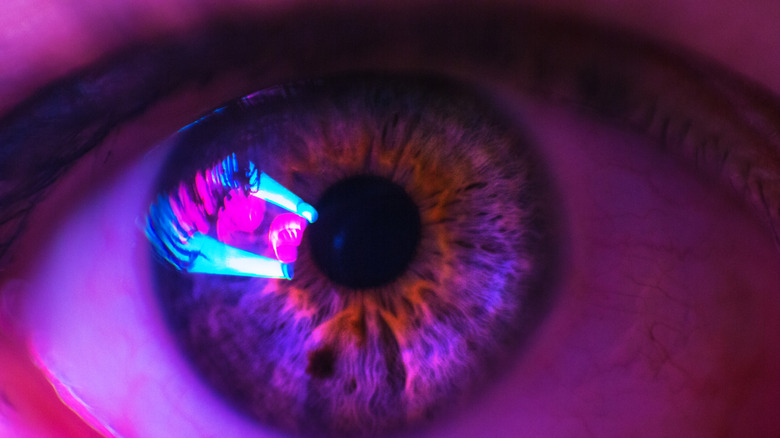
We perceive fluorescents as brighter because they're essentially ultraviolet light converted into visible light. In the case of neon sports jerseys, the molecules in the pigments of the shirt absorb UV light and re-emit it in a higher, narrower band of visible light, making colors seem more intense. In the case of fluorescent neon signs, the light produced is concentrated in the high-energy blue and violet wavelength.
But physics and chemistry aren't the only reasons why fluorescent lights seem so intense. Our evolution may explain our attraction to neon colors as well. For instance, fluorescent colors are used for pinnies on the uniforms of emergency personnel, since such stark monochrome hues stand out in dark settings. Our eyes are adapted to dart towards anything that might be a threat, and any out-of-place color triggers that response. Considering we evolved from apes (and continue to be apes), life before civilization was one of constant vigilance.
It's also possible that we instinctually respond to avoid fluorescent, bright colors in the wild. Many poisonous and venomous creatures use bright coloration to advertise their toxicity, in an adaptation called aposematism. One example is the poison dart frog; brilliantly colored in unnaturally "neon" colors, the poison dart frog is rarely eaten, since most predators stay clear of it at the sight of such a strange and alarming hue, especially when contrasted against the warm greens and browns of the tropical climates where it lives.
Fluorescent lights have been messing with our brains for decades
In the 1980s, fluorescent lights were common across the world, illuminating the way to restaurants, bars, and other late-night attractions. Their decline began when cheaper, lighter, and safer alternatives emerged to replace them. Perhaps the biggest nails in the fluorescent coffin were the emerging health concerns, as the sealed tubes of mercury are dangerous when disposed of improperly. Today, few traditional fluorescent lights are made, as most are increasingly replaced by LEDs. Yet, many of us are sad to see them go. There's something that attracts our eyes to fluorescent lights, and it starts in our brains.
Fluorescent lamps have been shown to stimulate waking brain activity, and some studies have even demonstrated how higher color temperatures, especially blues and violets, have long-term, disruptive effects on our sleep cycles. High-temperature fluorescent lamps essentially make us wake up during the hours in which we start to feel tired. It's no wonder fluorescent lights are associated with bars and nightlife attractions, since fluorescent bulbs are perfect for waking up paying customers.
There's also evidence that the rapid flickering of fluorescent lights triggers a "fight-or-flight" response, much in the same way that flashing emergency lights invoke feelings of alertness. Fluorescent lights are made of tubes of argon gas and a drop of mercury, and they can flicker noticeably, and seemingly randomly. However, fluorescent bulbs are basically really fast strobe lights, flickering their lights around 100 times a second. That's faster than the human brain can process, but just slow enough to cause an uncanny draw to the human eye.