

To Visualize Devastating Midwest Tornadoes, Watch This Drone Fly Directly Into One
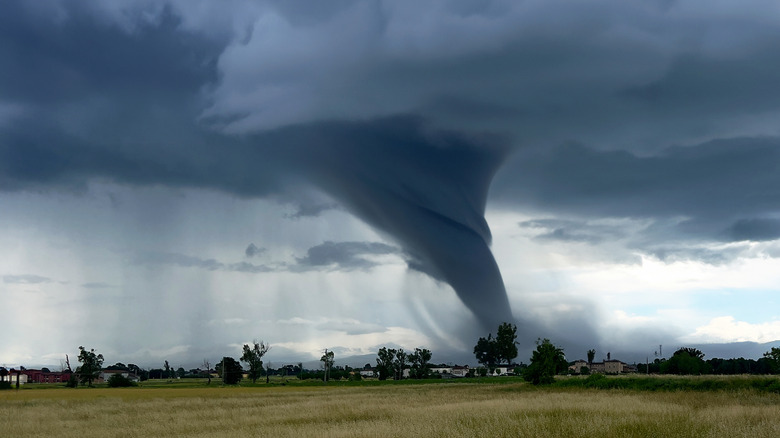
Tornadoes are terrifying natural phenomena but have fascinated people for centuries, with descriptions of twisters dating from the 17th century. Since the mid-20th century, though, tourists have even paid to experience the thrill of storm chasing alongside experts. Advances in technology, however, now allow storm chasers to bring this experience home with live streaming. One of these groups — The OTUS Project — made history on June 22, 2026, with the first ever live footage of flying a drone into a tornado.
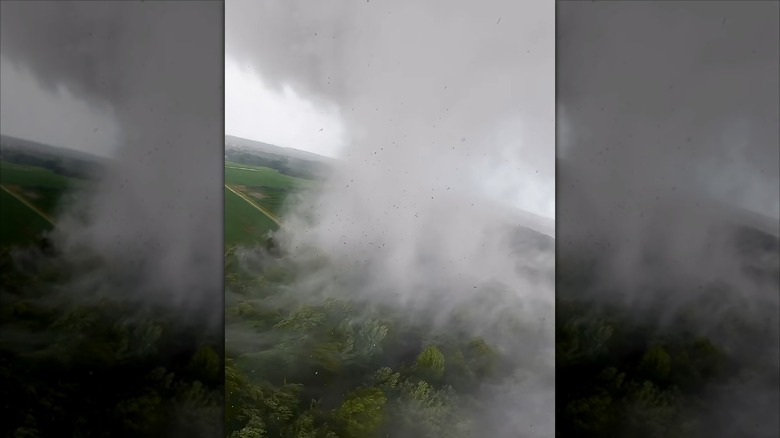
In a video clip posted to Facebook (originally part of a longer live stream on YouTube), meteorologist Max Velocity reacts to seeing the raw footage as he receives and shows it. The high-quality recording shows the yellow drone approaching the vortices of an EF3 tornado — the middle level of tornado strengths. Then, it enters a huge, powerfully swirling cloud that's violently spewing debris torn and lifted up from the ground and trees below. After passing through the twister, the drone turns around to prepare to enter again.
While this clip has gained a lot of attention, it's possible to watch The OTUS Project's original live-stream footage on YouTube. It includes the team's entire journey chasing tornadoes that day, along with the drone's numerous passes through the EF3 tornado. In the OTUS 13 recording of the intercept, which lasts about four minutes, you can see and hear the pilot talking about the drone being flown toward the ground but still rising in altitude because of how strong the twister is. Although the original live footage looks a little blurry, the group posted a clearer YouTube short for all to see.
The significance of flying a drone directly into a tornado
Meteorologists and researchers have faced many challenges learning the characteristics of tornadoes. Specifically, data from doppler radars and satellites is insufficient because twisters are so short-lived compared to hurricanes. The earliest attempts to gather surface-level thermodynamic data — like humidity, pressure, and temperature — resulted in the TOtable Tornado Observatory (nicknamed TOTO after "The Wizard of Oz" dog) in the 1970s and '80s. This stationary barrel was equipped with devices that were intended to record data as a tornado lifted them into the air. Although it was unsuccessful, it was the inspiration behind the 1996 disaster action-adventure thriller "Twister".
Then, that movie inspired scientists, leading to the development of rocket-propelled meteorological probes by extreme meteorologist Reed Timmer and his research team. The first launch of one of these rockets occurred in May 2019 near Lawrence, Kansas, releasing a parachute probe directly into an EF4 tornado. Once the probe enters the twister, control over it is lost. That's why being able to fly a drone into a tornado is so significant. Eventually, the technology could offer consistent measurements in certain locations within a twister.
Including the June 2026 flight, The OTUS Project has made 13 successful drone intercepts. The first occurred in May 2024 and was also the first time ever that a drone had been flown into a twister. Drone builder and operations coordinator Louis Tucker spoke to Fox Weather after the 13th flight. Along with noting advancements have been made to gather data, he said that nothing yet has been significant enough to "push science forward." Their goal, he explained, is to gather the data that's lacking to improve predictive models and enhance building standards to protect lives and property.