

Scientists Believe The World's Oldest River Predates Dinosaurs By 170 Million Years
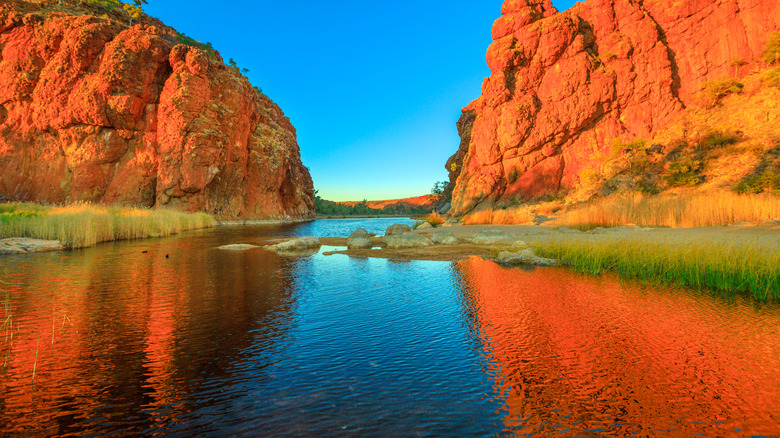
Can you guess what the world's oldest river is? Your mind might jump to the Nile, the Tigris, or the Indus, but those don't even make the top five. The oldest river, as far as scientists have been able to date, is one you've probably never even heard of. It's the Finke River, which weaves its way through the heart of Australia, in a land hardly touched upon by humans.
The Finke is over 400 miles long, originating the MacDonnell Ranges and terminating at Lake Eyre during the wet season; during the dry season, the river disappears into the Simpson Desert. Surrounded by a harsh arid climate that dries up parts of the river on a yearly basis, the Finke River hardly seems notable at first glance, but it's so old that it actually predates the mountains from which it flows. Scientists estimate its age to be between 300 and 400 million years old, which means the Finke once flowed through the supercontinent of Pangea, before when the dinosaurs lived, and almost as far back as the origin of plants.
How can you determine the age of a river? For that, geologists turn to radiometric dating, a method that determines age based on the decay of certain radioactive isotopes present in objects like fossils and rocks. Researchers studied rocks and sediment around the Finke to determine its 300–400 million year age range, although it's worth noting that rivers change course over time, and some parts of the Finke are younger.
The Finke River formed in an unusual way
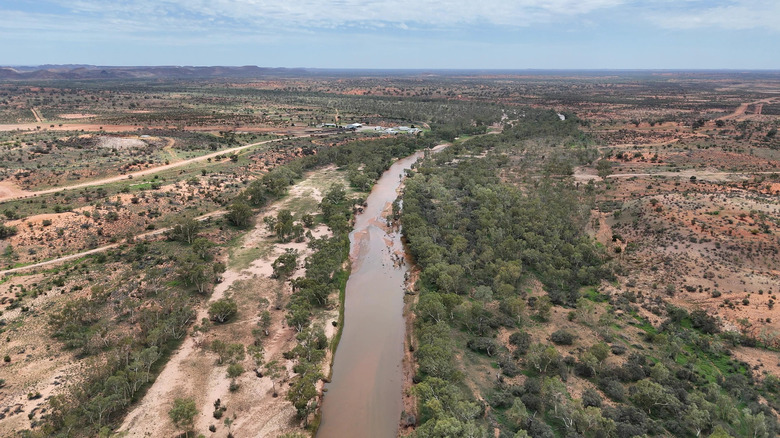
The Finke River was noted for its uniqueness, even before recent studies on it. The river holds a special significance to the native Arrernte people, who call it Larapinta, and have used its water as a lifeline for untold generations. It is believed that humans have dwelt along the river for tens of thousands of years, potentially as far back as humans have lived around the Nile, although the Finke's tiny watershed could never support large-scale settlements like in Egypt. Larapinta's presence in ancient Arrernte folklore helped to draw attention to its potential age, but no one could have guessed that it was older than Australia itself.
How can a river be older than the mountains it originates from? Well, the Finke River doesn't flow through the MacDonnell Ranges in the same way that most rivers flow through mountains. When the Finke River formed, the land was flat, and as tectonic forces lifted the MacDonnell mountains from the landscape, the river rose with them.
Due to this unique formation, the Finke River doesn't follow the natural shape of the mountains, but rather flows straight through them in deep gorges. It doesn't originate from a mountain lake or spring as one would expect, and is simply fed by the rare rainfall that comes in the wet season. This appears to violate geographic rules, and was yet another reason why researchers thought there might be something special about the Finke River's age.
Could any rivers be older than the Finke?
As with most aspects of natural science, it is impossible to be 100% sure of what the oldest river is. There were certainly rivers that formed before the Finke before disappearing due to tectonic activity. That the Finke has managed to survive so long is due to the fact that it lies in the middle of the Australian Plate, far from any fault lines. That being said, there are a few other rivers that could challenge the Finke for its title of world's oldest.
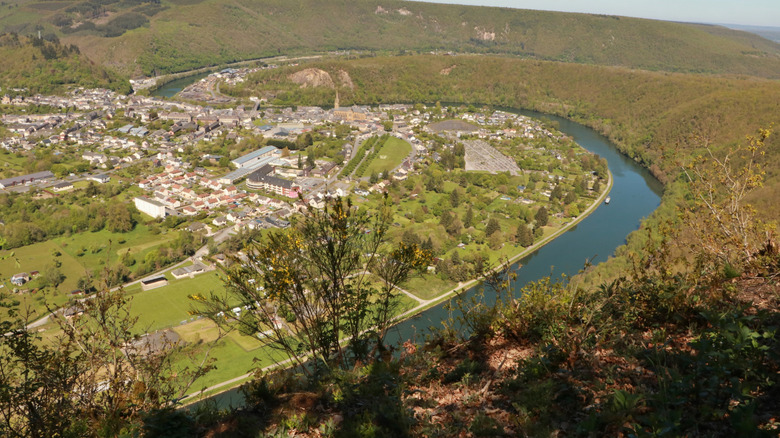
The river with the best case to beat the Finke is the Meuse River in Europe. It weaves through portions of France, Belgium, and the Netherlands, and is estimated to be between 320 and 340 million years old, potentially making it as old or even older than its Australian rival. Despite being half a world away, these two waterways are remarkably similar. The Meuse cuts right through the mountainous Ardennes, and just like the Finke River, its waters were flowing long before the terrain around it rose.
The main thing that keeps the Meuse from toppling the Finke on the list of world's oldest rivers is the fact that there is some geological evidence that a sea covered parts of the Meuse Valley more recently than the estimated age of the river. And so, unless some revolutionary piece of evidence comes forth, the tiny trickling stream in Australia retains the title of world's oldest river.