

Scientists Say They Finally Solved The Mystery Of The North Sea's Most Controversial Crater

Underwater craters can be caused by several geological processes, such as the movement of salt under the crater floor or when a volcano erupts underwater. These were a couple of possible causes of the Silverpit Crater that scientists discovered in 2002. However, recent research offers proof that the crater was created by an asteroid or comet, which was the original theoretical cause and is still one of the biggest threats to Earth from space.
Scientists have debated how the nearly 10,000-foot-wide Silverpit Crater came to be in the North Sea, about 80 miles from the coast of Yorkshire. In fact, there was a famous debate about it in 2009 at the Geological Society of London. Now, a team led by Heriot-Watt University associate professor Dr. Uisdean Nicholson published a paper in Nature Communications with the strongest evidence yet that an asteroid or comet struck Earth in that very spot about 43 to 46 million years ago.
Along with numerical simulations, part of this evidence comes from new seismic, biostratigraphic, and petrographic data, allowing the researchers to create detailed images of the layers of rock underneath and around the crater. Another piece of the puzzle was the microscopic analysis of rare "shocked" feldspar and quartz crystals that were collected from a nearby oil well. Nicholson explained in a press release that these rarities "can only be created by extreme shock pressures." Imperial College London professor Gareth Collins added, "It is very rewarding to have finally found the silver bullet."
The aftermath of the asteroid impact that created the Silverpit Crater
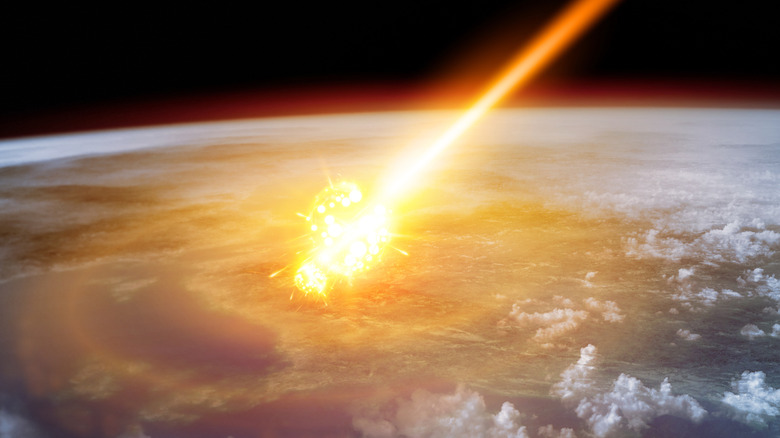
As with many of the biggest asteroids to ever hit planet Earth, the impact that created the Silverpit Crater was followed by a megatsunami. There's no official definition for the term "megatsunami," but it's generally proposed that such a wave exceeds 100 meters, or 300 feet. As the researchers surmised from their study, the 500-foot-wide asteroid or comet smashed into the North Sea from the west and at a low angle. The impact created a 5,000-foot-high wall of rock and water that fell back to the seabed, and a wave towering more than 320 feet followed — all happening within minutes.
To put that into perspective, the National Oceanic and Atmospheric Administration reports that most tsunamis grow to fewer than 10 feet tall. In extreme cases, though, tsunamis can exceed 100 feet. Such was the case with the deadliest documented tsunami in history. An earthquake off the coast of Indonesia in 2004 triggered tsunamis across the Indian ocean, reaching heights of over 160 feet in some places. That means the tsunami that followed the Silverpit Crater impact was twice as high. If that's not perspective enough for you, consider that the megatsunami would tower over New York City's Statue of Liberty at about 305 feet tall and London's Big Ben at 315 feet tall.
It's worth noting that the asteroid or comet was small compared to the one that led to the dinosaur extinction and created the Chicxulub crater. That asteroid was 6 to 9 miles in diameter, and the resulting crater just off the Yucatan Peninsula is 110 miles wide. Although, there's always a small possibility of a Chicxulub-type asteroid striking again — one of the ways Stephen Hawking predicted the world ending.