

Mystery Or Myth: Are Myers-Briggs Personality Types Backed By Science?
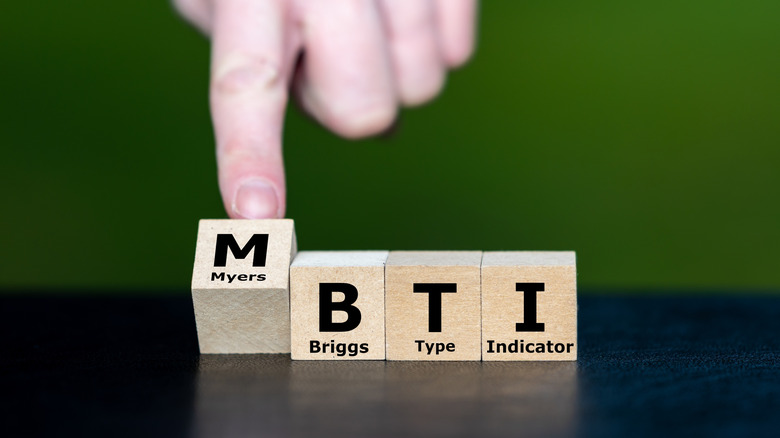
You have probably heard of, if not taken, the Myers-Briggs Type Indicator test. This organizes personalities into 16 different types, each classified by its combination of four trait-representing letters. Understandably, we seek to categorize ourselves as a way to elucidate our individuality while providing assurance that there are others like us. But this can lead to misinformation, such as assuming people are either left- or right-brained. Myers-Briggs personality tests have been used by corporations, universities, and even the military. However, scientists have levied many criticisms, including its inconsistency, oversimplification of human personality, and reliance on self-reporting. Overall, research studies have not empirically validated this personality test. So, while it might be a fun quiz to fill out, it is not actually predictive of your behavior.
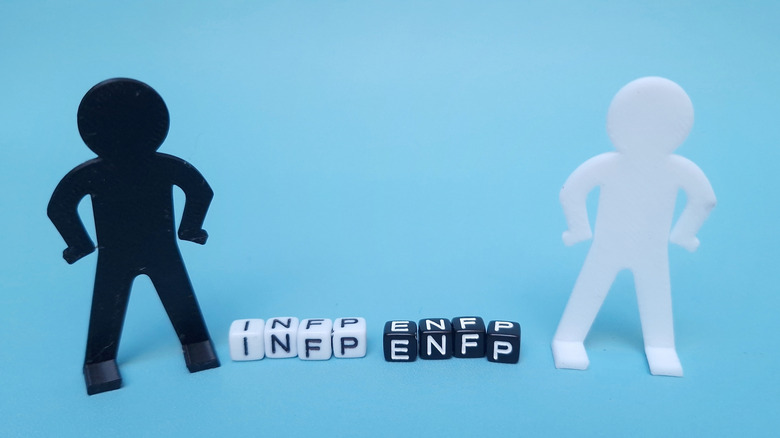
The first letter of each type represents either extraverted (E) or introverted (I) — indicating the environment in which you feel most energized, alone or among others. The second letter supposedly provides insight into how you interpret your surroundings, designated by observant (S) or intuitive (N). Observant individuals are focused on the realities of the present, whereas intuitive people are considering possibilities. The third letter is meant to indicate motivations and emotional approaches to the world. Thinking (T) personalities are characterized by prioritizing logic over emotion, while feeling (F) types often exhibit more empathy. Finally, the last letter represents the way we work and plan. Where judging (J) types are highly organized and enjoy structure, prospective (P) personalities readily improvise and enjoy flexibility.
The test and its origins
The test is based on the famous psychoanalyst Carl Jung's theory of psychological types, which he outlined in a book published in 1921. According to Jung, there were eight types, classified overall between extraverted and introverted, which could be further defined by rational functions (thinking or feeling) or irrational functions (sensation and intuition). Importantly, Jung suggested that whichever traits are not dominant are still present but simply repressed. Therefore, no truly distinct categories exist in which to place people; we are all complex configurations of various types.
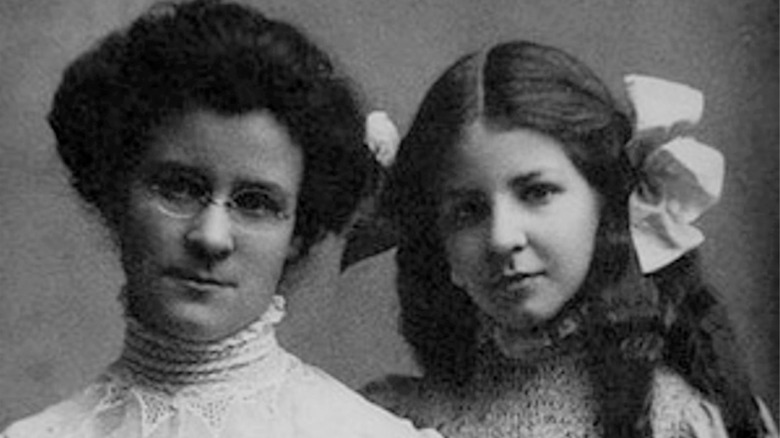
Katharine Cook Briggs began college at the young age of 14 and graduated at the top of her university class with a degree in agriculture in 1893. After marrying the second-best student in her graduating year, Lyman Briggs, she became a homemaker while her husband continued his studies in physics. But Katharine continued to study independently, particularly in the field of education, while homeschooling her daughter, Isabel Briggs Myers.
At home, Briggs paid close attention to her daughter and began to study her behavior. As a fiction writer, Briggs wanted to understand differing personalities. So, she turned to Carl Jung's 1921 book, "Psychological Types," even going so far as to write letters to Jung for clarification of his theory. When Isabel went on to have her own children, she too became invested in her mother's findings, and together they developed the test we know today.
The problems
Perhaps you have taken a Myers-Briggs personality test before and felt that the result was incredibly accurate to your understanding of yourself. However, this could be due to a phenomenon known as the Barnum Effect. Also referred to as the Forer Effect, the Barnum Effect describes how we tend to perceive certain descriptions as specifically representative of us, while they are, in fact, generally applicable to everyone. You might also witness this effect utilized by psychics and horoscopes.
This leads to the problem that many scientists have with the Myers-Briggs test: Its results cannot be validated. While someone might individually perceive their personality type as accurate, studies have shown no persistent correlation to behaviors and life outcomes. However, some studies have indicated correlations between traits identified in the Myers-Briggs test and specific learning styles. Thus, it is important to question whether this represents correlation or causality. Meanwhile, there are some tests that exhibit predictability, such as the Big Five trait openness, which might predict intelligence.
According to 16 Personalities, which provides a free version of the Myers-Briggs test, Albert Einstein, Kristen Stewart, and Neo from "The Matrix" all have the personality type INTP. Meanwhile, Taylor Swift, Bill Clinton, and Monica from "Friends" are all ESFJs. Of course, these are all conjectures as the test is meant to be self-administered, but it's fun for a quiz to tell you what celebrity or historical figure you resemble. However, in psychological settings, it is important for us to rely on evidence-based assessment.