

The Difference Between Blue And Brown Eyes Is Easily Explained By Science
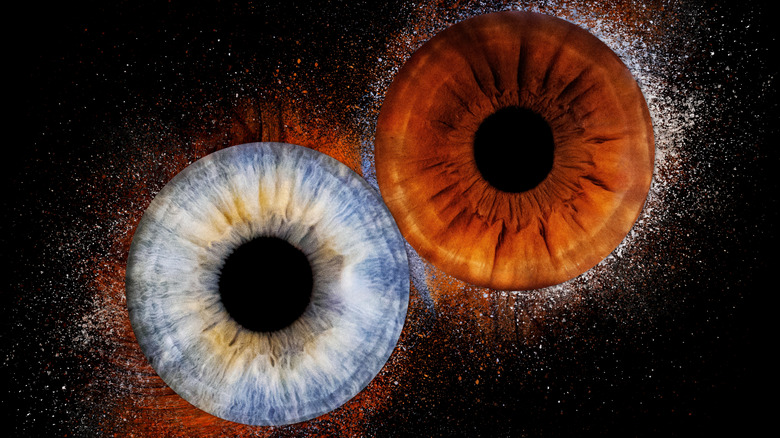
When it comes to your eyes, there are several different parts, but the part that most people notice first is the iris. That's because it's the colored part that circles around the pupil, so it simply stands out upon first glance. One of the interesting facts about the iris, though, is that science can easily explain why the color differs from person to person. Essentially, the difference between blue and brown eyes depends on two factors: the concentration of melanin and your genes.
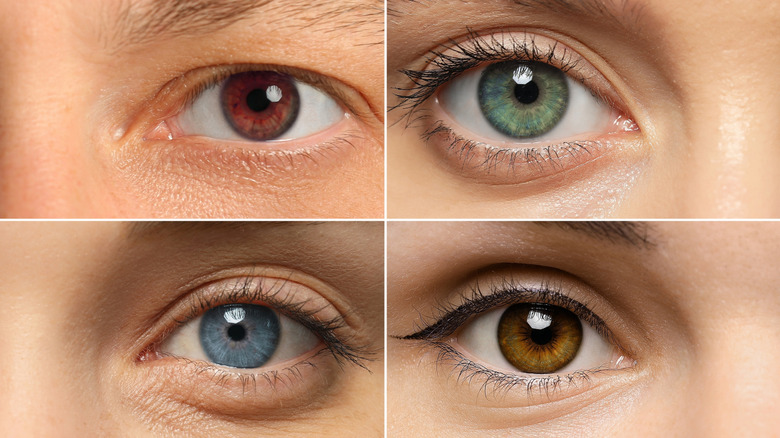
According to a study published in the Journal of Cellular Physiology, the most common eye color in the world is brown at 79%, while blue accounts for 8% to 10% of eye color. The amount of melanin — the same brown pigment responsible for why people have different color hair and skin — in the front and back layers of the iris is one of the reasons. While people with brown eyes have high amounts of melanin in both layers, those with blue or gray eyes have little to none in the front layer (the stroma). The lack of melanin in the front layer of the iris allows more light to scatter and escape rather than be absorbed, making the iris look blue.
A similar scattering of light occurs to make some people's eyes appear green (the rarest standard eye color) or hazel. While their stromas don't have enough melanin to look brown but too much melanin to look blue, their irises also contain a light brown pigment that combines with blue light, creating the effect of green or speckled hazel.
How genetics play a role in different iris colors
As mentioned, your genes are another factor in the difference between blue and brown eyes. The paper in the Journal of Cellular Physiology explains, "Gene expression determines the iris pigmentation and how much melanin is present in the eye, which is the number of melanin subunits that identify eye color."
Contrary to what scientists once believed, there is no single gene responsible. Eye color also can't be simply predicted based on parents' eye color and the theory that brown irises are dominant over blue. In fact, it's possible for a child to have brown eyes even when both parents have blue eyes. And although parents who both have brown irises are more likely to have a child with brown irises, the genetic factor is complicated and makes it more of a game of roulette.
According to a study published in the Journal of Human Genetics, about 16 genes play a role. Scientists involved in that analysis narrowed down the biggest contributors are HERC2 and OCA2, which are two adjacent genes on chromosome 15. Interestingly, a different paper published in Human Genetics found that a gene mutation that dilutes the brown pigment in the stroma may have originated in one common ancestor. And thanks to recent discoveries, we know that ancestor lived at least 17,000 years ago.
Why some people have one blue eye and one brown eye

While it's more common to see people with two blue eyes or two brown eyes, having non-matching iris colors is one of the rarest body features you might have. Called heterochromia, this eye condition affects less than 1% of people, including some notable celebrities like actress Kate Bosworth and actor Henry Cavill.
This rare eye condition has a few variations. Complete heterochromia means that all of each iris is its own color. Toronto Blue Jays pitcher Max Scherzer (pictured above) is a prime example of someone with complete heterochromia featuring one blue eye and one brown eye. Then, there's partial or sectoral heterochromia, which means that part of an iris is a different color from the rest. And, central heterochromia means that the inner part of the iris around the pupil is one color and the rest is another color.
Most people have congenital heterochromia, which means that they were born with it or developed it shortly after birth. In such cases, the trait is potentially inherited from a parent and often a mutation of the HERC2 or OCA2 that affects the production and distribution of melanin in the stroma. Some cases of heterochromia, though, are acquired. For instance, they may occur from an injury to the eye or indicate an eye condition, such as glaucoma, pigment dispersion syndrome, and eye tumors. Diabetes may even cause heterochromia if it's uncontrolled and damages the eye's small blood vessels, resulting in a darkened iris.