

Scientists Believe This Is The Oldest Living Ocean Species (And It's Not What You Think)
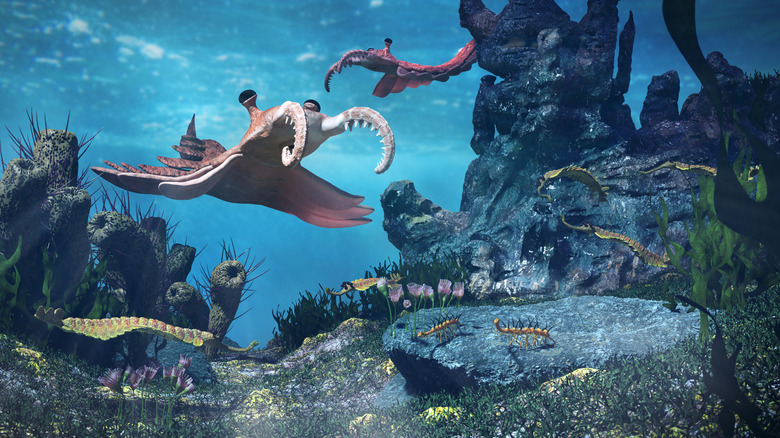
When people talk about ancient animals, they often might think about sharks, dinosaurs, or even nightmare-inducing giant insects from the Carboniferous. Animal life is thought to have begun beneath the ocean's surface, and there are currently living marine species that have been around for hundreds of millions of years. For example, the spiral-shelled nautilus and the distinctive horseshoe crab have origins going back 500 million and 450 million years, respectively. But what scientists believe is the oldest living ocean species may surprise you: the sea sponge.
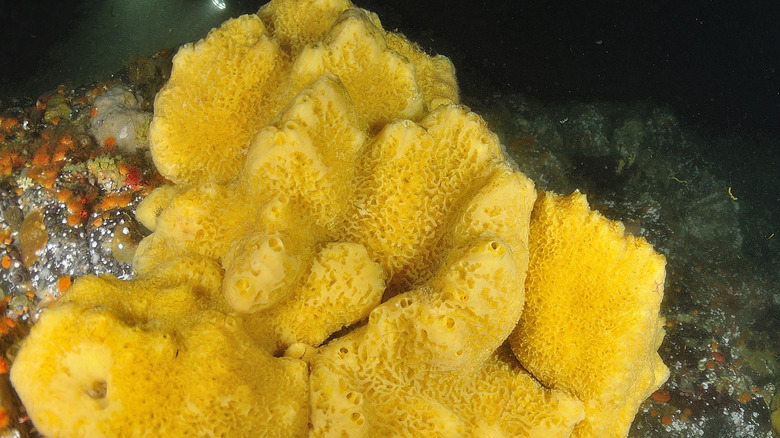
Sponges are simple, soft-bodied multicellular organisms that live in different parts of the ocean. They can be found in shallow seas near the shore and in the perpetual dark of the deep ocean. Part of the phylum Porifera, sponges have bodies with many holes, or pores, that allow water to pass through. Sponges filter water as it passes through their bodies, feeding on bacteria and plankton. The ancient ancestors of today's sea sponges lived in much the same way. And while the scientific consensus is that sponges are the oldest of living ocean species, their exact age is still being determined.
Scientists Study Physical and Chemical Fossils
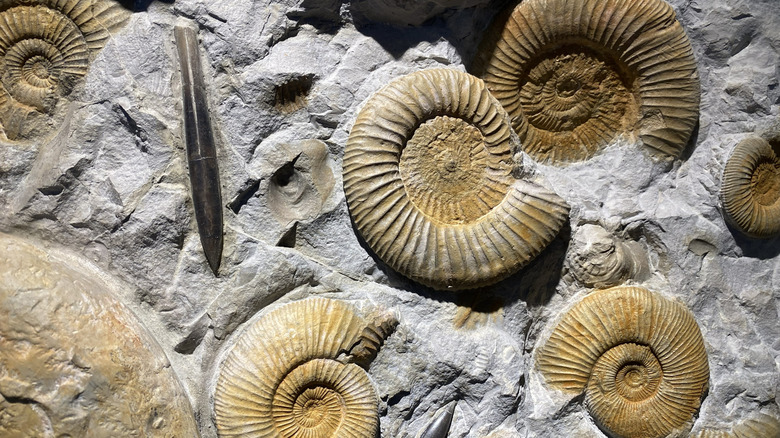
Two of the methods for determining how old a species rely on fossilized remains of an animal and chemical markers found in ancient rock. Fossils are formed when dead animals are buried in sediments and portions of their bodies are replaced by minerals. Some common fossils that people may think of are the shells of ancient ocean life or dinosaur bones. However, unlike the nautilus with its spiral-shaped carbonate shell and bony dinosaurs, intact fossils of ancient sponges can be hard to come by. This is because they have soft bodies without shells, and the oldest sponge species didn't have a skeleton made of silica.
However, in some cases, even the soft bodies of sponges can be preserved in the fossil record. Scientists have found fossils resembling sponges that are hundreds of millions of years old. One study published in the journal Nature in 2021 discussed finding sponge-like structures in rocks from northern Canada that were part of an underwater reef 890 million years ago. Their microscopic analysis found that the shape, size, and branching style of the pores in those structures were a virtual match to the networks of pores found in modern sponges. If these structures were the mineralized remains of ancient sponges, it would set the clock back on sponges a few hundred million years.
Chains of Carbon Hold Clues on Ancient Life
Analyzing chemicals embedded in ancient rocks is also shedding light on the age of ocean life. In 2009, researchers found high amounts of a chemical called a 30-carbon sterane in rocks from Oman. Steranes are stable versions of a biochemical known as sterols that are found in all organisms made up of cells with a nucleus. Sterols are molecules made of ring structures of carbon atoms that have carbon chains and other chemicals linked onto them. Humans have 27-carbon sterols while plants have a 29-carbon version. The 30-carbon sterols those researchers found are usually only found in sponges, though their presence in rocks could have a nonbiological origin.
In 2025, these researchers published a study on rocks from Oman, India, and parts of Russia. They found the presence of even rarer 31-carbon sterols along with 30-carbon molecules in rocks from a period between 541 million and 635 million years ago. They verified their findings against sterols they synthesized to confirm that these chemicals were a biological signature. Scientists will analyze more samples of rock to narrow down the age of these chemical fossils.
It's unclear whether sponges can be traced back 890 million years or only 541 million, but further study will help scientists home in on an exact age. But even at the most recent part of that range, it's clear that these soft-bodied filter feeders are the oldest living ocean animal.