

The Difference Between Black Holes And Wormholes Is Easily Explained By Science
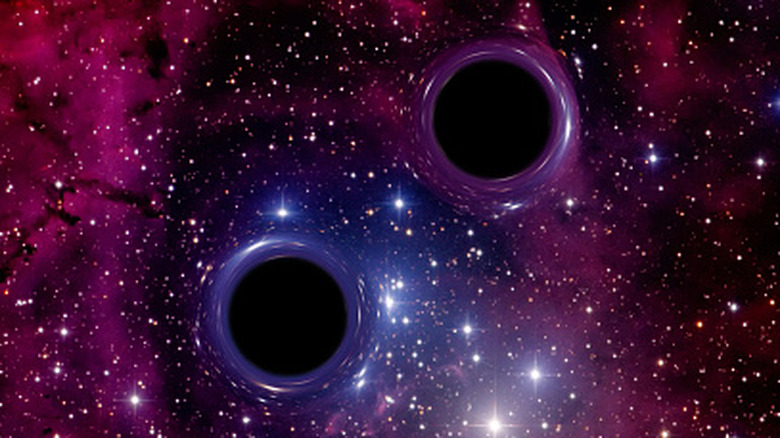
Scientists are constantly discovering things about the cosmos that seem unimaginable. For instance, NASA broke records in 2024 when they stumbled upon the earliest galaxies in existence. Just last year, they concluded that the Hercules–Corona Borealis Great Wall — the biggest known structure in the universe — is actually larger than they thought. Some discoveries aren't always what they seem, though, and may even be confused with fiction. Case in point: black holes and wormholes.
Despite some confusion between the two, there's actually a huge difference between the two. The first thing you should know is that black holes exist, and researchers have actually seen them. In fact, they finally confirmed the existence of runaway black holes just last year with a study published in arXiv. The second thing is that wormholes are a hypothetical possibility that scientists haven't seen in the cosmos. Despite that, the third main difference between them is that black holes are huge, dense masses with such strong gravitational pulls that light can't even escape them, while wormholes are theoretical shortcuts in space-time. Learning more about each, though, can provide a better understanding of what they are and how they differ.
Facts about black holes
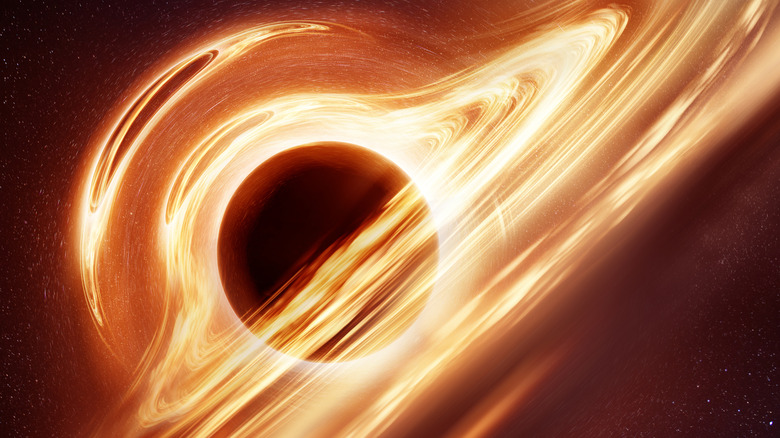
Science still can't explain many mysteries about black holes, but researchers have made several discoveries. For instance, some of them develop from supernovae, which is an explosion from a massive star that runs out of fuel. Astronomers have also found that black holes aren't rare at all. In fact, huge black holes are present at the centers of most galaxies at least the size of our Milky Way, and they can send particles flying at almost light speed.
Sagittarius A* is a supermassive black hole at the center of our galaxy. Its mass is 4 million times that of the sun; meanwhile the smallest known black hole is only about 3.8 solar masses. And both pale in comparison to TON 618, the biggest black hole researchers have seen at 66 billion times in mass. And, although Sagittarius A* is at the center of the Milky Way, it's not the closest to Earth at 26,000 light-years away. That honor goes to Gai BH1 at about 1,500 light-years, while the farthest away is QSO J0313-1806 at about 13 billion light-years.
One misconception about these cosmic bodies having such a strong gravitational pull is that they pull stars and other matter into them. On the contrary, they exert the same gravity as other matter of equal mass. If the sun in our solar system was replaced with a black hole with the same mass, the planets' orbits wouldn't change. Matter that gets close enough, however, experiences spaghettification — a real term and disturbing fate of falling into a black hole. As research has continued, scientists have discovered a new class of black holes — intermediate-mass black holes — and published their findings in The Astrophysical Journal Letters.
The theory about wormholes
When it comes to wormholes, the concept of such a cosmic phenomenon has an interesting evolution. It started with a paper originally published in Physikalische Zeitschrift in 1916 by Austrian physicist Ludwig Flamm, aiming to make theoretical physicist Albert Einstein's and German astronomer Karl Schwarzschild's solutions regarding general relativity and black holes clearer and more accurate. He found another mathematical solution that led to the opposite of a black hole — a theoretical white hole (as it was later termed) that ejects matter instead of absorbing it. With that finding, he proposed the possibility that a black hole is connected to a white hole by a space-time conduit.
Then, in 1935, Einstein and American-Israeli physicist Nathan Rosen published a paper in Physical Review. They proposed the possible existence of a "bridge" — which became the Einstein–Rosen bridge — that stretches across space-time to connect two distant points. However, it wasn't until a 1957 paper in Annals of Physics written by American physicist Charles W. Misner and nuclear physicist John Archibald Wheeler that the term "wormhole" was coined. Flamm's contributions to the scientific community weren't widely appreciated until the images that his work conjured became commonplace in texts related to blackholes, neutron stars, wormholes, and more around the mid-1970s.
Breaking down all the research, the basic understanding is that wormholes could reduce space travel times between galaxies from millions of years to just hours or minutes. Another idea is that they may act like time machines, so you would arrive at point B at a time earlier than when you entered point A. As for whether wormholes could actually exist or not, scientists are divided. Skeptical scientists believe that the bridge's own gravity would make it collapse in the middle, unless enough internal negative energies are present to counteract it.