

Pork Farms Are Killing A Lot More Than Just Pigs
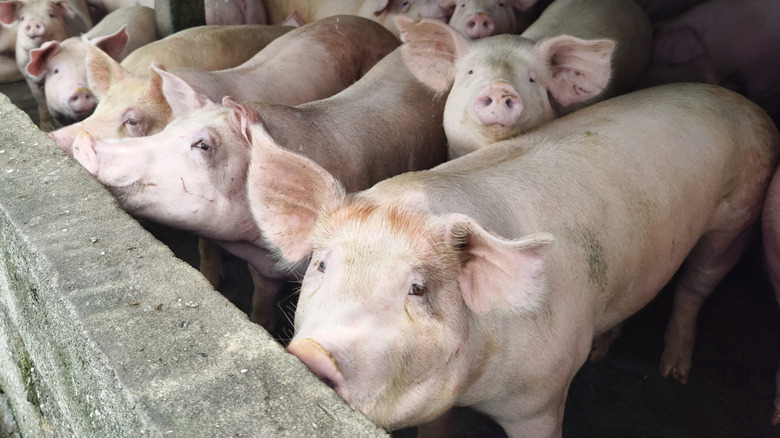
Pork is a big part of the American diet, but pig feed is high in nitrogen and phosphorus, and, consequently, so is pig poop. Farms remove most of the waste in enormous quantities and transport it elsewhere to be used as fertilizer. Inevitably, farms eventually run out of area to spread it, and rain washes much of the fertilizer into local waterways. All that fertilizer feeds algal blooms, and when bacteria eat that algae, they deplete the water of oxygen. Eventually, the native ecosystem suffocates. Near industrial-scale pig farms, the populations of aquatic animals can be decimated by the choking water, as the nearby lakes, rivers, and streams become inhospitable.
But the deadly hazards of pig farms extend beyond the local algal blooms. A 2021 research study illuminated these wide-sweeping effects of pig farms by constructing a "life cycle assessment" (LCA) model of three different pig farms. Essentially, LCA models allow researchers to evaluate a cradle-to-grave timeline of the resources put into a system. Pig feed, for example, requires a lot of resources to produce and deliver. The researchers discovered that, once pig feed is eaten and digested, the byproducts can find their way into the local ecosystem.
The resulting environmental footprint of pig farms is enormous. The United States alone has an inventory of around 73 million full-grown hogs (and that's not to mention the uncounted swarms of feral pigs wreaking havoc in Texas). After the slaughter, little is wasted — byproducts such as blood and other inedible parts are rendered and used elsewhere. The waste produced by the living pigs, however, can have seriously deadly ecological consequences. Inevitably, the feces, urine, and gas leaks into the surrounding air, land, and water.
Every step of pork production contaminates the environment
Pig feed can contaminate waterways even before it reaches the trough. The corn, soybeans, and other crops used to feed pigs require high quantities of pesticides, herbicides, and insecticides to produce food at an industrial scale. As illustrated by the aforementioned 2021 study from China, those chemicals contribute significantly to the environmental footprint of the pig farm industry. Agrochemicals inevitably find their way into local water ways, just like the pig waste products do.
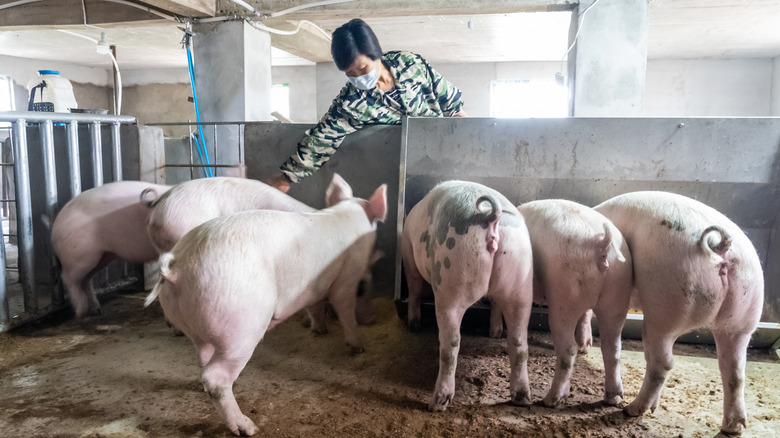
It would be impossible to raise thousands of pigs in one facility without producing solid waste, but one of the largest environmental impacts of pig farming is the gas emissions. No matter how quickly a farm can clear excrement, bacteria and other microbes continuously break down waste throughout the entire process. In fact, the air in a factory pig farm is so polluted with noxious gases that workers often require face masks or respirators. The airborne pollutants include aerosolized bacteria, hazardous gases, and particulates — which is essentially dust like you might find in your home, only much thicker and more choking.
Perhaps a pig farm's greatest environmental impact is its greenhouse gas emissions, the most hazardous of which is ammonia. It's the gas that makes urine smell bad, and it's also a compound that helps make pools smell so distinct after enough people pee in it. Yet, while ammonia can contribute to air pollution, its greenhouse-gas effect is nothing compared to the potent nitrous oxide released from pig waste. One of the most powerful greenhouse gases, the nitrous oxide emissions of pork farming pose the greatest environmental threat, as the gas is around 300 times more powerful of a greenhouse gas than carbon dioxide. Evidently, pork comes at an environmental price.