

Scientists Never Expected To Discover Something So Cute At The Bottom Of The Ocean
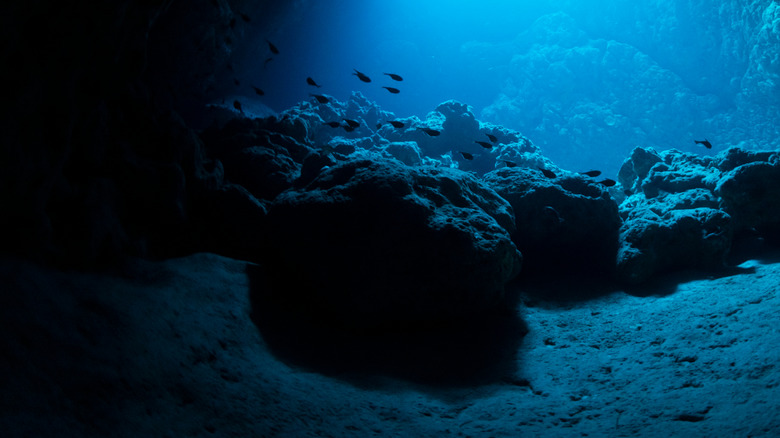
The Earth's ocean floor is so vast that slightly less than 29% of it has been mapped as of April 2026. Since these deep waters are also home to more life than any other place in the world, it's no surprise that scientists keep finding new creatures as more of the waters are explored. None of them expected to find a tiny blue octopus so cute that it's hard to stop looking at it, though.
Researchers have documented some of the strangest deep-sea discoveries, like giant tube worms that live around hydrothermal vents in the Pacific Ocean and the rarely seen glass octopus that lives in the open ocean. In a recent paper published in Zootaxa, they revealed a new small marine animal — named Microeledone galapagensis — that looks a little bit like a cartoon drawing. Its eyes are huge against its golf ball-sized body and appear to be looking straight at you in an image provided in a press release.
The scientists — a collaboration with the Galápagos National Park Directorate and Charles Darwin Foundation (CDF) — first discovered the creature in 2015 during an expedition near Darwin Island. That's on the edge of the Galapagos archipelago where there are more than 1,000 flora and fauna that don't exist anywhere else on the planet. In a video shared by the CDF on YouTube, the team provides zoomed-in footage of the octopus, which they captured with a remotely operated vehicle (ROV) at 1,773 meters (5,800 feet) under the surface while they remained aboard the E/V Nautilus.
What scientists have learned about Microeledone galapagensis so far
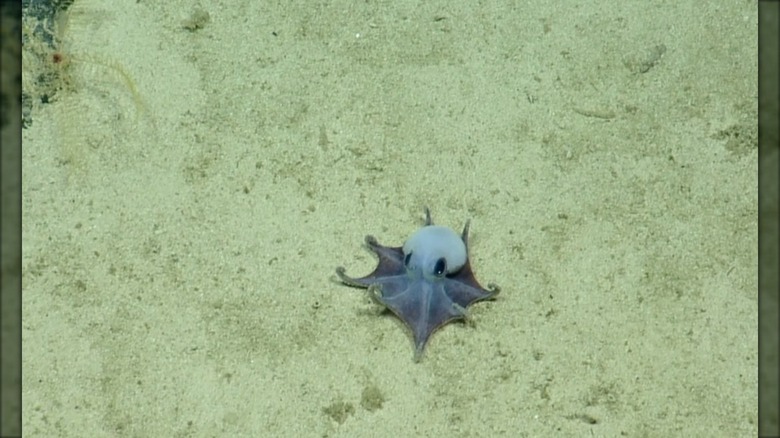
Before the researchers ended their deep-sea expedition in 2015, they collected a marine specimen (a mature female), as well as saw and captured footage of two other Microeledone galapagensis to take back to the CDF Research Station. They weren't sure about its species, though, so they preserved and sent it to a specialist — Chicago's Field Museum curator emerita of invertebrates, Janet Voight.
The short arms, missing ink sac, and smooth skin were immediately intriguing. While stubby-armed types of octopus have been found in the Atlantic Ocean, those species have lumpy skin. The blue octopus also has tiny suckers, which is what the suction cups on an octopus are called, on their bottom sides. Talking to National Geographic, Voight posed the question, "If they live by moving their arms in the sediment on the seafloor and there isn't a lot of prey for them there, how do they survive with such short arms that carry so few suckers?"
The researchers determined that the mantle — the round bulb-like body — has very little pigment, appearing pale blue, but is deep purple on the inside. This reverse countershading may be its secret to thriving in the depths of the ocean. While it eats bioluminescent creatures, its shading acts as camouflage, keeping it hidden from predators. To get a closer look inside of the collected specimen without cutting it up, though, Voight and manager Stephanie Smith used CT imaging. They were able to see its beak (mouth) — and other internal organs — well enough to determine where the new species belongs.