

Scientists Say This Is One Of The Apex Predators Of The Antarctic (And It's Not A Polar Bear)
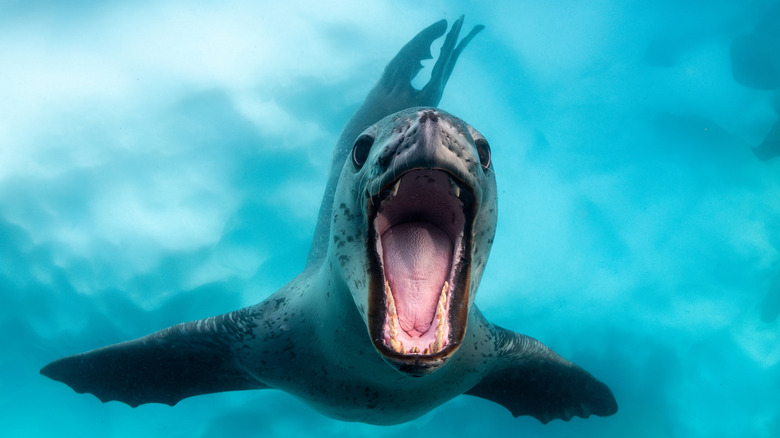
When asked what the apex predator of the Antarctic might be, many people would likely say the polar bear. However, polar bears live in the Arctic at the North pole, rather than the South, and their equivalent in Antarctica is actually the leopard seal. While it may not have the reputation of its Northern counterpart, the leopard seal is a ferocious predator and formidable hunter.
The Antarctic food web is a huge ecosystem of creatures, from krill at the small end, which are eaten by nearly every animal, from squid to penguins, right through to predators such as orcas and leopard seals at the top. In fact the orca, which is technically a dolphin, is the only natural predator the leopard seal has, placing the seal almost at the top of this enormous food web.
It's not difficult to see why these amphibious mammals are so named: Their spotted coats are the giveaway. They share plenty in common with their jungle namesakes, too, moving at an incredibly fast 25 miles per hour in the water, and having a muscular build and terrifying set of teeth. Reaching a size of up to 1,300 pounds, they are a terrifying prospect for any creature that is unlucky enough to come across them. Attacks on humans are incredibly rare, as they are generally not an animal that sees humans as food, but they are a daunting opponent for the many marine animals of the Antarctic.
Leopard seals are ideally suited to hunting the waters of the Antarctic
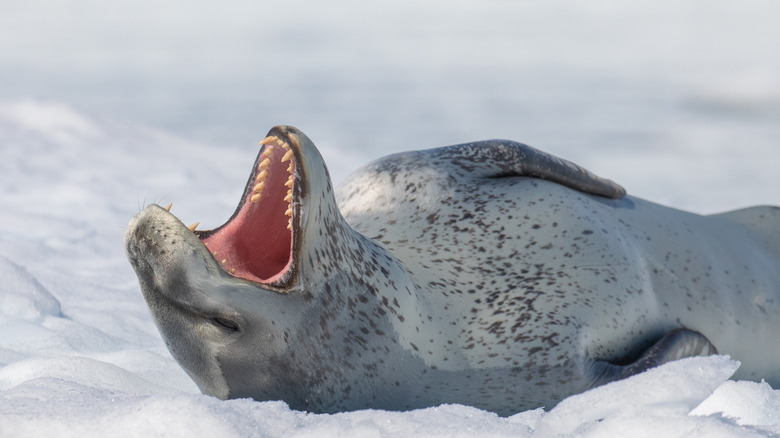
As marine mammals, leopard seals, or sea leopards as they are also known, are comfortable both on land and at sea. Monitoring of the animals has shown that they actually spend two thirds of their time in the water. While they need to resurface to breathe in the absence of gills, they can spend up to 15 minutes underwater at a time, which is bad news for the fish and other aquatic creatures trying to evade their attention.
If you have ever seen a seal move on ice, you will acknowledge they can be slightly ungainly, and the sea leopard is no exception. But once in the water, they are extremely agile and well-suited to catching their quick prey. Their teeth give them a big advantage, allowing them to grab hold of a variety of different prey. Their large molars target the tiny krill, while the incredibly sharp canines allow them to grab larger birds and mammals.
Like whales, they have adapted to cope with the extreme temperatures they live in, and have a layer of blubber to protect them from the cold. This makes it easy for them to hang out on the ice, waiting hungrily for their next meal to pass by.
Penguins are one of many marine creatures that are hunted by leopard seals
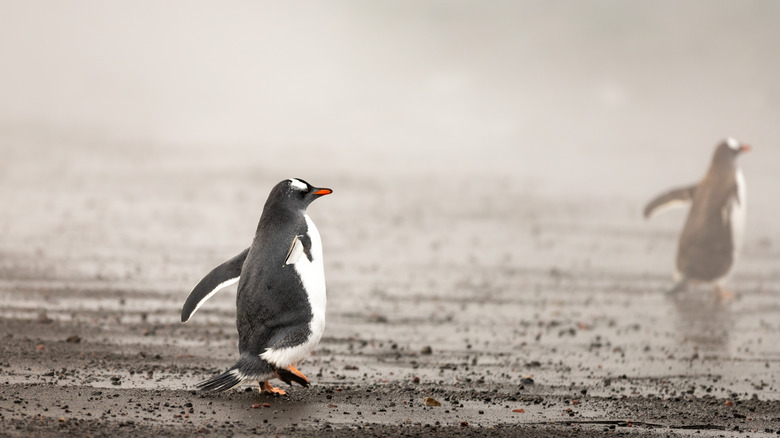
Unlike many of their seal cousins, who are stereotypically represented as cute and cuddly, leopard seals have a less favorable reputation. This is due in part to their fondness for snacking on penguins, one of the most-loved members of the animal kingdom. The method of attack doesn't do much to help improve their public image either, stalking the birds from under the water, then pouncing and shaking them violently before tucking in.
Arguably, the penguin isn't even the most shocking target of the sea leopard, since they also eat other seals, including baby fur seals. The females seem to target these larger prey more than the males, and it is the females of the species that reach the largest sizes. Males are more likely to target easier prey further down the food chain, such as fish, crustaceans, and of course huge quantities of krill.
Though the orca is a far more famous Antarctic hunter, and does ultimately take the top spot as apex predator of the ocean, the leopard seal is a ferocious runner up. If they can avoid becoming lunch to their only enemies, leopard seals are well equipped to survive the harsh Antarctic conditions and live up to 26 years. Since they are not on the list of Antarctic animals that are considered endangered, the future of the sea leopard as an apex predator seems pretty secure.