

Science Explains Why Cockroaches Die On Their Backs
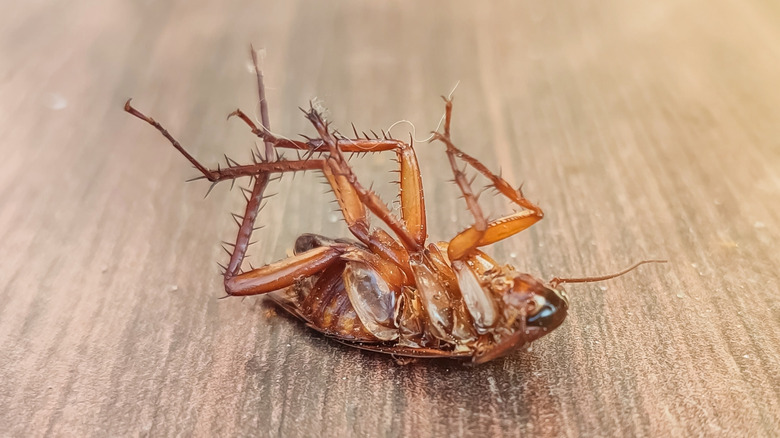
Seeing a cockroach crawl across the floor might be one of the most cringeworthy things that could happen because such insects carry a range of bacteria, viruses, and more. That's also the unsettling reason you should never squash a cockroach in your home. Since it's among the organisms that are insanely hard to kill, you might use a pest control spray to put it (and any of its friends) out of its misery. Once the chemicals have done their job, you'll likely see the cockroach (or its many friends) dead and lying on its back. As it turns out, their bodies turn belly-side up because of the chemicals' effects.
The most common active ingredients in cockroach sprays are pyrethroids, such as allethrin, cypermethrin, esfenvalerate, lambda-cyhalothrin, and tetramethrin. Derived from the pyrethrum daisy (Chrysanthemum cinerariifolium), the natural form is called pyrethrin and has been used as an insecticide for more than two millennia. Even very low doses from simply walking where the bug spray rests on a surface can be a death sentence for vulnerable cockroaches.
These neurotoxins work best when they come into contact with cockroaches because they interfere with protein channels that transport potassium and sodium through the neuron membrane. As a result, pyrethroids impair the nervous system, triggering muscle spasms, tremors, and loss of balance. Since cockroaches have rounded backs and a high center of gravity, their bodies naturally tip over. That doesn't mean they're dead right away, though.
Cockroaches on their backs aren't always dead
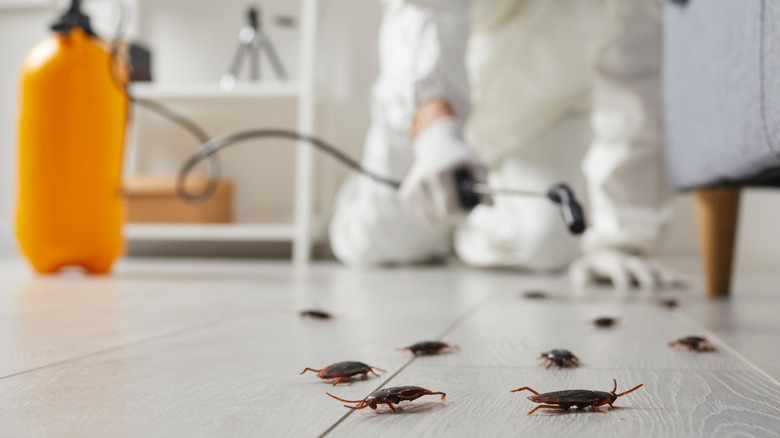
Dying belly up isn't actually normal for cockroaches. If they end up on their backs for whatever reason in their natural environment, they can grab onto nearby debris — such as leaves, rocks, and sticks — to turn themselves back over. Clean, flat, smooth surfaces in your home, like countertops and hard floors, don't provide anything for the insects to grab onto. As a result, they can't flip back over themselves and just end up lying there helpless.
When pyrethroid pesticides are used against cockroaches, the chemicals initially render the insects unable to control their muscles, so you might notice their bodies and legs twitching. That could be the neurological effects of the chemicals or simply them struggling to grasp for something to turn back over. Plus, there's no set amount of time for cockroaches to die after they flip onto their backs from pyrethroids. It could take anywhere from minutes to hours for the insects' internal organs to break down, and the timing depends on the temperature and how much of the pyrethroid soaks into their bodies. Generally, you know it's dead when you don't see any body movement after poking it with an object, particularly the legs and antennae.
Also, keep in mind that some species — particularly German cockroaches — are turning into superbugs that are impossible to kill. That's because the species has built up a resistance to insecticides. If they don't get a large enough dose, they could scurry off and recover. In such cases, gel baits are considered to be a more effective approach.