

Why Death By An Inland Taipan Snake Might Be One Of The Worst Ways To Die
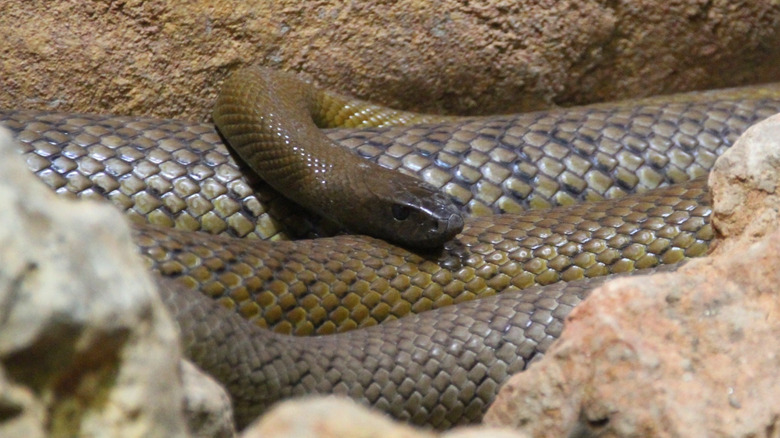
The inland taipan is the most venomous land snake in the world. Just a drop of its venom the size of a poppy seed is enough to kill an adult human, placing the inland taipan high on the list of venomous animals that can kill you in minutes. Yet, surprisingly, there are no recorded deaths from inland taipans. As the name implies, the inland taipan is native to the remote inland areas of Australia, so interactions with humans in the wild are rare. Most bites occur from mishandling captive snakes, meaning antivenom is usually close at hand. Still, even surviving a bite won't save you from experiencing the excruciating pain of the world's most venomous land snake.
If you're ever bit by an inland taipan, you'll know immediately. Unlike how the world's longest venomous snake, the king cobra, latches onto its victims, the inland taipan strikes and releases quickly. Sometimes they strike multiple times to ensure they've envenomated their target. Because inland taipan fangs only grow to about a quarter of an inch long, the sensation is like being stabbed repeatedly by a pair of short needles. Of course, the immediate pain of an inland taipan strike is nothing compared to the quick-acting effects of its venom.
As the venom works its way through your tissues, its neurotoxins attack local nerve fibers. This assault causes severe pain around the bite that radiates to the rest of the body over time. Dull throbbing headaches are common, and sudden, severe nausea often causes victims to vomit violently. After around 15 minutes, blood pressure drops, and vomit may turn into blood. Eventually, the nervous system fails to communicate with the muscles in the diaphragm, and breathing slows to a stop.
Surviving an inland taipan snake bite is still a nightmare

There are fewer than 15 reported cases of inland taipan bites and no reported deaths. That doesn't mean, however, that bite survivors walk away without a scratch. Even with antivenom and medical treatment, recovery can take a lifetime. In September 2012, an Australian teenager was bitten on the hand by an inland taipan and spent weeks in the hospital recovering. Bafflingly, the bite occurred in Kurri Kurri, New South Wales, a small town over 600 miles away from the inland taipan's habitat in the desert. Because they didn't have inland taipan antivenom on hand, medical responders were forced to use a polyvalent antivenom to save the teenager's life — but not before the venom did irreparable damage.
Because inland taipan venom contains toxins that break down tissue fibers, the kidneys are quickly overwhelmed by the workload. This can cause internal scarring and even life-long kidney problems. (Though scientists are working on growing synthetic kidneys to end kidney disease once and for all.) At the site of the bite, damage to the muscles may never fully heal, leaving behind a collapsed divot or extensive scarring on the skin.
For some survivors, the neurological changes are the most debilitating. After an inland taipan bite, it's common to experience muscle weakness and fatigue for months or even years afterwards. Others may lose their sense of smell. Psychologically, many survivors are prone to symptoms of PTSD and depression. And it's hard to blame them. The potent venom of the inland taipan is adapted for paralyzing large prey within minutes, causing most victims to lose control of their nervous system while they're still conscious. Paralysis by snake bite is not something you want to experience twice.