

Scientists Say Star Trek's Transporters Are Closer To Reality Than You Think
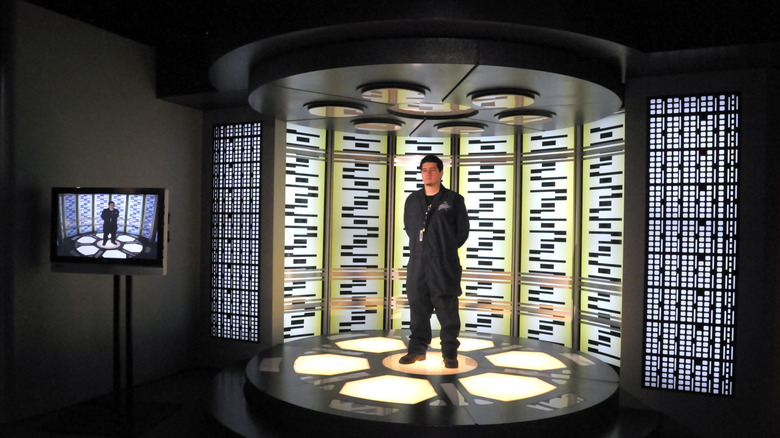
Teleportation is the process by which matter or information is transferred from one location to another without physically traveling through the space between them. For decades, teleportation existed only in fantasy literature and science fiction. Today, although we are still far from being able to say, "Beam me up, Scotty," advances in quantum physics have brought us theoretically closer to making it a reality than ever before.
A recent breakthrough was made by an international team of physicists from Paderborn University in Germany and Sapienza University in Rome, Italy. The researchers achieved the first successful quantum teleportation of the polarization state of a particle called a photon, which is produced due to the structure of the atom.
This transfer occurred between two independent photon emitters located in two buildings that were 270 meters apart but connected through an optical system of lenses, mirrors, and other specialized devices. Nothing physically traveled from one location to another. Instead, the properties of one photon were transferred to another photon, essentially demonstrating that an aspect of the photon could be transmitted and rebuilt a sizable distance away.
So what would it take for a human to be teleported in real life?

Of course, teleporting properties of a single particle like a photon or an electron is much less complex than teleporting a human being. A human teleporter would need to do three things: 1) identify the position and type of every atom in an individual's body, 2) transmit that atomic information to another location, and 3) use the transmitted information to build atoms at the destination into an exact copy of the person.
As astrophysics professor Alan Calder observed to SlashFilm, the key to developing a transporter a la Star Trek is to make the concept of quantum teleportation a reality. "I think that in principle, you could, through that sort of teleportation, actually move an extended body if you had a lot of energy and a lot of knowledge," said Calder.
The successful photon experiment has demonstrated that quantum teleportation with a simple particle (the first part of what Calder said and part of the second requirement of human teleportation) is indeed possible. But scientists still need to map all of the atomic information in a human being and transmit that information to distant atoms to assemble into a replica of the person. This high bar that still needs to be surmounted is similar to the reasons why physicists have a big problem with Star Trek's phasers. However, the fact that even a small part of this complex process is now a reality gives us hope that, one day, teleporting humans could be possible.
The science behind teleportation
The teleportation of an object requires two locations to be linked by a quantum connection. This enables quantum entanglement to occur, in which changes to one object instantaneously affect the other object, even across long distances.
One way to form this quantum connection is through something called a Bose-Einstein condensate (BEC). A century ago, Albert Einstein and Satyendra Bose predicted that cooling matter to temperatures approaching absolute zero would cause the atoms in the matter to lose their individual identities and merge into a single quantum state. Years later, physicists successfully created BECs using rubidium or lithium atoms. The BEC traps and store quantum information, facilitating entanglement across large distances.
Although BECs consisting of atoms are a reality, a human BEC poses considerable challenges. BECs can form only from bosons (such as photons), while humans also consist of fermion (such as protons, neutrons, and electrons). Since two fermions cannot occupy the same quantum state, forming a human BEC for teleportation would violate our present understanding of physics. That said, since we have proof of concept that quantum entanglement can occur for a single photon, this isn't as farfetched as some of the dumb things everyone overlooks in "Dune." But it isn't exactly a small obstacle either.
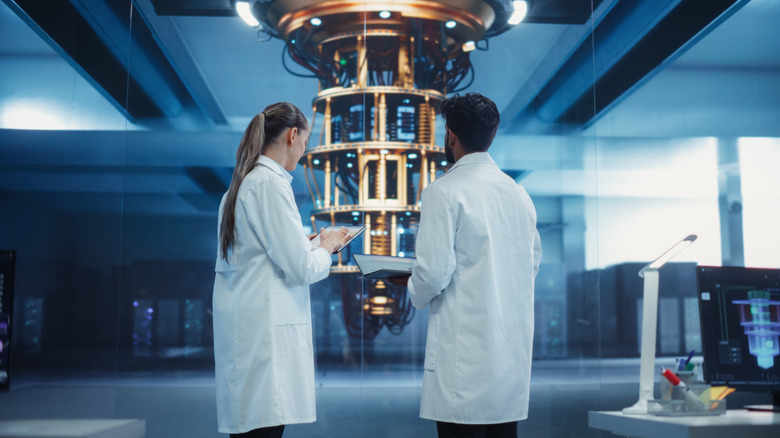
While Star Trek human transporters are still the stuff of science fiction, quantum teleportation of information is already a reality and forms the basis of quantum computers. By leveraging instantaneous transmission of information among quantum computers across vast distances, the computing power of an individual quantum computer can be greatly multiplied. Each new breakthrough in this field brings us closer to practical quantum technologies that are already revolutionizing computing, navigation, cybersecurity, and global communications.