

Scientists Couldn't Believe That These Ants Were Giving Birth To Clones From Another Species
When you think of cloning, the first thing that might come to mind is a sci-fiction movie. However, from gene cloning to therapeutic cloning, DNA cloning is a real thing. What you might not realize is that cloning has been happening in nature for millennia. For instance, single-celled organisms that reproduce asexually, like bacteria, produce offspring that are genetically identical. Scientists weren't prepared to learn, though, that the Iberian harvester ant (Messor ibericus) is capable of partial asexual reproduction after mating with a different species in order to clone it.
Publishing a paper in Nature, researchers explain a shift from the norm of a species only reproducing offspring of the same species. The team sampled more than 120 populations of harvester ants around Europe, performed DNA sequencing on almost 400 individual ants, and observed about 50 colonies in artificial lab nests. After all that, the scientists determined that some of the male ants laid by the M. ibericus queen weren't the same species. They were the species M. structor instead, with 11.5% of the 286 eggs or larvae genotyped having an exclusively M. structor nuclear genome.
Because of that, two brothers from the same mother had such different genomes and morphologies that it's as if they have been separated for millions of years. Additionally, the M. structor hatched in the M. ibericus colony has a unique nuclear-mitochondrial genome compared to that of individuals in their own species' colonies.
The differing characteristics between M. ibericus and M. structor ants
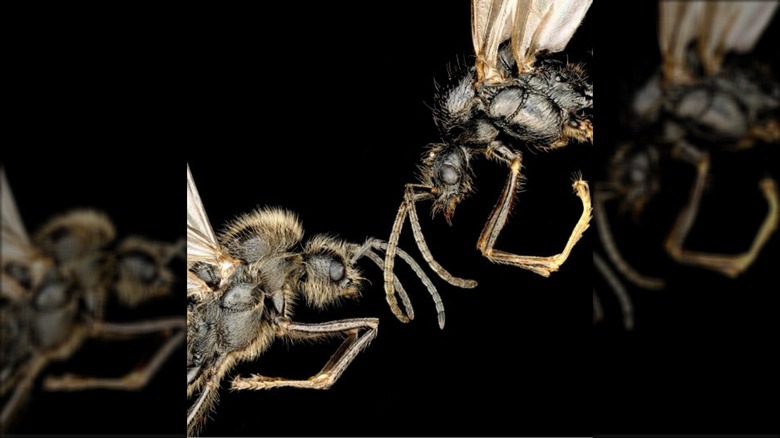
The nuclear DNA of M. ibericus and M. structor suggests that these species last had a common ancestor about 5 million years ago. Since they split, the two generally live in different habitats. M. ibericus live in a variety of habitats (from farmland to suburbia) and in multiple colonies together, while M. structor prefer mountainous areas in separated colonies. However, the two species' habitats can overlap in fields and lanes near mountains.
In the M. ibericus colonies where the M. ibericus and M. structor males are produced by the same queen, though, there's one standout difference in their appearance: the pilosity (hairiness). Overall, the amount of hair on each species is one reason the researchers looked more closely at their genomes: 56% of the samples (which turned out to be M. structor) were almost hairless, while the remaining 44% (which turned out to be M. ibericus) had a dense amount of hair. The hairlessness is actually a distinct characteristic of M. structor species hatched in their same-species colonies.
Why this cloning discovery between the M. ibericus and M. structor is so special
The discovery of cloning among ants isn't new. In 2005, a study published in Nature described the clonal reproduction of the little fire ant (Wasmannia auropunctata), but only the females were clones, and they were of the same species. Another study published in 1999 in Insectes Sociaux found that at least two ant species in central Europe were likely producing hybrid offspring, while a 2002 study published in PNAS found that two species of harvester ants have to mate with different male species to produce hybrid female workers for species survival. Also, harvester ants are known for spermatophagous parasitism, using sperm from another species to produce workers.
The M. ibericus, though, is taking these knowns to a whole new level. Rather than spawn cloned offspring of the same species or mate with males of another species to produce hybrids, it's the only known animal species that reproduces its own species and clones another species. The researchers believe that this evolutionary ant adaptation started out as obligate sperm parasitism, a circumstance in which the queen requires male sperm from another species to reproduce without using the male's genes. Over time, that may have turned into reciprocal sperm parasitism, when both species depend on each other.
Even that has developed into something science has never seen, which the researchers are referring to as sexual domestication. Since the M. ibericus has mastered cloning M. structor workers, queens don't have to leave the nest to find male sperm, allowing them to maintain the clonal line and species. University of Montpellier evolutionary biologist Jonathan Romiguier told Science that "in a sense, [it's] the most complex, colonial life form we know of so far."