

Why Historians Say This Volcanic Eruption Was The Worst Of All Time
Numerous volcanoes have erupted in the last 100 years. In fact, about 50 to 70 volcanoes erupt around the world each year. The eruption at Mount St. Helens in Washington State was the deadliest and most destructive volcanic eruption in U.S. history. However, it wasn't the worst of all time. According to historians and scientists, the worst volcanic eruption ever recorded in human history was that of Mount Tambora.
Located on Sumbawa island in Indonesia, Mount Tambora is an active volcano that experienced some seismic activity from 2011 to 2013. There were also a couple of small eruptions in 1880 and 1967, but these incidents were nothing compared to the calamity caused by its April 1815 explosion. In a paper published in Progress in Physical Geography: Earth and Environment, scientists estimate that the eruption expelled about 157 billion tons of molten rock, raining large stones across the island.
Another study in the Journal of Volcanology and Geothermal Research found that the blast exerted energy equivalent to more than 66 trillion pounds of TNT. Because of that force, whirlwinds developed and destroyed villages. Over 95% by mass emerged as pyroclastic flows, and 40% by mass of those flows turned into ash. All of that was followed by plinian eruptions — intense and violent blasts of gas and volcanic materials — and the caldera collapsing. In the end, the event lasted more than four months.
The Mount Tambora eruption was the deadliest, most widespread catastrophic event
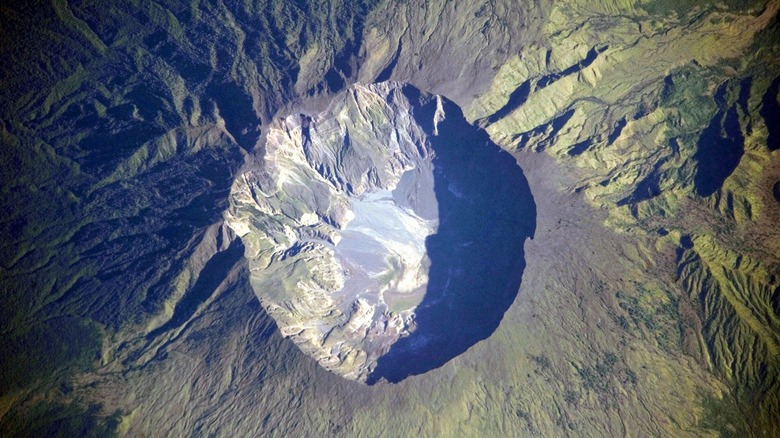
Because of that, the Tambora eruption has a Volcanic Explosivity Index (VEI) 7 rating, which is massive considering that the scale only goes to VEI 8. Plus, more than 71,000 people died during the eruptions and aftermath (possibly surpassing 90,000 deaths), making it the deadliest volcanic event of them all. By comparison, the Mount St. Helens eruption has a VEI 5 rating and killed 57 people.
Many of the island deaths were due to the pyroclastic flows, but some of them were because of the tsunami that the eruption triggered. However, the effects of the Tambora eruption extended far beyond Sumbawa island and even Indonesia. Along with the volcanic material and ash that the volcano spewed into the air, it released about 60 million tons of elemental sulfur into the stratosphere. All of that mutated into a haze that blanketed the globe, absorbing heat and blocking the sun throughout 1816.
On average, worldwide temperatures dropped by more than 5 degrees Fahrenheit. Weather patterns also shifted, with storms becoming more frequent and snow falling in summer in Eastern North America and Western Europe. In fact, that's why summer 1816 was referred to as the year without a summer. The lack of sun led to crop failures, which resulted in tens of thousands of the estimated deaths from famine and disease — such as epidemic typhus. Combined, the events and effects make it Earth's most destructive volcanic incident in the past 10,000 years.