

Science Fiction Vs. Fact: Quantum Mechanics And Interstellar's Message To The Past
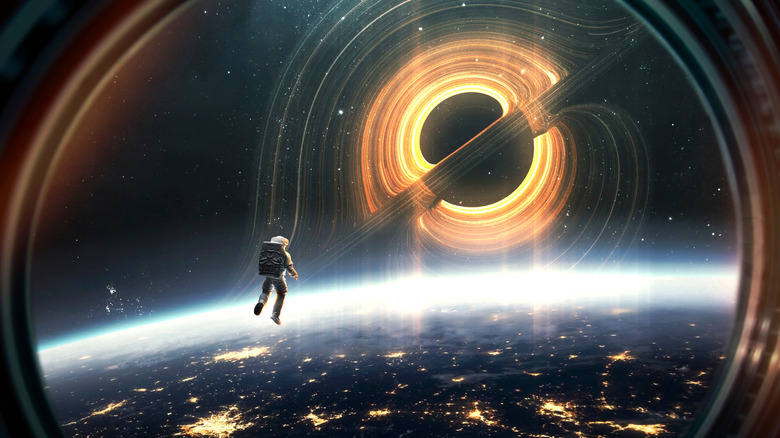
It's been over a decade since Christopher Nolan's ground-breaking "Interstellar" hit theaters, and the film is still considered one of the most scientifically accurate sci-fis of all time. Nolan teamed up with Nobel-prize-winner, theoretical physicist Kip Thorne to ensure the concepts and visuals of the film were in line with our contemporary understandings of astrophysics. Nonetheless, it's still a work of fiction. The loosest use of scientific concepts occurs during the film's climax, when the protagonist Joseph Cooper safely enters a black hole and transmits a message from its center across space and time to his daughter.
Inside the supermassive black hole, Cooper discovers a "tesseract" technology, conveniently planted there by future humans, which allows him to send morse code and binary messages to the past by manipulating objects in his daughter's bedroom. Ostensibly transmitted into his brain by extraterrestrial magic, Cooper's message contained critical "quantum data" that completes "the gravity equation." It's implied that this ambiguous equation bridged the gap between general relativity and quantum mechanics, saving the human race. Scientists call such a hypothetical equation quantum gravity, and it's the missing link in the long-sought-after Theory of Everything, which stumped even Einstein.
However, the film's science turns to fiction well before Cooper gets his hands on an extraterrestrial telegraph/time machine. While there remain many mysteries about black holes, scientists are confident that entering one would be deadly. Indeed, Cooper would have been killed through a disturbing process called spaghettification upon falling into the black hole. Atoms closer to a black hole's center experience a greater gravitational pull than the particles farther from the center. This extreme gradient force produces a stretching effect that rips people into noodle-like strands. In real life, no amount of plot armor could save you from spaghettification.
Even quantum information can't escape a black hole
By a black hole's very nature, it's impossible to observe its insides from outside its event horizon. The event horizon is the spherical boundary surrounding a black hole where nothing can escape — not even light. It's quite literally the point of no return. Inside of the event horizon, spacetime is curved to such an extreme degree that all timelines and trajectories point to the crushing singularity at the black hole's center. Even massless particles traveling at the universal speed limit, the speed of light, can't escape a black hole's event horizon. If a massless photon can't escape, neither should Cooper's message.
Black holes suck up information, too, a quirk that defies the long-held Principle of the Conservation of Information. In quantum mechanics, information, such as a particle's spin, energy level, or superposition, cannot be completely destroyed. Instead, such information should theoretically always be available for omnipotent observers, even after a particle is destroyed. The resulting particles from the fallout of a particle collision, for example, could be traced back in time to determine the information of the original particles.
But when a particle passes a black hole's event horizon, the principle fails. This info-destroying nature of black holes creates the Black Hole Information Paradox. In the 1970s, Stephen Hawking set out to solve the paradox. But instead of proving the Principle of the Conservation of Information as a universal law, he did the exact opposite. Hawking's research described how black holes conserve mass–energy by emitting a faint glow of energy called Hawking radiation. Hawking radiation, however, is entirely informationless. It would seem contemporary physics leaves no room for sending messages or escaping from a black hole.
The wormhole escape hatch is based on shaky speculative science

In "Interstellar," Cooper is ripped through a wormhole after transmitting his message, which ejects him back into the safety of our own solar system. While in theory a wormhole could provide an escape hatch for a black hole, wormholes remain purely theoretical. Rather than real phenomena, wormholes are more like pen-and-paper exercises in Einsteinian physics.
One of the biggest differences between a black hole and a wormhole is what lies at their centers. Black holes form when a collapsing star reaches a critical density. Once enough matter is packed into a small enough space, the resulting gravitational forces draw the surrounding spacetime and its contents into an infinitely dense point called a singularity. Wormholes, however, are theorized as tunnels or tubes of spacetime that connect two different nodes in the universe. Theoretically, if one node were placed inside a black hole and the other elsewhere, a wormhole could allow someone to escape the inescapable.
The problem with wormholes is that they produce some impossible time-travel paradoxes. Because the immense gravity of a black hole slows down time, as it does on Miller's Planet in "Interstellar," placing a node inside one could allow a person to travel between different timelines. Place one end of a wormhole close enough to a black hole and you could even manipulate space-time dilation to travel back in time and kill your own grandfather!
"Interstellar" relied heavily on contemporary astrophysics to construct a sci-fi with unprecedented scientific accuracy. However, the science gets murky with the introduction of wormholes, surviving spaghettification, and sending messages through space and time from an inescapable black hole. But what audience would prefer to see Matthew McConaughey stretched into spaghetti before he can save the world?