

In The '60s, The US Military Detonated A Nuke In Outer Space. They Didn't Expect What Happened Next.
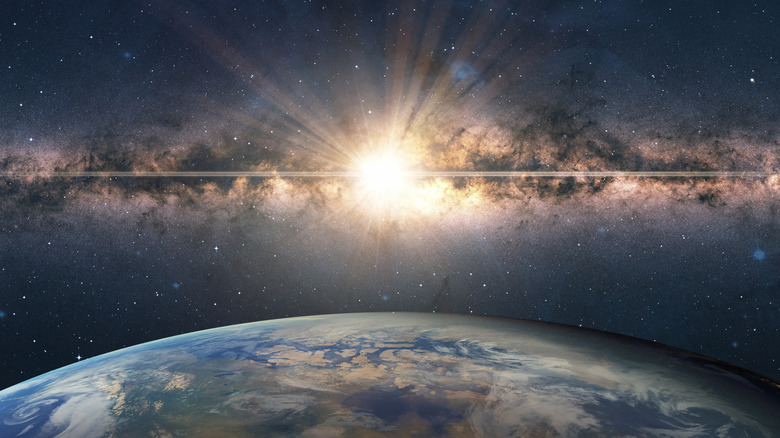
During the Cold War, the United States and Soviet Union often tested nuclear weapons by simply detonating them in remote places and taking notes. Numerous islands were obliterated in the process — most famously Bikini Atoll — and nukes were also detonated underground and under the ocean's surface. With so much wanton destruction, scientists were well-versed in the effects of nuclear explosions on the planet by the 1960s so they set their sights on the heavens. In 1962, the United States launched Operation Fishbowl to find out what happens when you detonate a nuke in space. They discovered that the effects were more powerful than the world could have imagined — and destroyed about about a third of the world's satellites in the process.
The United States had already conducted a high-atmosphere nuclear test in 1958, but the weak 1.7-kiloton bomb was detonated at only 125 miles above sea level, where atmospheric gases in near-earth outer space reach blistering temperatures. So, for Operation Fishbowl, U.S. scientists decided to double the height and increase the bomb's explosive power by a factor of over 800. The first two rockets broke apart before they could leave the atmosphere, leaving radioactive debris to fall from the sky. But the third launch, dubbed "Starfish Prime," was a devastating success.
The 1.4-Megaton bomb exploded at 250 miles above Johnston Atoll. In Hawaii, some 825 miles away from the atoll, onlookers witnessed a blinding flash in the sky, and auroral displays were reported as far as New Zealand. The nuclear explosion unexpectedly released a high-energy electromagnetic pulse that destroyed around half of the planet's two dozen satellites, damaged others, and knocked out telephone communications. In just one test, the U.S. discovered how a nuclear explosion in space can affect the entire planet.
Why a nuclear explosion in space is so much bigger and far-reaching
When a nuclear bomb is detonated in the earth's lower atmosphere, its explosion of high-energy radiation and heat is absorbed and scattered by atmospheric gases and the ground, restricting its reach to a predictable volume. This also happens naturally: our atmosphere is constantly absorbing radiation from the sun, acting as a sort of gaseous sunblock, while our planet's magnetic field shields us from record-breaking solar radiation storms, such as the radiation storm that occurred in January 2026.
When a nuclear bomb is detonated in outer space, however, the massive quantities of high-energy radiation and the electromagnetic pulse are able to travel uninhibited. At 250 miles above the surface, there are few atmospheric gases to collide with and slow down these particles. As a result, even very distant satellites may be within the path of the unimpeded expanding spherical wavefront produced by the nuclear explosion. During the Starfish Prime test, the nuclear blast and electromagnetic pulse reached satellites a few thousand miles away from the explosion.
Of course, a large percentage of Starfish Prime's energy was directed right at Earth. This explains the auroral light shows that were seen across the Pacific Ocean, where the so-called "Northern Lights" usually don't occur. As the nuke's charged particles collided with gases in the upper atmosphere, they produced dazzling light shows whose afterglow lasted for hours afterwards. Even more long-lasting, energetic electrons from the explosion became trapped in the atmosphere, creating an artificial radiation belt around the earth that lasted for at least five years. It even sent the planned Apollo mission scientists into a panic, as NASA scrambled to find out if the artificial radiation belt would kill its astronauts on their way to the moon.
After Starfish Prime, the world decided that nuking outer space is a bad idea
Thanks in part to the indiscriminate damage wrought by the Starfish Prime test, international lawmakers realized that detonating nukes in outer space placed the entire world in danger. Thus, in 1963, the Cold War superpowers signed the Limited Nuclear Test Ban Treaty, which halted undersea and outer space nuclear testing. Four years later, the UN signed the Outer Space Treaty, which banned placing nuclear weapons in satellites, on the moon, or carrying them anywhere in outer space.
Today, we can sleep peacefully knowing that there are no nukes dangling 250 miles above our heads, even if their danger is still present here on the ground. But nuclear waste from the indiscriminate nuclear tests of the Cold War continues to poison countless sites worldwide. Fortunately, recent research into radiation belt remediation, which uses radio waves to dissipate radiation belts, may provide hope for a future free of radioactive contamination. For now, the scars of our nuclear heydays of the 1960s remain imbedded in the earth and sky.