

This Creepy Animal Occupation Is Even Riskier Than You Think
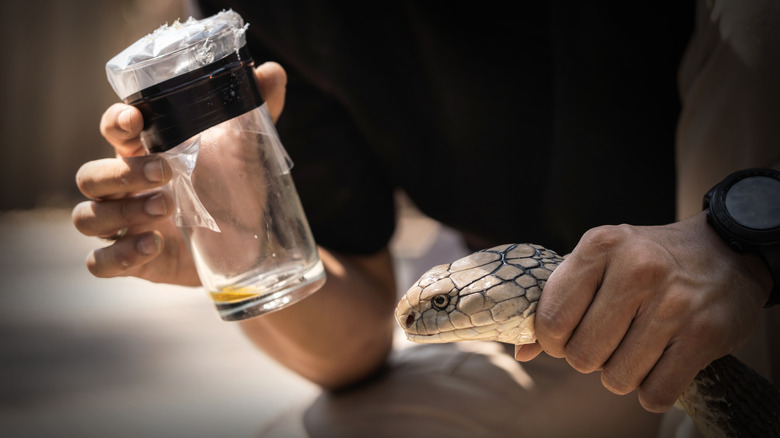
An estimated 50 to 100 people in the United States are "snake milkers," and their job isn't for the faint of heart. These highly-trained herpetologists extract venom from the world's deadliest snakes, including the fast-killing inland taipan and the longest venomous snake, the King Cobra. The trade has been around for decades, but the process has remained fundamentally the same. To milk a venomous snake, you have to grab it by the head, compel it to open its jaws, steer its dripping fangs into a container, gently hold the venom glands on the side of its head, and then return it to captivity. The entire process takes less than a minute, but it's plenty of time for a snake to strike.
Professional snake milkers are basically expected to receive at least a few bites in their careers, which is impressively low considering the thousands of milkings they perform per year. Although there are no official statistics, experienced milkers claim that most accidental envenomations occur during the few seconds required to grab a snake by the head.
It takes an expert's touch (and a lot of practice) to smoothly pin a snake's head, which is why many professionals prefer to go gloveless for better tactile dexterity. And besides being unwieldy, thick puncture-proof gloves can aggravate snakes and encourage a bite.
Even for snake milkers who wear gloves, there's still a risk of being bitten through thinner fabrics or weak points in the protective gear. Modern facilities are well-equipped to deal with the inevitability. Most carry species-specific antivenom to use in the case of an accidental envenomation, and those that don't maintain emergency protocols with nearby hospitals that do. These days, snake milkers virtually always survive accidental envenomation, but even with prompt treatment, many survivors still suffer from lifelong effects.
When the antivenom makers need their own medicine
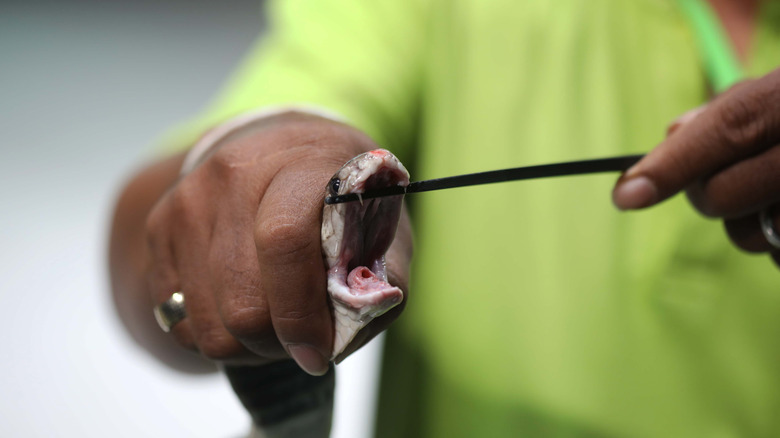
The more venomous the snake, the greater the demand for antivenom in local hospitals. Consequently, snake milkers work with many of the world's deadliest snake species, some of which possess venom that can kill you in mere minutes. As soon as a venomous snake bites, snake milkers are in a race against time to minimize the damage done. Some snake venoms are primarily composed of cytotoxins, which attack and kill cellular tissues. Given enough time, cytotoxic venom can cause lifelong muscle damage and scar tissue.
Other venoms are primarily neurotoxic, which means they attack and disrupt the nervous system. Neurotoxins often inflict damage to the nerve terminals shockingly fast, causing nerve damage, psychological trauma, and even brain damage. One snake milker survivor allegedly complained of lifelong vision problems after being bitten, as he lost his ability to visually focus his eyes for more than a few seconds.
Perhaps the most common long-term, systemic effect of venomous snake bites is kidney damage. Even victims that receive prompt antivenom treatment are at risk for lasting kidney problems. Kidneys are responsible for filtering the blood; when snake venom enters a person's blood stream, their kidneys must filter the flood of toxins. Some venoms even actively attack the kidneys' organ membranes. In the worst-case scenarios, complete kidney failure is possible.
It's ironic that snake milkers risk their lives and health to produce life-saving antivenoms, especially since that antivenom may be used on themselves. For many in the risky, niche career, their passion for herpetology and medicine is worth it. Snake venom extracted through milking is also used in medicines that treat cardiovascular diseases, chronic pain disorders, and neurological disorders. Indeed, it appears the very venom that can kill you in the wild can also save your life.