

The Deepest Part Of The Ocean That Isn't The Mariana Trench
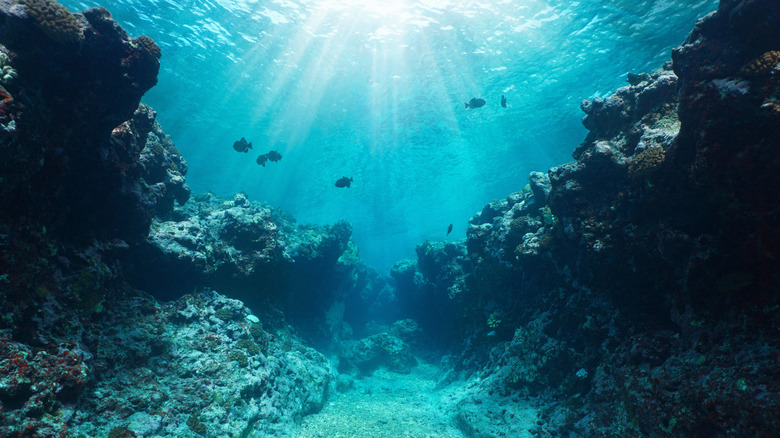
Earth's surface is home to a wide array of landscapes ranging from flat plains to jagged mountains to deep canyons. This is true for the land masses we can see and for the 70% of the planet's crust covered by oceans. Far from being a flat, uniform surface, the seafloor is home to mountains and trenches that dwarf many features on land. The famed Mariana Trench is the deepest ocean trench, measuring more than 36,000 feet deep at its deepest point. A close second is the perhaps lesser known Tonga Trench in the South Pacific Ocean, at around 35,509 feet.
The Tonga Trench, the deepest trench in the southern hemisphere, is northeast of New Zealand and south of Samoa. It runs parallel to the islands of Tonga that give it its name and is more than 800 miles long and around 50 miles wide. The deepest part of the Tonga Trench, known as the Horizon Deep, was first measured by the research vessel Horizon in 1952. The bottom of the Tonga Trench was finally visited by a crewed submersible in 2019 as part of a mission to study the deepest parts of Earth's five oceans known as The Five Deeps. In addition to the Tonga Trench, this expedition visited the Mariana Trench and the deepest trenches in the Atlantic, Arctic, Indian, and Southern oceans.
What makes a trench
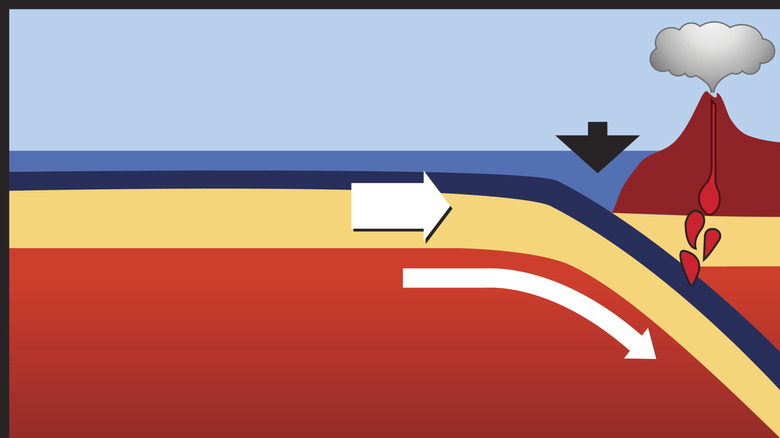
Ocean trenches are deep, V-shaped valleys in the ocean floor that are made when two plates of oceanic crust move toward each other. One of the plates moves beneath the other, a process known as subduction, bending to form a trench. At the Tonga Trench, the Pacific Plate is diving beneath the Indo-Australian Plate, moving at around 9 inches per year. This makes it the world's fastest plate convergence zone.
In addition to creating deep trenches, regions where plates converge are often geologically active. The famed Pacific Ring of Fire, a band of earthquakes and volcanoes around the edge of the Pacific Ocean, is the result of subduction. When subducting crust descends, it melts, and magma rises to the surface, creating volcanoes. This process is what gave rise to the Tonga islands that run parallel to the Tonga Trench. This arc of islands is home to more than 30 active or recently active volcanoes, including the underwater volcano Hunga Tonga–Hunga Ha'apai, which erupted in 2022. The movement of subducting crust also releases energy in the form of earthquakes. The Tonga Trench region experiences more deep-focus earthquakes — that is, earthquakes happening more than 180 miles deep – than any other subduction zone on Earth.
Life in the trench
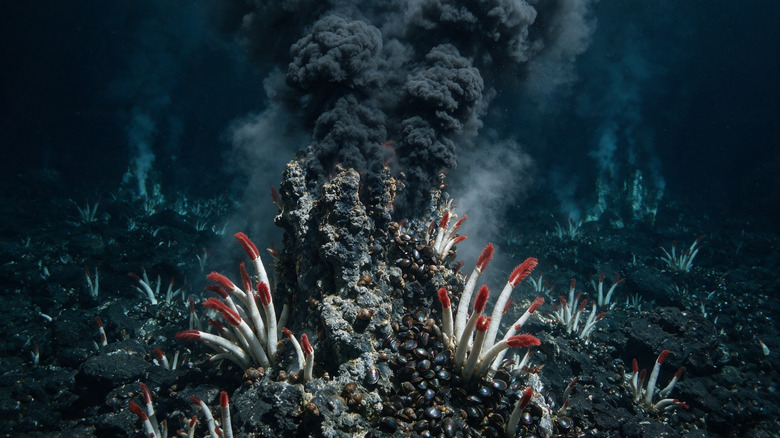
The bottom of the Tonga Trench is so deep that sunlight can't reach it. However, even with perpetual darkness, crushing water pressure, and near freezing temperatures, the Tonga Trench is far from lifeless. Ocean trenches are isolated ecosystems because organisms that live there couldn't survive leaving the great depths. The Tonga Trench is home to a unique species of snailfish that lives at around 23,000 feet beneath the surface as well as crustaceans that scuttle along the floor of the trench. Researchers also observed a Pacific sleeper shark in the trench at nearly a mile underwater. However, one thing that researchers haven't found in the Tonga Trench is traces of human activity; other ocean trenches sometimes contain trash that has sunk from the surface of the sea.
Trenches are unique locales that humanity is only now beginning to understand. A large part of the ocean remains inaccessible because of its enormous size and great depths. Deep enough to cover 24 Empire State Buildings stacked one on top of another with room to spare, the Tonga Trench is home to the second deepest part of the ocean and one of the remotest places on Earth.