

Drinking Sports Drinks Every Day Could Have An Unexpected Effect On Your Health
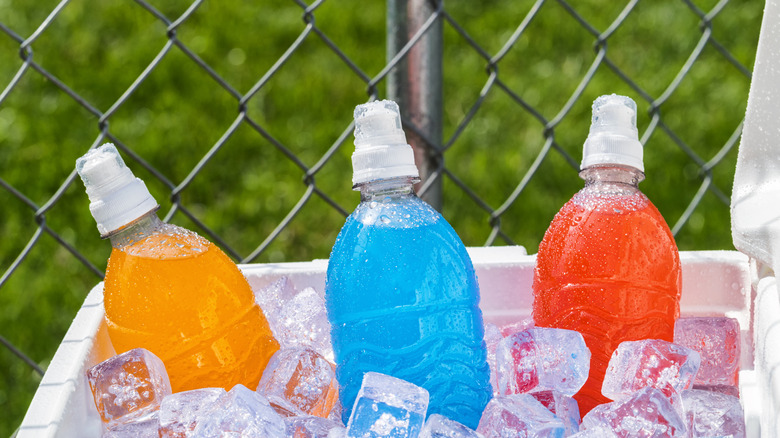
If you've ever perused the sports drinks aisle of the supermarket, you will likely have been met with a vast array of unusually brightly colored drinks with bold claims on the labels. While it is true that sports drinks aid with hydration and electrolyte balance, there are a number of negative effects of these drinks on the health of regular consumers, including obesity and tooth decay.
The claim behind sports drinks is that they replace electrolytes lost during exercise, and therefore prevent dehydration. In the case of an athlete who is exercising intensely for an hour or more, this can be a useful way to quickly replenish lost minerals. However, the advertising for sports drinks is very broad, and many young people choose to drink them as a "healthy" beverage even in the absence of exercise.
Part of the issue is that the marketing of sports drinks helps to frame them as a healthy option, even though they can in some cases be packed with sugar. Words like "electrolytes" imply that they are providing an essential component to fitness, and anyone with even a moderate physical activity routine may assume that they can benefit from them. Sweating due to exercise does cause the loss of minerals, especially sodium and chloride, but in truth, only the most vigorous exercise is likely to require electrolytes to be replaced in such a manner, leaving everyone else sipping on a sugary drink with little benefit.
The sugar content of sports drinks can lead to chronic disease
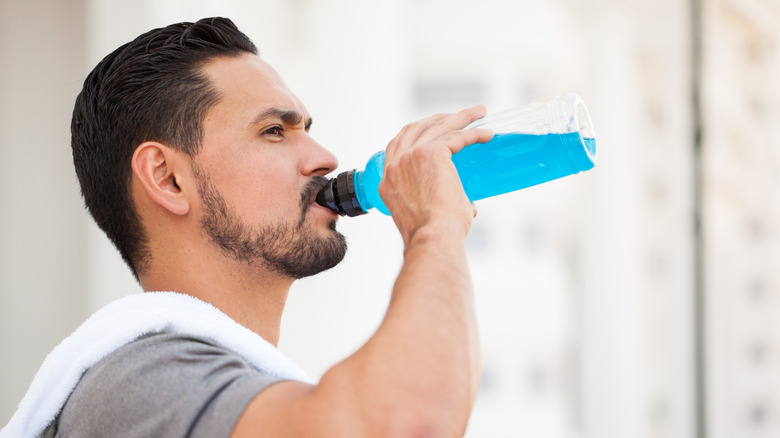
While it is true that sports drinks do not contain as much added sugar as a can of soda, this is not exactly a nutritional accolade, since a standard can of cola contains a whopping 39 grams. An average sports drink contains a little more than half of that in the same volume, at 21 grams per serving. Considering the daily recommended limit of added sugar is 36 grams for men and 25 grams for women, according to the American Heart Association, this means that one serving of a sports drink represents a huge percentage of the added sugar limit for the entire day. It is also worth noting that sports drinks are usually sold in larger bottles, meaning that anyone drinking the entire bottle in one sitting will actually be close to the sugar content of a regular can of soda.
If consuming a sports drink without intense exercise is an occasional occurrence, it is unlikely to have a significant impact on health. However, consumption on a regular — or even daily — basis is linked to weight gain, and chronic disease. A study published in The Obesity Society of more than 7,500 young people, aged between 9 and 16, found that the more often sports drinks were consumed, the higher the chance of an increase in body mass index (BMI.) Frequent consumption of sugary drinks in childhood and adolescence, including sports drinks, has also been linked with high blood pressure. A study by The American Heart Association involving 25,000 young people showed that "each daily serving of sports drinks was linked to a 36% higher risk" of high blood pressure in later life, which in turn increased the risk of heart attack and stroke.
Teeth can suffer as a result of sugar content
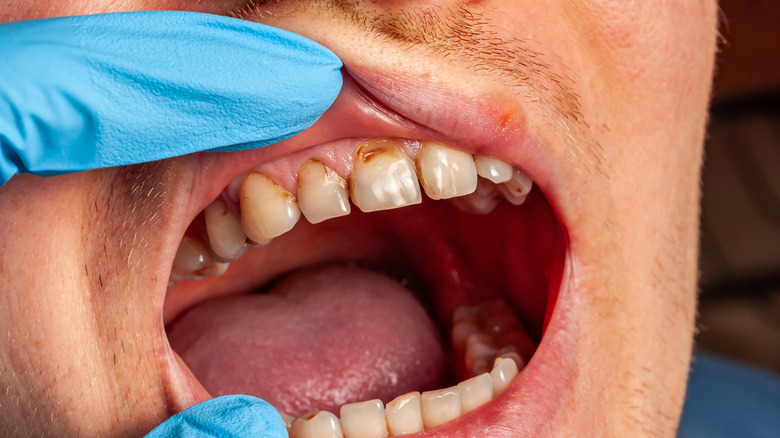
While excessive sugar content in sports drinks can have serious health effects and eventually lead to chronic disease, there is also another long-term issue — dental health. A 2022 study on athletes has shown a correlation between sport drinks and dental erosion, suggesting that drinking them regularly is detrimental to oral health.
There are two main ways in which sports drinks can negatively impact teeth. The first is through the sugar content, which, as discussed, is high in many electrolyte drinks. Sugar allows the bacteria within plaque to form an acid, which then breaks down part of the tooth enamel over time, leading to tooth decay. This happens whenever we eat sugar, and regular brushing is required to reduce the chance of the plaque becoming acidic — just one of the gross things that can happen if you don't brush your teeth.
The second issue with sports drinks is that they tend to be acidic in the first place. Many varieties of sports drink have pH levels between 3 and 4, which is incredibly acidic compared to water, with a neutral pH of 7. This means the drinks can contribute to erosion from being in contact with the teeth, before the plaque bacteria even get started. While sports drinks can be consumed reasonably safely as an occasional treat, they should be viewed on a par with soda, and restricted in the same way. The continued marketing of sports drinks as an essential part of exercising may encourage people to reach for one in the name of efficient rehydration, when good old calorie-free water would do the trick instead.