

Gross Things That Happen When You Stop Brushing Your Teeth For A Week
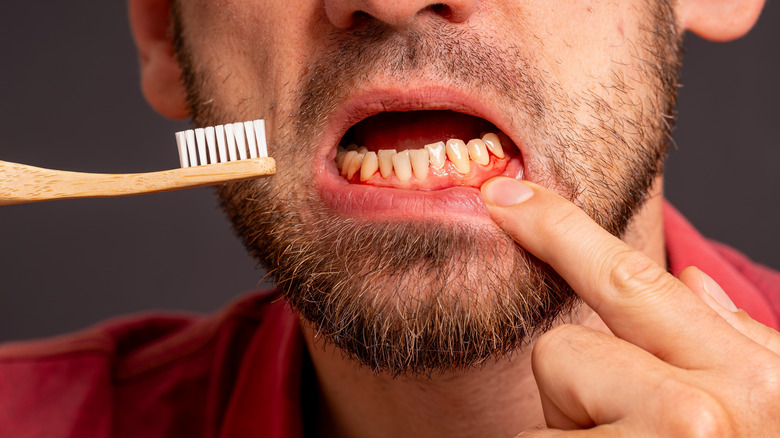
Teeth brushing is a hygiene habit that the majority of us consider non-negotiable; we aim to clean those pearly whites twice a day without fail. Missing one brushing very occasionally is unlikely to cause long term issues, but even a few days without a thorough brush can leave your teeth, and the rest of your mouth, feeling pretty gross. Abandoning your oral hygiene for a whole week can cause numerous problems, such as plaque, tartar, and bad breath, some of which may not be easy to fix yourself.
After you eat food, even savory foods that don't taste sweet, plaque begins to build up within just a few hours. It is unlikely that you would feel the plaque on your teeth at this point, and it won't cause pain straight away, but it is the first step in dental decline. Brushing your teeth a few hours later before heading off to bed will remove this thin film of plaque and prevent it from doing any long term damage.
If the plaque is allowed to set in for a whole week however, it hardens and turns into tartar. Tartar is much harder than plaque, has a yellowish tinge, and cannot be managed at home through brushing. Running your tongue across your teeth will give a clue as to the changes that are happening on the surface. Your teeth will feel dirty and your gums may hurt and become inflamed too, triggering early gingivitis. At this stage, a trip to the dentist is essential, as a professional dental cleaning will be necessary to remove the tartar and prevent serious long-term issues in your mouth.
Bad breath can build up fast

In addition to the potential long-term issue with your teeth, there is another crucial side-effect of a week without brushing — your breath. When you brush your teeth regularly, as well as removing plaque build up on your teeth, you are also clearing small chunks of food from your mouth. If no brushing takes place, these little pieces will remain lodged in your teeth, and start to break down. This causes a nasty smell to be produced, and the longer you leave it, the stinkier it will become. Although the enzymes in saliva can help to limit bacterial growth in the mouth, they cannot replace daily brushing in terms of keeping your breath fresh and your teeth clean.
This is why flossing daily is recommended, since even adequate brushing may not release tiny food particles between the teeth. Mouthwash can also be used to kill bacteria in the mouth and could help to prevent bad breath. However, dentists recommend this should be in addition to thorough brushing, rather than a solution on its own.
Your tongue can become a bacteria trap
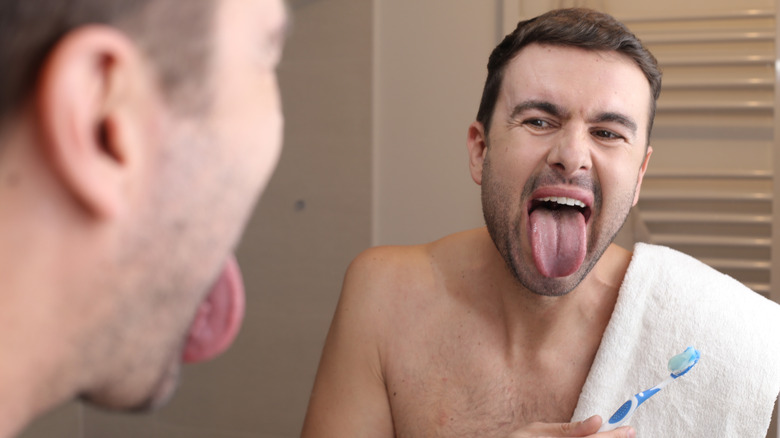
The teeth aren't the only place that foul-smelling bacteria can hide in the mouth. The tongue is also a culprit, with small chunks of food finding it easier than you may imagine to hide out. Speaking to Healthline, doctor of dental surgery, John D. Kling, explained, "It's not smooth. There are crevices and elevations all over the tongue, and the bacteria will hide in these areas unless it is removed."
Even good teeth brushing can lead to odor-causing bacteria on the tongue, so you can only imagine the state of things after a week without a toothbrush. By this point, it will not be a faint odor that can be fixed with a breath mint, but a serious case of halitosis caused by trapped food and bacteria across the whole mouth. While most of the issues after a week without brushing are reversible following a trip to the dentist for a professional clean, daily teeth brushing can prevent these gross effects from happening in the first place and keep your mouth healthier in general.