

The Bizarre Psychological Phenomenon That's Still A Mystery To Scientists
We may receive a commission on purchases made from links.
Throughout history, people from peasants to kings have claimed the ability to predict the future, a power referred to as precognition. For some, signs of the future arrive in dreams, while for others the future is written in tea leaves. In any case, there is no empirical evidence for the oft-claimed superpower. After all, Newton's second law of thermodynamics, which describes entropy, establishes a fundamental rule of the universe: The arrow of time only points in one direction. Yet, although the future is unknowable, the commonness of precognition claims still puzzles scientists. Why do otherwise rational people believe they've done the impossible and glimpsed the future?
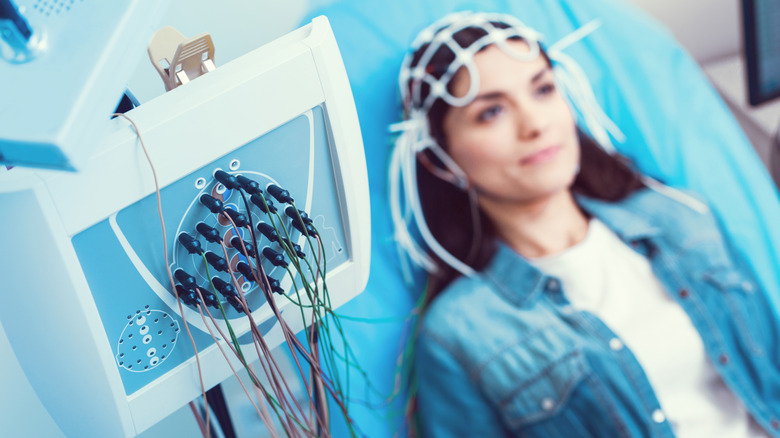
Of course, non-scientific explanations abound. Pseudoscientific fields such as parapsychology often point to weak statistical patterns to prove the existence of precognition. For instance, in the 1990s, parapsychologist Dean Radin tested human subjects' brain activity before and after they were shown an image. According to the findings, subjects had statistically predictable brain activity before an image even appeared, as if they were experiencing an emotional response to an image they hadn't seen yet. Similar studies showed supposed precognitive responses in the skin, as well. Unfortunately for the parapsychologists, their results were never successfully replicated.
Thus, scientists regard precognition to be the result of a trick of the mind and sheer chance. Psychologists attribute the phenomenon to the "implicit processing hypothesis," which is the same cognitive mechanism that causes feelings of deja vu. Because our brains use unconscious pattern recognition to create and recall memories, sometimes they confuse a present event with a past dream or prediction. For someone experiencing this moment of inaccurate recall, it can feel like they had read the future in the past and now it's come true.
How our brains can trick us into thinking we're fortune tellers

The implicit processing hypothesis is only one possible explanation for the experience of precognition. After all, claims of clairvoyance have arisen out of just about every society and culture, and there are famous examples of accurate predictions in ways that can't be explained by an individual's subjective memory alone. For instance, some proponents of the phenomenon point to the 1865 Jules Verne novel "From the Earth to the Moon," in which a spaceship launches from Florida on a trip to the moon. A century later, Verne's prophetic "vision" was fulfilled with the launch of Apollo 11 from the Kennedy Space Center.
But Verne wasn't a clairvoyant with precognitive visions of the future. He spoke to scientists, read countless books, and had a fairly accurate understanding of the direction in which society and technology were headed. He also got a lot wrong. It turns out we use rocket engines (not giant cannons) to travel to the moon. Good science fiction writers rely on contemporary science to make predictions about the future, so their predictive accuracy depends on their skill at recognizing patterns in history and technology.
We do the same in everyday life. Our brains are hardwired to find patterns and assess risk, even when those patterns and risks aren't really there. It's similar to the way our brains may trick us into seeing faces where there aren't any or lead us to believe we're being watched when we're alone. Connecting current events to dreams or predictions is a psychological tool to help the mind piece together the world and prepare for potential events. Human beings can't predict the future — but that doesn't stop us from trying.