

The Unexpected Organ That Could Secretly Be Running Your Life
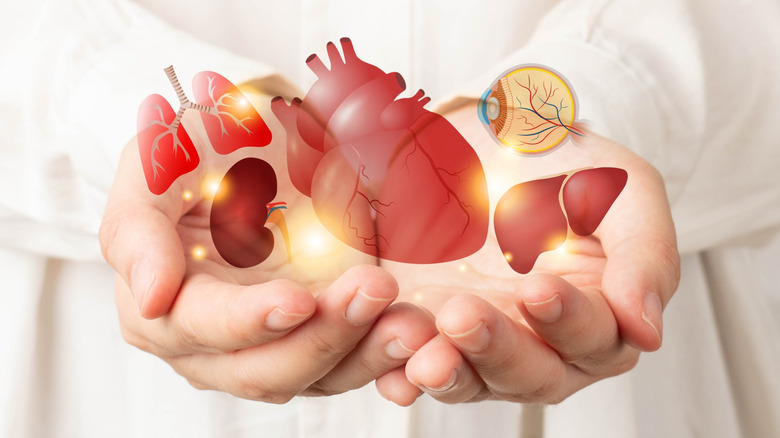
When it comes to the human body, there's still a lot for the scientific community to figure out. In fact, there are some organs that scientists still debate are useless or not. That doesn't mean that they haven't uncovered the functions of many human organs, though. The thyroid is one of those organs that researchers have learned quite a bit about (although there's still room to grow). Of their many findings, you might be surprised about the ways the thyroid plays a major role in running vital functions of the body.
First of all, the thyroid is a gland with two lobes (halves), measuring a total of about 2 inches across, that are connected by the isthmus in the middle — resembling a butterfly. It's located in the lower neck just above the sternum. Among its most important functions, though, is secreting hormones T3 and T4 that control your basal metabolic rate (BMR). T4 (thyroxine) has a smaller effect on BMR than T3 (triiodothyronine), but T4 is converted into T3 by the liver and tissues as the body needs it.
As a result, an overactive thyroid that produces too much of these hormones — a condition called hyperthyroidism — causes a high BMR that burns more calories, which may lead to weight loss. An underactive thyroid that doesn't produce enough of these hormones — a condition called hypothyroidism — causes a low BMR that burns fewer calories, which may lead to weight gain.
Healthy thyroid hormone levels are a key component of fertility

Changes in BMR and weight aren't the only aspects of the human body that the thyroid influences. According to a study published in the Journal of Endocrinological Investigation, the thyroid's function affects fertility in women and possibly in men. Researchers have found evidence that thyroid-stimulating hormone (TSH) — one of the hormones from the pituitary gland — and thyroid hormone receptors have an inevitable role in fertilization, folliculogenesis, embryogenesis, and implantation. For instance, hormones from the organ support preantral follicle growth by promoting follicle-stimulating hormone (FSH).
Because of that, an impairment in thyroid hormone production (hypothyroidism and hyperthyroidism) and hormone signaling can have detrimental effects on ovarian reserve and the placenta. Scientists haven't determined the specific molecular mechanisms involved, but they've also seen changes in androgen and estrogen hormones when hypothyroidism is present. Plus, about 80% of women diagnosed with hypothyroidism have disturbances and irregularities in their menstrual cycles.
On the other hand, women with hyperthyroidism also have increased levels of androstenedione and testosterone, as well as an increased conversion of those hormones to estrone and estradiol, respectively. These differences result in 2.5 times as frequent disturbances in menstrual cycles compared to the general public.
In men, hypothyroidism doesn't impair male reproductive development, but it can cause delayed sexual maturation if it's left untreated. It can alter sperm morphology as well, with men who have the condition producing atypical sperm more than those who don't have the condition. On top of that, the illness may cause a total sperm count and motility decrease. More investigation into how thyroid health affects male fertility is needed, however.
Thyroid hormones can affect mood swings and mental health
Alongside regulating the rate at which the body uses energy, the hormones produced by the thyroid support how well many organs function, including the brain. When those hormones are out of balance — whether because of hypo- or hyperthyroidism — they can trigger emotional issues, such as anxiety, depression, and mood swings. A meta-analysis published in JAMA Psychiatry found that overt hypothyroidism (not subclinical hypothyroidism) has a moderate connection with clinical depression, and that connection is stronger in women than in men.
In addition to emotional changes, a thyroid hormone imbalance can cause problems with cognitive function and processing information, such as brain fog, short-term lapses in memory, and poor mental alertness. A review paper published in Cureus found that psychiatric conditions like bipolar disorder and schizophrenia have an intricate relationship with thyroid health. On one hand, hypo- or hyperthyroidism can contribute to such disorders and exacerbate their symptoms. On the other hand, medications for these psychiatric disorders can negatively affect thyroid function. Researchers believe further investigation is essential and that the best way to effectively manage psychiatric and thyroid disorders is through a collaborative approach to care from both endocrine and mental health specialists.