

In The '60s, US Military Satellites Were Hunting Secret Nuclear Tests. What They Found Came From Deep Space
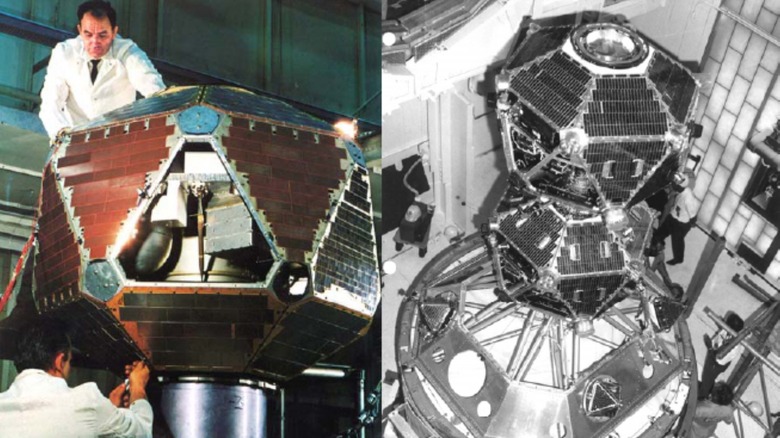
Satellites may be key to Donald Trump's Gold Dome missile defense system, but they're a whole different beast compared to the military satellites launched in the 1960s. Although the functions of the satellites are similar (watching out for potential threats to the United States), the '60s Vela satellites didn't have the advanced technologies of modern versions. Despite that, some of them were fitted with equipment that led to an amazing discovery: gamma-ray bursts (GRBs) in the cosmos.
In 1963, the United States signed the Test Ban Treaty alongside the Soviet Union and Great Britain to prohibit the testing of nuclear weapons underwater and in Earth's atmosphere and outer space. A government-run and Air Force-managed program involving the launch of 12 reconnaissance satellites into Earth's orbit in pairs from 1963 to 1970 to detect nuclear activity in breach of the treaty.
The Vela 4A and 4B satellites were launched in 1967 with gamma-ray sensitive instruments. Just a couple of months later, Los Alamos National Laboratory scientist Ray Kelbesadel and his coworker Roy Olson saw what they thought was evidence that the Soviet Union had conducted nuclear bomb testing. The pair reviewed previous data from the Vela 3A and 3B satellites and found a similar event, suggesting an unknown gamma source. It wasn't until 1972 that they and coworker Ian Strong were able to use computers to filter the data and that from Vela 5A, 5B, 6A, and 6B to identify a total of 16 GRBs from 1969 to 1972. In 1973, they published their findings in The Astrophysical Journal, concluding that the GRBs came from somewhere beyond our solar system.
What scientists have learned about gamma-ray bursts since the Vela discoveries
Scientists have long known that GRBs are one of the different types of radiation, and the discovery of these powerful bursts of energy in the cosmos left them with even more questions. However, it took until 1991 for NASA to launch the Compton Gamma-Ray Observatory (CGRO), one of the agency's Great Observatories, to study the various energies in the universe. Equipped with four telescopes, it was instrumental in suggesting the cosmological origins of GRBs, as well as active blazar galaxies that are powered by supermassive black holes and more.
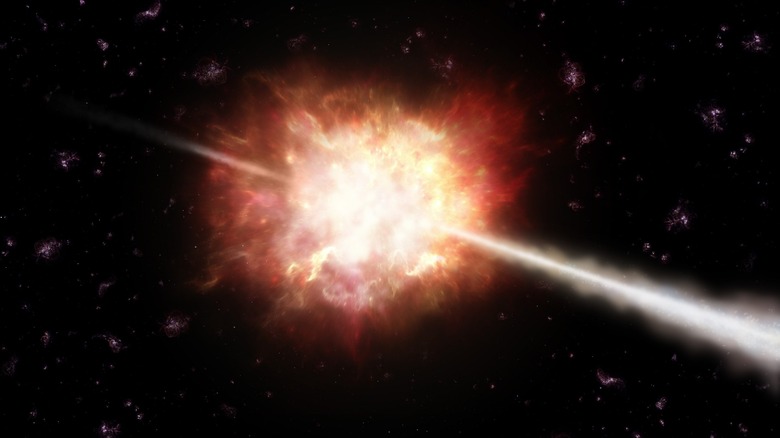
In fact, one of the telescopes — the Burst Alert Telescope (BAT) — was specifically designed to detect GRBs and calculate an initial position to send to the Neil Gehrels Swift Observatory — all within seconds. Scientists were able to use the resulting data to determine that the intense fusion energy was the same as the hydrogen bomb and occurs on a daily basis. As astronomers have continued to study the cosmic phenomena, they've identified the closest on record at over 100 million light-years away. They've also classified them into two types. Short GRBs are initial flashes that disappear within two seconds, while long GRBs last beyond two seconds and produce more gamma rays.
Now, researchers associate these short bursts with two neutron stars colliding or a neutron star colliding with a black hole. Long bursts are associated with a supernova — a massive star running out of nuclear fuel, resulting in the core collapsing and rebounding, which emits a huge, explosive shock wave. In both cases, the newly formed black hole sends streams of particles through the surrounding material at about the speed of light, which is what emits the gamma rays. Understanding GRBs is far from done, though, and research is ongoing.