

The Unsettling Reason Spiders Love Your Smelly Socks

When it comes to arachnids — a group of arthropods that includes mites, scorpions, and ticks — spiders are some of the most fascinating. The pirate spider uses sneaky tricks to trap other spiders, while a not-yet-named, new spider species in Australia hunts with a catapult. However, that doesn't make up for the unsettling feeling you might get knowing that there are spiders out there that love smelly, worn socks. As it turns out, Evarcha culicivora has a taste for blood.
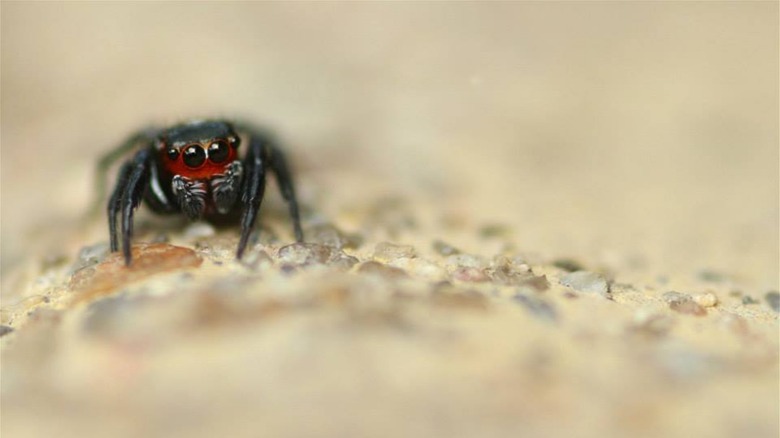
E. culicivora is a type of jumping spider that's also known as a vampire spider because blood is its favorite meal. Scientists have known that this spider species feeds on vertebrate blood by targeting blood-engorged female mosquitoes since a study about it was published in Proceedings of the National Academy of Sciences of the United States of America in 2005. Unlike vampire bats that may target humans (although rare), the spider doesn't have sharp enough fangs to pierce skin and directly feed on humans for blood. Instead, it relies on the color red and human scent to hunt for its mosquito prey.
In an interview with BBC Earth News, University of Canterbury, New Zealand spider biologist Fiona Cross explained, "When they smell blood, they can launch into feeding frenzies where they kill up to 20 mosquitoes in rapid succession, and not necessarily to eat all of them." The sense of smell exhibited by E. culicivora is unique among jumping spiders, so it may have adapted the ability because its prey has that ability.
How scientists concluded that E. culicivora is attracted to smell socks
Researchers have spent years studying E. culicivora. In a study published in Medical and Veterinary Entomology, they found that it prefers Anopheles mosquitoes, which are known for carrying malaria. Scientists conducting research in Western Kenya noticed that E. culicivora would remain calmer around them than other jumping spider species. Since the spider's prey is mosquitoes, they decided to see if the spider was also attracted to human odor.
In a study published in Biology Letters, the pair described how they tested the theory. They put a pair of 100% cotton socks that were fresh and unworn into one section of a stimulus chamber and an identical pair that had been worn for 12 hours immediately before initiating the trial into a separate stimulus chamber. Meanwhile, 16 spiders (male and female; juvenile and adult) at a time were placed in holding chambers (with the option to leave) two minutes before air was pumped through the stimulus and holding chambers. Of the total 109 spiders, those exposed to the smelly sock odor "spent significantly more time in the holding chamber" compared those that were exposed to the fresh sock air.
Cross, a co-author of the study, told LiveScience, "It really is quite unprecedented that a spider should find human odor attractive." Given that E. culicivora can't pierce skin and target malaria-carrying Anopheles mosquitoes, the scientists believe that they could cohabitate with people to reduce the spread of malaria.