

Scientists Say This 3.8 Million-Year-Old Face Solved A Major Mystery Of Human Evolution
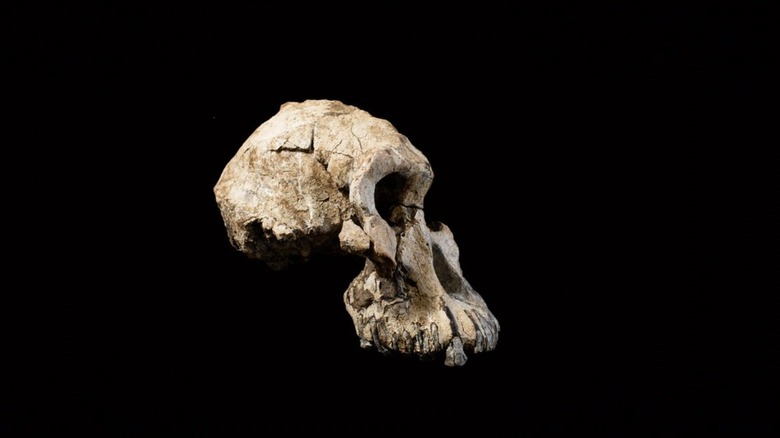
There will never be a single "missing link" that connects human beings to our ape ancestors. Instead, evidence for human evolution is found in DNA, artefacts, and fossils, which anthropologists use to construct a human family tree. But that tree is always changing with each new discovery. The famous "Lucy" skeleton gave scientists a glimpse of a 3.2 million-year-old hominin ancestor named Australopithecus afarensis, while the face of the 3.7 million-year-old "Little Foot" skeleton revealed an extinct human cousin. And in 2016, paleoanthropologists found an even older hominin fossil: a 3.8 million-year-old skull that demonstrated how the human family tree isn't a straight line, but one with many crisscrossing branches.
The fossil was found near the same site as "Lucy" in Ethiopia, though it came from an earlier hominin species named Australopithecus anamensis. For years, A. anamensis was only represented in the fossil record by broken bits and pieces of jaw bones and scattered teeth. The 2016 skull, however, gave the species a face. Its small brain, long canines, robust jaw, and wide cheek bones paint a picture of a transitional ape not yet as intelligent as its descendants but well-adapted to a life of foraging tough tubers, fruits, and nuts.
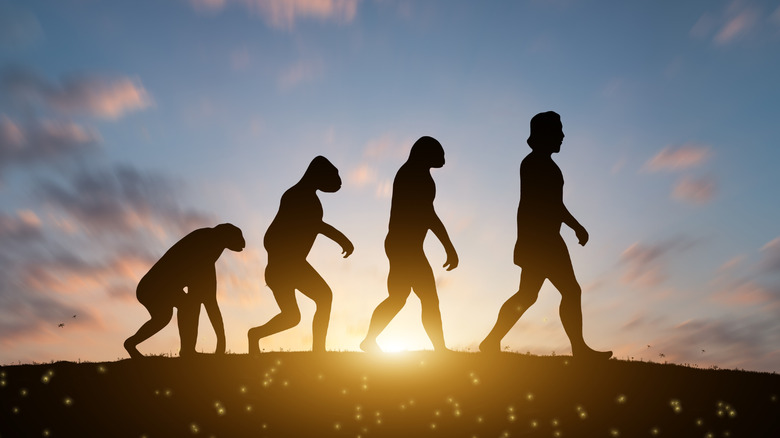
The discovery changed how anthropologists regard this distant period in human evolution. For one, it suggests that A. afarensis ("Lucy") wasn't a direct descendent of A. anamensis, since the two species co-existed for at least 100,000 years. It also disproves the outdated linear, ladder-like model of our own evolution. The relationship between the two hominin cousins complicates the hominin family tree while also refining our understanding of its many branching, overlapping lineages. Even hominin species that aren't direct ancestors of human beings, all of which have gone extinct, have a place on our family tree.
Why the linear ladder model of evolution isn't accurate
Theoretically, every organism on earth can be traced back to a single common ancestor. In fact, every individual human being alive today shares a maternal ancestor that geneticists refer to as the Mitochondrial Eve. This mother of all mothers lived between around 200,000 years ago, and her signature can be found today in the shared mitochondrial DNA of human cells. But to trace back our lineage further, the record of the human evolutionary timeline becomes much more murky, with only fragmented fossils, tools, and partially reconstructed DNA to piece together the story.
Thus, it's futile to attempt to construct a direct ancestry of living humans beyond a few hundred thousand years. Paleoanthropologists must rely on the morphology of bones to study human evolution, and the endeavor is complicated by the many merging and diverging human species that co-existed with our own direct ancestors. In fact, several extinct human species, including Neanderthals, mated with human beings in the past and passed down their DNA signatures. The most famous examples are the aforementioned Neanderthal DNA in people of Eurasian descent and the Denisovan DNA found in people from Oceania.
Because of interbreeding, it's challenging to determine if a hominin fossil came from a "cousin" species or our direct human lineage. Some hominin groups branched off and evolved into different species, such as how A. afarensis ("Lucy") split from A. anamensis rather than replaced it. However, in the early stages of speciation, the two populations can be genetically similar enough to remerge and swap certain genes. Compared to the 3.8 million-year-old face of A. anamensis, we're quite different — our brains are larger, our jaws are smaller, and our dentition is weaker — but these ancient hominin cousins still offer insights into the intertwining branches of our evolutionary past.