

How A US Military Contractor Invented The Microwave Oven By Accident
We may receive a commission on purchases made from links.
While the majority of products used on an everyday basis have been invented with a specific purpose in mind, there are still plenty of major scientific discoveries that happened by accident. One of these is the microwave, which was pioneered by former military man Percy Spencer while working for Raytheon, a military contractor, in the 1940s.
At the age of 18, Spencer became a radio operator in the U.S. Navy, during which he taught himself the subjects necessary for engineering. He joined Raytheon (then called American Appliance Company) when World War I ended. The British then contracted the company to produce combat radar equipment — specifically the primary cavity magnetron component — during World War II, and Spencer was responsible for developing a mass production method that output 2,600 of them a day, which helped win the war.
The cavity magnetron component was a source of microwaves, which are a type of radiation on the electromagnetic spectrum. Spencer just happened to be standing near active radar equipment one day after the war and noticed that a candy bar was melting in his pocket. Theorizing that the microwaves could cook food, he set some popcorn kernels nearby. After those popped, he put an egg in a kettle with a hole in it and directed the energy into the hole. Although the egg exploded, it confirmed his theory, and follow-up experiments and designs led to the first microwave patent being filed by October 1945 and approved in January 1950.
How the microwave has evolved since the first Raytheon Radarange
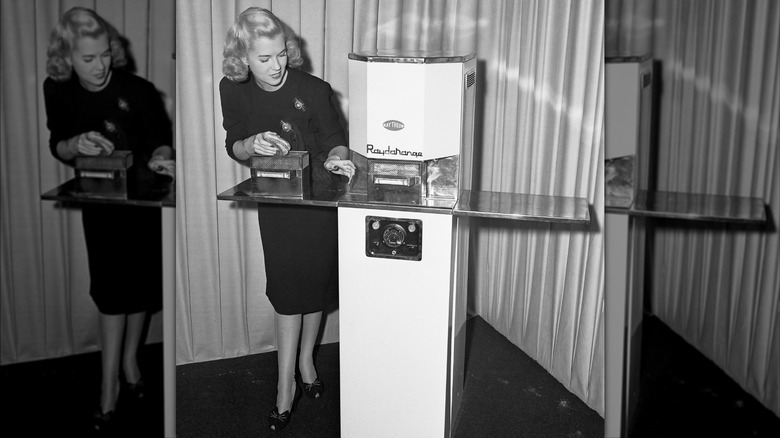
The first Raytheon microwave was actually called the Radarange, and it emerged on the market in 1946. The appliance was hefty at almost 6 feet tall and over 750 pounds and used 3,000 watts of power; it also cost a pretty penny — $5,000. It was installed on the Savannah, a nuclear-powered cargo vessel, as well as other ship galleys, large canteens, and restaurants.
In 1955, Raytheon began selling a smaller microwave designed in conjunction with Tappan for household use. It was probably the first microwave to have mesh on the inside (which actually serves a purpose) because the door had a window. Sales remained hampered, though, because of its sheer size, high price tag ($1,295), and public uncertainty about microwave radiation. It wasn't until the company acquired Amana Refrigeration in 1965 that it was able to produce smaller appliances on a larger scale. Just two years later, the Radarange RR-4 was introduced — the first compact countertop microwave that used just 115 watts and was priced at $495.
The kitchen appliance didn't hit its stride in sales until the 1970s when the parts required for manufacturing became cheaper and the safety standards were improved. In fact, the Amana Radarange started to become more popular than gas-powered ovens by 1975. With even further improvements over the years, microwaves ended up in 90% of American households by 1997. Modern microwaves are now capable of convection cooking and have advanced features like a dual crisp element that acts like a broiler, and sensor cooking that adjusts power levels and cooking times based on internal moisture.