

Scientists Say People Who Live Past 110 Have This Unusually High Biomarker In Common

Aging is such a fascinating part of life, and the human race has been looking for ways to live longer for thousands of years. Couple that curiosity with major developments in science, and global life expectancy is up to an average of 79 years as of 2024 (per the National Center for Health Statistics). New research, though, may have found that healthy aging is possible with an abundance of certain T cells.
After scientists discovered last year that the CIRBP protein in giant bowhead whales could hold the secret for extending human lifespans, another team discovered a correlation between high amounts of CD4 cytotoxic T lymphocytes (CD4 CTLs) and people who live beyond 110 years. The findings were published in Cell Reports and suggest that the immune system can continue to adapt to new threats even in supercentenarians (individuals 110 and older). In fact, the research team observed that these cells, which are considered rare, multiply and expand as we age.
Analyzing blood samples from 28 adults, the researchers saw a median proportion of 4% CD4 CTLs in those aged 70 to 99. The median proportion rose to 9.6% in those 100 to 109, which nearly doubled to 17.6% in supercentenarians. Since the cells are "atypical and relatively rare," University of Osaka associate professor and first author Kosuke Hashimoto explained in a press release that "their marked increase in supercentenarians may provide important clues as to how the immune system is maintained in extreme old age."
What an abundance of CD4 CTLs indicates about individual health
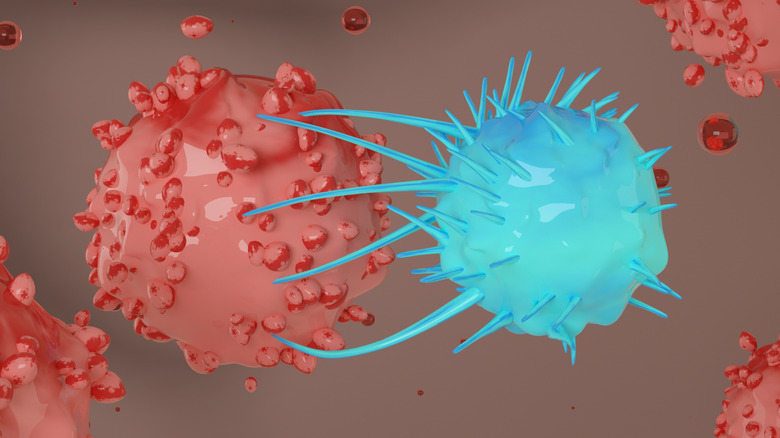
The initial findings that CD4 CTLs increase in number as people age suggest that the clonal expansion starts around 100 years of age. However, there was at least one outlier — a participant under 100 who had the highest proportion of CD4 CTLs — leading the scientists to question why these cells multiply so much. That's when they decided to analyze the T-cell receptors in the participants' blood samples, allowing them to observe the function and communication between immune system cells.
Every T cell generates a distinct receptor so that the body can recognize various antigen threats and respond. When CD4 CTLs encounter antigens, they clone themselves, and those clones kill the target, which is why they're considered killer T cells. In the supercentenarian study, the research team discovered that a large portion of the total CD4 CTLs were single clonal lines.
The clonal line in one centenarian's sample accounted for 53.8% of the total, while the largest individual clone among all the samples represented 33.3% on average. When the researchers compared the most common amino-acid sequences from the CD4 CTL receptors to a database, about 30 of them matched the sequences from individuals diagnosed with breast, liver, and lung cancers. None of the study participants had been diagnosed, though.
These findings could mean that higher amounts of CD4 CTLs correlate to the immune system being in a constant state of threat response. Hashimoto noted in the press release, "Some CD4 CTLs may recognize cancer-related targets, although their exact targets remain unknown." Clearly, the immune system is doing a lot more than fighting off colds, and more investigation is needed to determine if CD4 CTLs have other functions.