

Scientists Say This Optical Illusion Could Reveal If You Have Schizophrenia

Some signs of schizophrenia are very noticeable, such as seeing things that aren't there (hallucinations) or believing in things that aren't real (delusions). There are also less obvious signs, such as a lack of expression, motivation, or interest in socializing. Mental health professionals use these signs to help diagnose schizophrenia in patients. But beyond these signs, there's an interesting phenomenon that reveals the connection (or lack thereof) between what our eyes see and what our brains perceive we are seeing. Although not a formal diagnostic test, how people respond to the "hollow mask illusion" may provide an inkling that someone has schizophrenia.
A study conducted by scientists from University College London (UCL) and Hannover Medical School found that, in the brains of people who don't have schizophrenia, the "bottom-up" process of transmitting visual information from the eyes to the brain converge with the "top-down" mechanism of interpreting this information in the brain. These are just some of the processes that the parts of the brain control. People without schizophrenia interpret what their eyes see in the context of information stored from past experiences. When these folks see the inside of a hollow mask, which has a concave appearance (unlike normal convex faces), they perceive it as a normal face because of the similarities to faces they have seen before. This leveraging of past experiences to make sense of visual cues is similar to the bizarre Baader-Meinhof phenomenon.
By contrast, in people with schizophrenia, the bottom-up and top-down processes are disconnected or weakly connected, causing them to not be fooled by the hollow-mask illusion. Instead, they correctly view the mask as a 2D mask with nothing behind it.
How researchers conducted the hollow mask illusion experiment
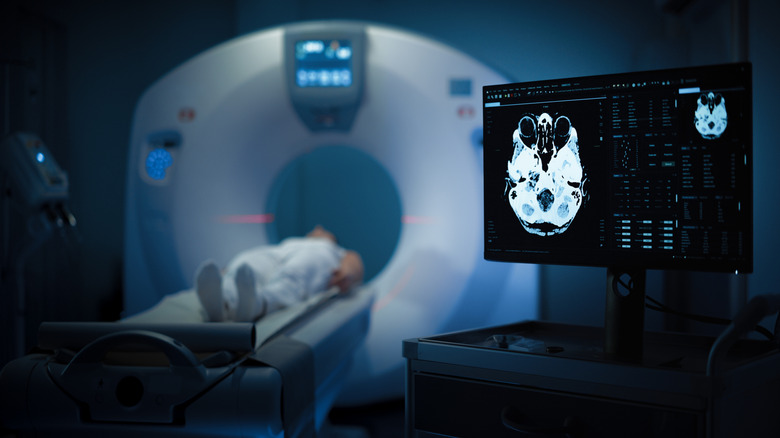
In the UCL-Hannover study, 3D "normal" faces and 3D "hollow" faces were shown to subjects with schizophrenia and to other subjects who did not have schizophrenia (control subjects). The participants lay flat inside an MRI scanner that monitored the responses in their brains. The MRI was fitted with a device that projected one image to a subject's left eye and another image to their right eye. When two images taken at slightly different angles of a human face were projected to both eyes, the subject perceived the image as being 3D, similar to a normal human face. An inverted image (the digital equivalent of a hollow mask) was presented by swapping the images projected so that the left image was shown to the right eye and vice versa.
All 16 of the control subjects fell for the illusion (i.e., they perceived the hollow mask as a normal face) 99% of the time, while the 13 subjects with schizophrenia were fooled by the hollow mask a mere 6% of the time.
The brain MRI results provided a potential explanation. In the control subjects who didn't have schizophrenia, the part of the brain involved in top-down processing and the part of the brain controlling bottom-up processing showed greater connectivity when the subjects viewed the hollow faces. By contrast, subjects with schizophrenia did not show any change in connectivity between the two brain areas. What's happening in these people is kind of the opposite of the bizarre sensory phenomenon that happens when your brain gets bored and starts filling in the blanks with incorrect images or thoughts.
What do these results mean for people with schizophrenia?
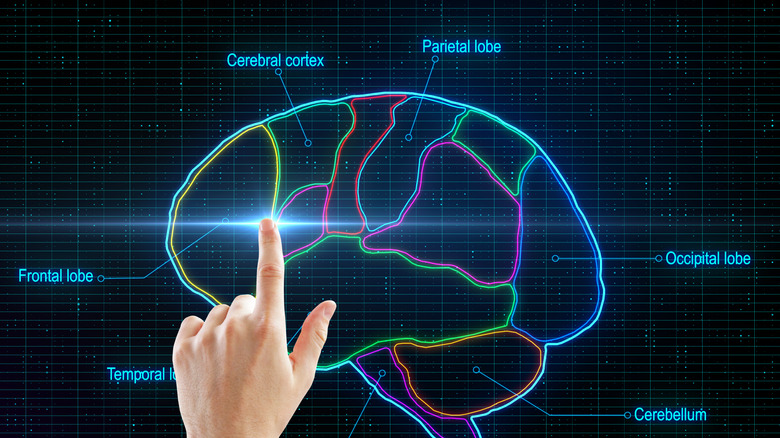
More than a century ago in 1911, Eugen Bleuler came up with the term "schizophrenia" to describe the condition, reflecting the "splitting" of brain areas. Our understanding of schizophrenia has since evolved somewhat and researchers now think that people with schizophrenia have differences in the connectivity between the different brain areas rather than a splitting of these areas per se.
Some researchers think that responses to the hollow-mask illusion reveal a weakened connection between brain processes that produce expectations based on past experiences (top-down) and stimulus-driven processing (bottom-up) in people with schizophrenia. People with schizophrenia may rely less on top-down processes when perceiving objects. In 1989, H.M. Emrich proposed a third process (a "censor") that interacts between the top-down and bottom-up processes and is disrupted in psychosis. This corresponds with the results in the hollow-mask illusion experiments.
Given its striking results, can the hollow-mask illusion be used to diagnose schizophrenia? Although the test isn't recommended by mental health professionals or researchers as a tool for the diagnosis of schizophrenia, it may be useful as an indicator and research instrument.