

The Disgusting Mistake You're Making When Washing Fruit
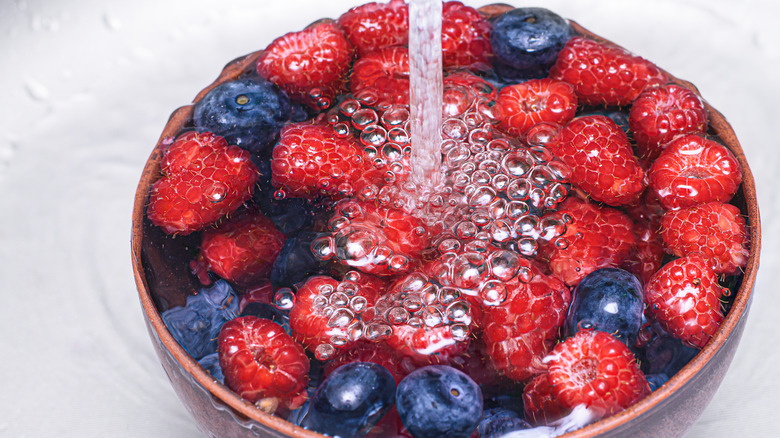
Washing your fruit as soon as you get it home from the grocery store seems like a responsible thing to do, protecting your family from microbes or debris that may be lingering. However, in doing so you may be inadvertently speeding up the rate it spoils, and causing more of the very pathogens that you are trying to prevent.
To clarify, washing fresh fruits and vegetables is absolutely essential, but the timing is crucial. Washing them long before you plan to eat them will cause certain fruits to develop mold as they sit in the fridge in their newly damp state, waiting to be eaten. Berries are a particularly sensitive case, and should only be washed directly before you tuck in to them. The combination of a thin skin and a high water and sugar content is what makes these fruits so irresistible, but it is also the perfect environment for mold to grow.
Reassuringly, the mold that grows on these fruits is not dangerous, even though it will make them significantly less palatable. "Mold on berries won't make you sick, as it's not toxic," says Judy Simon, a registered dietitian. But opening your beautiful pack of blueberries to find them covered in fur is incredibly disheartening, so anything we can do to prevent this travesty is crucial.
Washing certain fruits can remove their in-built protective coating
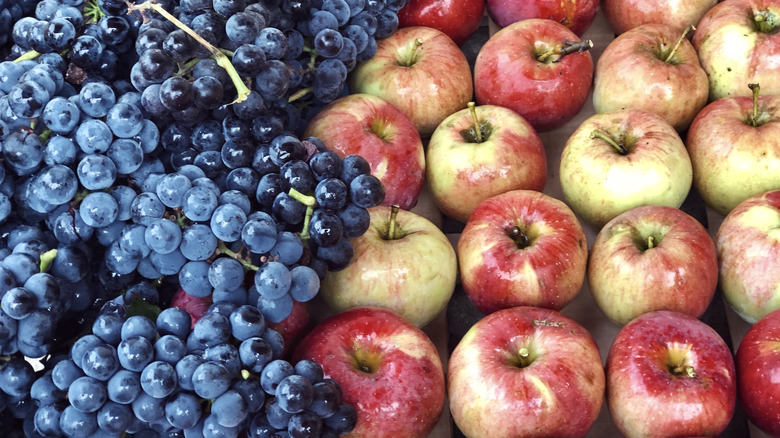
Berries are not the only fruit that benefit from not being washed long in advance. Grapes can give the impression that they are dirty, causing you to wash off the very coating that is protecting them. They often form a "bloom" on the exterior as a protective coating, but as it looks a little like dust, people often deliberately wash it off. This leaves the fruit susceptible to microbes, and more likely to grow fungus than if they hadn't been washed.
Similarly, the waxy exterior of apples essentially has the same function as the bloom, protecting the fruit inside from insects and pathogens. When apples are washed commercially, a replacement wax is often applied to restore the protection since the natural wax has been washed away. Keeping apples in the fridge then washing before eating is the best way to keep the protection in place for as long as possible.
Very delicate stone fruits such as peaches and plums have thin skins and are susceptible to damage, hence the phrase "bruise like a peach." According to Stephanie Smith, a consumer food safety specialist and food science professor, "Soft fruits and vegetables that are likely to be damaged or allow rapid mold growth should be kept dry and washed just before using." For these fruits, sitting in a wet environment for many days increases the chances of them spoiling, and the likelihood of you needing to throw expensive produce in the trash.
How to wash your fruit correctly to avoid making things worse
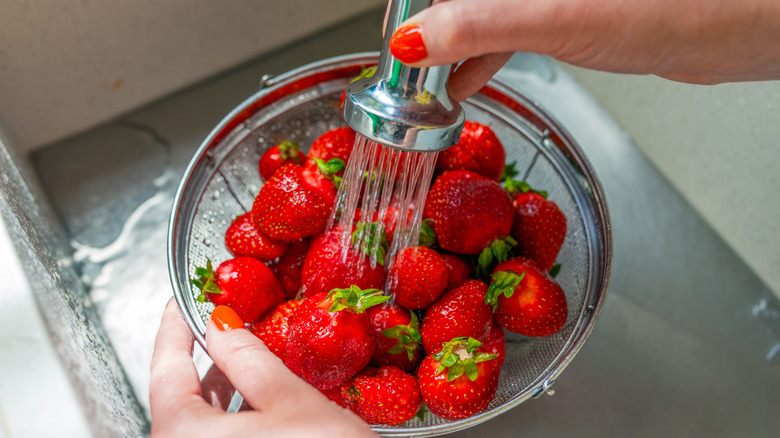
Washing all fresh fruit that you buy is still absolutely the best and safest thing to do, it is just important to do it at the correct time. Ideally, thoroughly wash your fruit immediately before eating it, rather than in advance. Washing berries in a vinegar solution has been shown to be more effective than water alone, rinsing well afterward to remove any lingering acid taste.
If you need to store fruit after washing it, drying it to remove excess moisture is crucial. Store berries with as much space between them as possible, as this will allow them to breathe and reduce the rate of mold growth. If you do notice a small patch of fuzz on fruit, you may wonder whether to eat the unspoiled part, or chuck the whole fruit in the trash. "If you see small mold spots 1 inch in diameter or less in low-moisture fruits and veggies such as cabbage, bell peppers or carrots, you can cut it away and then eat the non-moldy part," says Judy Simon. With berries though, she recommends disposing of any that have visible mold.
Skipping washing fresh produce entirely is not an option, so be sure to always rinse to remove dirt and debris, even if it won't remove all of the pesticide residue. But for the longest shelf life, and to make sure you can enjoy the produce at its best, washing fruits and veggies immediately before serving is the safest option.