

This Naturalist's Troubling 21st-Century Predictions About The Earth Should Make You Pause
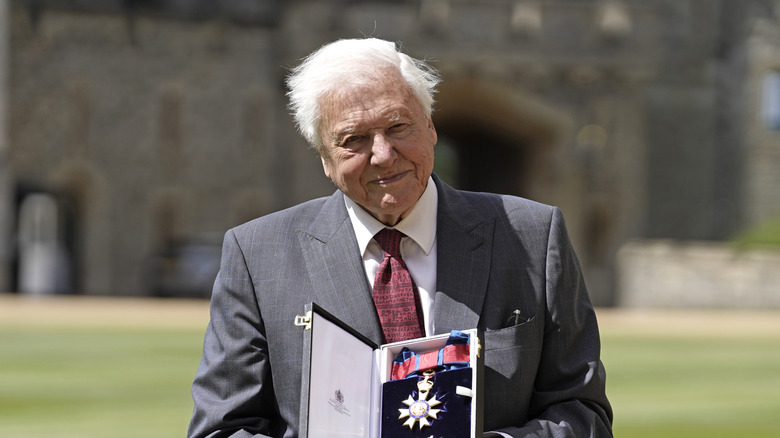
Sir David Attenborough turned 100 years old this past May, and it appears that people all across the world still consider him to be the de facto spokesperson for nature. He's certainly qualified for the job. Attenborough has spent nearly eight decades as a naturalist and broadcaster, promoting a worldwide appreciation of nature. Yet, while much of his early work remained silent on environmental policy, he broke that silence in 2020 with the release of the documentary "David Attenborough: A Life on Our Planet." In it, he describes his vision of the future as the globe continues to warm — and his vision is bleak.
David Attenborough has predicted six consecutive catastrophes that he believes are likely should we continue on our current trajectory: The water cycle will collapse, global warming will accelerate, the warming oceans will become unlivable for marine species, food production will fall, and, finally, the earth will experience a sixth great mass extinction event. It's a doomsday vision that can be hard to swallow, but Attenborough's predictions are based in science more than his personal politics.
If Attenborough's predictions are true, the first calamity will be a massive disruption of the global water cycle due to projected rainforest destruction in the 2030s. When rainforests are cut down and their rivers are dammed for hydroelectric power (bringing about considerable environmental effects), they dry up and turn into savannah-like landscapes where rainwater readily evaporates away. And the process is already underway in the 2020s. In the Amazon, forest fires have increased in frequency and intensity with each passing year. According to Attenborough, at its current rate of deforestation, the Amazon's water cycle will collapse within the next decade. This would cause a disruption of the global water cycle as we enter the 2040s, just in time for global warming to accelerate.
With the ice caps gone, global warming accelerates out of control
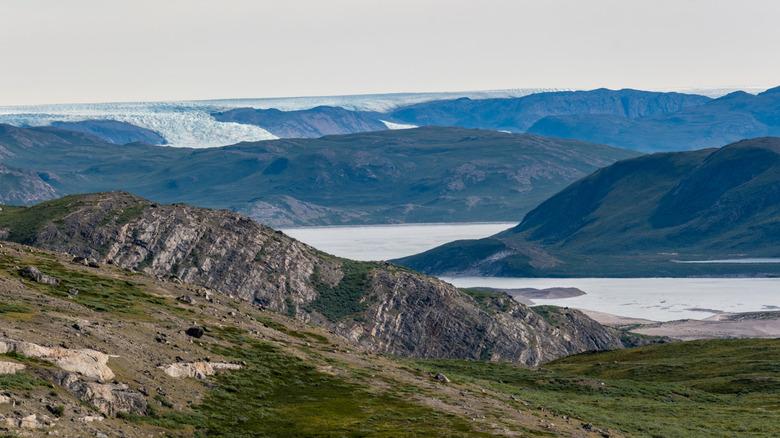
The rate of global warming is already accelerating, but the loss of the ice caps would affect the environment by speeding it up even more. David Attenborough predicts the 2040s will be marked by "ice-free" summers in the Arctic. Without the highly-reflective white cap at the top of our world, more of the sun's energy will be absorbed by the darker-colored land and sea beneath them. This could generate a chain reaction, in which hotter summers in the Arctic melt permafrost, releasing their methane, and accelerating global warming. As a greenhouse gas, methane can be as much as 80 times more potent than carbon dioxide, and there's a lot of it trapped in Arctic circle permafrost.
By the 2050s, Attenborough predicts the oceans will pass their tipping point. Warm water contains less dissolved oxygen, and many species are expected to go extinct rather than adapt to the declining oxygen. Worse yet, much of the extra carbon dioxide in the air dissolves into the oceans and turns into carbonic acid. As a result, the pH of the oceans will drop, bleaching coral reef systems and wiping out the marine species that depend on them.
Attenborough envisions all these factors coming to a head for humans by the end of the century. With the loss of pollinators, soil fertility, and predictable weather, large-scale agriculture will become unsustainable and unproductive around the 2080s. This will lead to a food crisis marked by civil unrest, supply chain disruptions, and widespread hunger. These years may be the beginning of the end and shepherd in the planet's sixth mass extinction event.
Hoping his predictions don't come to pass, Sir David Attenborough urges the world to move away from fossil fuels, rewild and conserve natural ecosystems, and slow population growth. Our survival might depend on it.