

What's At The Deepest Point In Lake Superior?
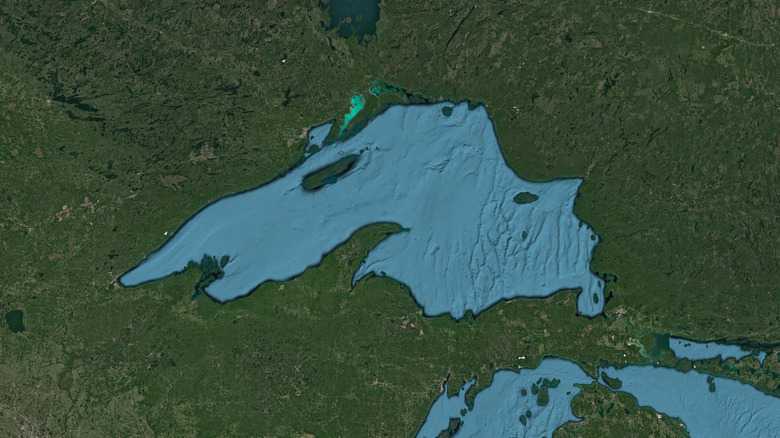
Lake Superior is one of the true geographic marvels of the Americas. It is the world's largest freshwater lake by surface area, by far the largest of the Great Lakes, and, surprisingly, the cleanest lake in America. It is also the third-largest lake in the world by total volume after Siberia's Lake Baikal and East Africa's Lake Tanganyika, and although it's quite a bit shallower than either of those, Lake Superior still boasts some shocking stats. Its average depth is just shy of 500 feet, but its deepest point, known as Superior Maximus, is almost three times that, at a whopping 1,332 feet. That's over 400 feet deeper than the deepest point in the runner-up, Lake Michigan. Naturally, scientists want to know what's down in those depths, and they found out for the first time in 1985.
That year, a submersible piloted by J. Val Klump of the University of Wisconsin-Milwaukee finally reached the bottom of Superior Maximus to take samples of lakebed sediment. The next year, researchers dropped a time capsule into Superior Maximus, with the intent that it should be opened in 2037, the date of Michigan's bicentennial. After that, researchers didn't follow up on the site for four decades. It was only in the summer of 2026 that scientists went back, this time using a robotic submersible. The results of these investigations tell us that not many lifeforms live at the bottom of Superior Maximus, but the few things that do are pretty unique.
Lake Superior's depths are home to a mysterious fish

Researchers liken the bottom of Superior Maximus to the surface of the moon–that's how barren the environment is. The 2026 expedition only captured footage of a few species living down there, as well as, unfortunately, a discarded beer can — proof that humanity's impact on the environment really knows no limits.
Amongst the animals spotted by the robot submersible were a tiny species of crustacean called mysis (Mysis diluviana), which are only about 1–2 centimeters long each. The mysis spend all day hanging around the bottom of the lake, and then rise to shallower depths when night falls to feed on various plankton. They also noted rare bottom-feeding fish like the deepwater sculpin (Myoxocephalus thompsonii) and the burbot, the world's only species of freshwater cod.
Researchers also might have hoped to spot a small silver fish called a kiyi (Coregonus kiyi), which used to live in all the Great Lakes, but is now thought to be endangered, and possibly gone from everywhere save Lake Superior. Kiyi have been caught in fisheries around Lake Superior, but nobody has ever recorded them live in their native habitat, or determined crucial information like when and where they spawn. The kiyi have been threatened by pollution and invasive species in the Great Lakes, and unfortunately, the 2026 expedition didn't lay eyes on any of them. However, separate projects working with indigenous fishers have made strides in tracking kiyi, and they certainly don't appear extinct just yet.
Something weird is happening to trout around Superior Maximus
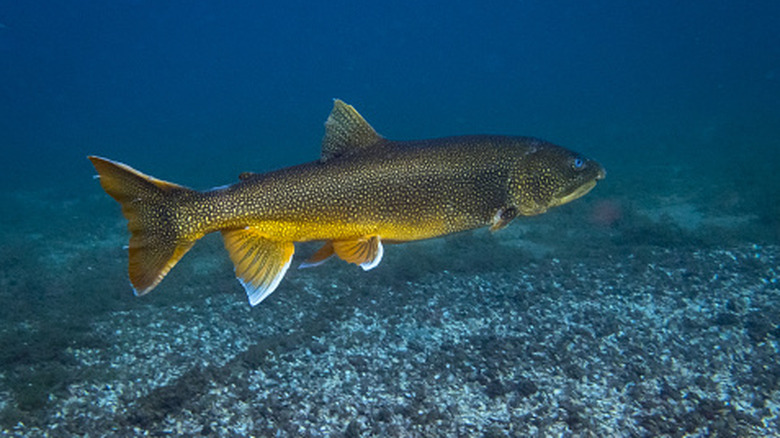
One species found in Lake Superior has been raising alarms amongst scientists over the past decade. The siscowet lake trout are the lake's most abundant predators, and their preferred prey are bottom feeders. Siscowet trout typically stay below 250 feet underwater, and they have been caught at depths exceeding 1,000 feet. Even though they didn't appear at the bottom of Superior Maximus in the most recent survey, they are abundant in the waters above it, and it's no stretch to think that hungry siscowet could venture down there for a meal. Unfortunately, something seems to be harming these fish, and scientists aren't really sure what.
Siscowet trout are typically quite pudgy. It is their ample layer of fat that allows them to survive in the most frigid depths of the lake, and makes them a popular fishing target for their Omega-3 fatty acids. However, since roughly 2015, large numbers of siscowet trout in Lake Superior have been showing up strangely emaciated. They have become known as "zombie trout" for their almost skeletal appearance. Stranger still, the phenomenon seems to be especially strong in the waters around Superior Maximus. The Michigan Department of Resources reports that 54% of siscowet trout caught there in a 2025 survey were so-called zombie trout.
Scientists suspect some kind of famine may underlie the event, but further research will be necessary. That means Superior Maximus could get a much closer look in the near future.