

This American Composer's Brain Is Still Making Music Years After His Death. Here's How (And It's Not AI)

For artists, every page written, scene painted, or song composed can build a legacy, keeping them from sliding into obscurity. These works can influence future generations of creators, and AI can mimic their style, but ultimately death serves as a hard stop for creating new art. However, for one American composer, the grave has not stopped his brain from making music. Using tissue from deceased composer Alvin Lucier, scientists created a brain-like structure that can make new music.
As an experimental composer, Lucier had long sought out new and unusual ways to create music. In 1965, he became the first to produce live music using nothing but brainwaves captured by electrodes attached to his head. He followed this work, "Music for Solo Performer," in 1997 with a piece of music made using ordinary household objects like pencils titled "Opera with Objects."
Lucier died at the age of 90, but not before providing a sample of his blood to a team of artists and scientists that he had been working with since 2018. Their project, known as Revivification, sought to find ways for the composer to create music after his death, something Lucier agreed to because of his long fascination with neural signals. To accomplish their goal, the Revivification team turned to the power of stem cells.
Creating unique music with a miniature brain
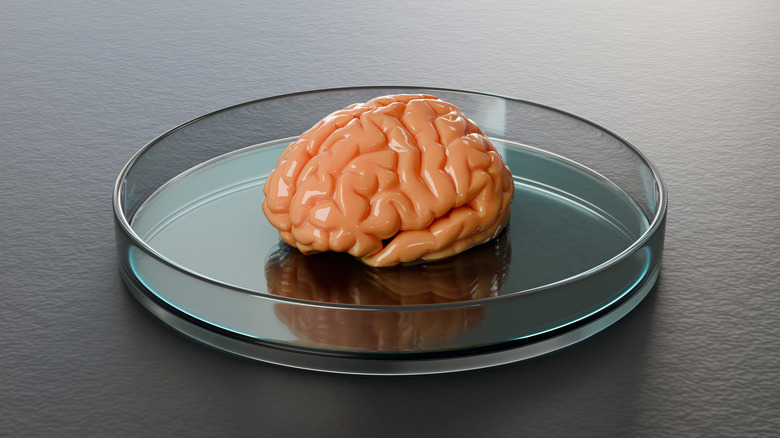
Stem cells are cells found in embryos, placentas, and adult tissues that retain the ability to differentiate into different types of cells. In this case, scientists turned blood cells into induced pluripotent stem cells that they then differentiated into neurons. One area of interest with pluripotent stem cells is the creation of three-dimensional self-organized structures of differentiated cells known as organoids. Organoids essentially act as miniature versions of organs. For instance, a brain organoid would have some of the same anatomical features of a natural brain.
While organoids have found use in drug testing and disease research, the Revivification team wanted to create music. The neurons they created from Lucier's stem cells grew into a miniature brain in a dish. The two blobs of neurons that make up this organoid are the central part of the Revivification project's exhibit, which was displayed to the public at The Art Gallery of Western Australia in Perth. Electrical signals from different layers of neurons pass through the mesh of electrodes the organoid was grown on, then to a computer that processes those signals, and finally sends them to 20 brass plates containing mallets and transducers that surround the gallery. Sounds in the gallery are also picked up by microphones and sent back to the mini-brain. The result is a unique and constantly changing stream of sound.
But is it creative?

While awe-inspiring, the Revivification project has drawn the attention of supporters and skeptics. The Revivification team sees their work as an extension of Lucier's artistic essence. And while the resulting soundscape is unique, skeptics are unsure about whether it can be considered creative work as there is no consciousness or intent behind the sounds being produced.
The project also raises interesting philosophical questions about what constitutes intelligence or creativity. This is especially relevant considering the growth of generative AI and what its output represents. Even if AI can faithfully recreate the work of past artists, can it be considered creative? The Revivification team did not set out to answer these questions, but rather to spur this type of conversation.
Whether the output of this mini-brain can be considered an artistic work is up for debate. However, the Revivification project, with its collaboration between scientists, artists, and Lucier himself, could be considered an act of creativity. Art can in some sense immortalize artists, but AI and the Revivification project pose some interesting questions about what human consciousness actually means and whether an artist can continue creating beyond the grave.