

California's Strangest Animal Has Up To 27,000 Teeth And Numbing Slime
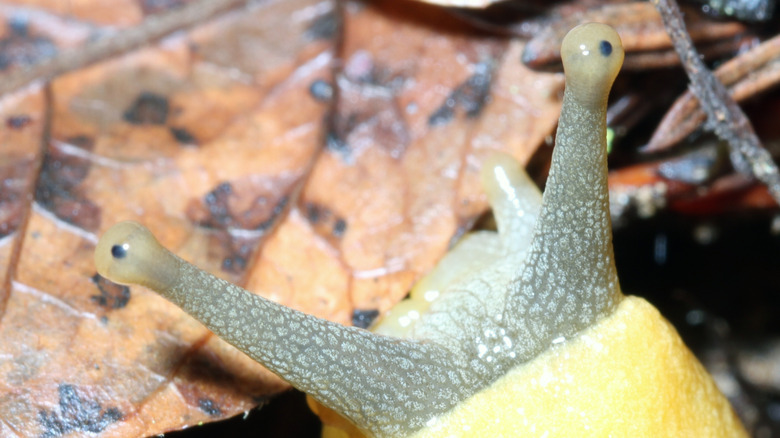
Scientists have estimated that there are more than 8 million species on Earth. Among them, researchers have discovered some of the strangest deep sea creatures ever (like the goblin shark) and the strangest organisms you can only see with a microscope (like the tardigrade). What about some of the strangest animals the human eye can see on land, though? In California, that honor goes to a mollusk that can have up to 27,000 teeth: the banana slug.
There are actually three species of banana slug (Ariolimax). The California banana slug (A. californicus) and slender banana slug (A. dolichophallus) have (so far) only been found in California, while the Pacific banana slug (A. columbianus) has a wider range extending north into Oregon, Washington state, and British Columbia. Officially named the state slug in 2024, these mollusks are vital to the ecosystem. However, one of the coolest things about them is their abundance of teeth, which are calcium-rich denticles.
Banana slugs can grow up to 10 inches long and have up to 27,000 microscopic denticles on their radulas, the ribbon-like, flexible membrane in their mouths. According to a study published in PLOS One, the tooth-like structures are tightly interlocked with each other in rows and have a different aspect ratio, length, and inclination depending on where they are positioned. You would think that a creature with so many teeth would use them for a predatory purpose. Since they're curved one way, though, banana slug denticles basically file or grind down decaying vegetation, fungi, and plants as they eat.
Banana slugs produce numbing slime that has multiple applications
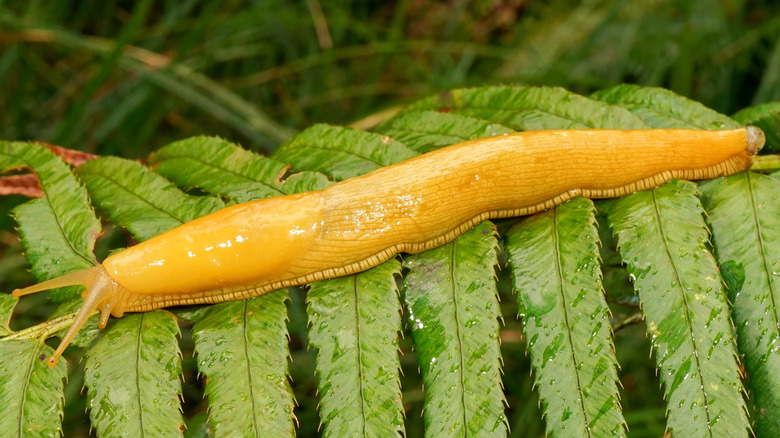
While having tens of thousands of denticles is a super intriguing fact about banana slugs, these mollusks have other interesting characteristics. Some examples include having two sets of retractable tentacles and spending hours in the act of mating before actually exchanging sperm. Even more fascinating is that its mucus or slime provides multiple advantages.
Like with slugs in general, banana slug slime isn't liquid or solid. It's categorized as a liquid crystal instead because the molecules are neither too compact or dispersed. On top of that, the molecules are arranged in a pattern that resembles a crystal, which helps the mucus hold together. It comes out as dry mucin granules, which expand hundreds of times over in volume when they come into contact with water. That's why mucus works so well to keep the mollusks moist and to make the ground underneath them smoother to move across. Perhaps the coolest part, though, is that it has unique anesthetic properties.
You see, banana slugs move at a maximum of 6.5 inches per minute (32.5 feet per hour). Since they're prey for small mammals, salamanders, and snakes, they can't exactly perform avoidance maneuvers. Instead, their slime contains chemicals that act as a numbing agent when the predators touch it, even if the predators only touch the trail that the slugs leave behind. The mucus can make the tongue and throat go numb as well, deterring the predators from chewing or swallowing completely. Fortunately, you don't have to worry about that when making edible slime with home recipes.