

Scientists Dug Up 66 Million-Year-Old Fossilized Dinosaur Poop And Found Something They Never Expected
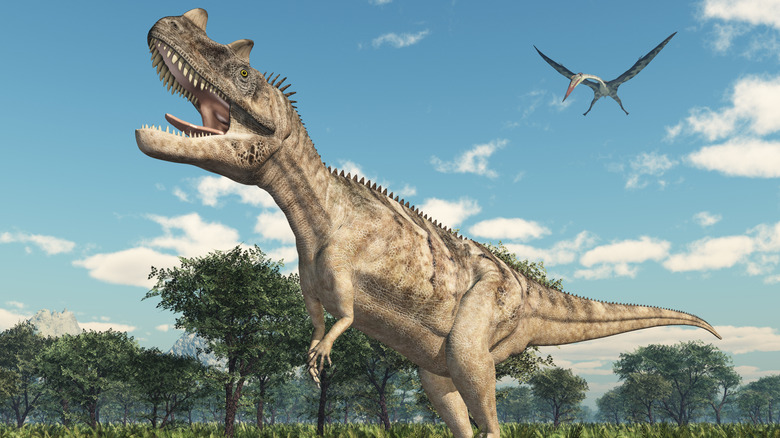
The Hell Creek Formation is a vast stretch of rock formations in northeastern Montana known for being arguably the best place to find fossils in the United States. Today, after decades of research in the region, scientists are still uncovering unexpected things. In 2016, paleontologist David DeMar stooped down to pick up what looked like a small rock, but he had no idea that he was holding a piece of fossilized dinosaur poop, and when he turned it over, he got quite the surprise. Embedded in the dark mass was a small feather, seemingly identical to the birds of today.
By now it is well known that the major mass extinction event that killed off Tyrannosaurus rex and the like did not take out all of the dinosaurs. A group of flying dinosaurs called Neornithes survived, and gave rise to all of the modern birds we know today, from the ostrich to the pigeon. These likely arose sometime in the mid-Cretaceous period, meaning they emerged alongside iconic dinosaurs like T. rex and Triceratops. This was also the last of the three periods in which the dinosaurs lived, meaning birds got here just in time to see all their fellow dinos wiped out.
Researchers say the fossilized feather from Hell Creek is the best preserved dinosaur feather discovered to date. In a paper published in Current Biology, they present the story of a remarkable bird, all thanks to a little poop.
What the poop knows
Fossilized poop is technically known as coprolite. Coprolites are one of the most prominent examples of trace fossils, meaning fossils that don't come from actual animal body parts, like poop and footprints. However, coprolites often contain non-trace fossils — actual pieces of the plants and animals eaten by the pooper. This makes each coprolite a treasure trove of artifacts from multiple species at once.
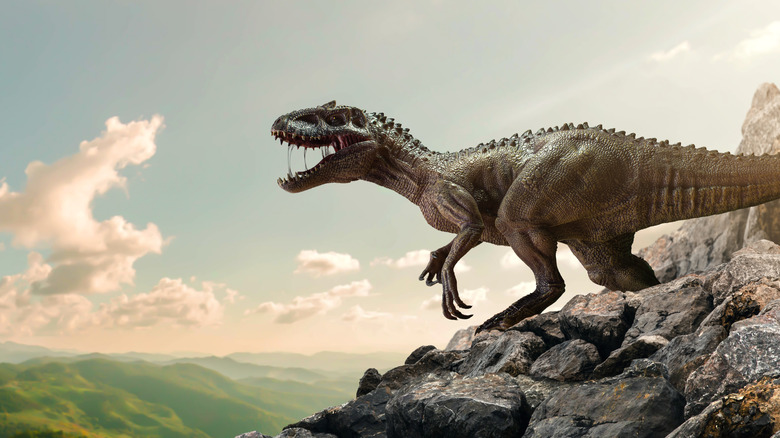
The coprolite found at Hell Creek actually broke off of a much larger hunk of poop that probably came from a large theropod, perhaps even T. rex itself. Evidently, this big dino ate a bird, but not a bird like the ones we know today. When researchers took a closer look with a CT scan, they discovered other, smaller feathers embedded in the coprolite. They also found fish scales, suggesting the bird had enjoyed a meal of its own not long before.
This and the location of the fossil all line up with the description of an extinct line of flightless waterfowl called Hesperornithiformes, which did not survive the asteroid collision that wiped out the other dinosaurs. Scientists have long wondered how Neornithes survived the great extinction while Hesperornithiformes and other ancient birds did not. The feather embedded in this precious piece of poop may hold the answer.
Why only some birds survived mass extinction
While the largest feather in the Hell Creek coprolite looked nearly identical to a modern bird's, the CT scan found other feathers that looked different. They were much smaller and barely fuzzy, suggesting that the bird they came from possessed very poor insulation. The Cretaceous period saw hotter average global temperatures than the present, with the poles estimated to be around 60 degrees Fahrenheit at the time. A warmer planet meant there was no urgent need for thicker feathers, but the good times for Hesperornithiformes wouldn't last.
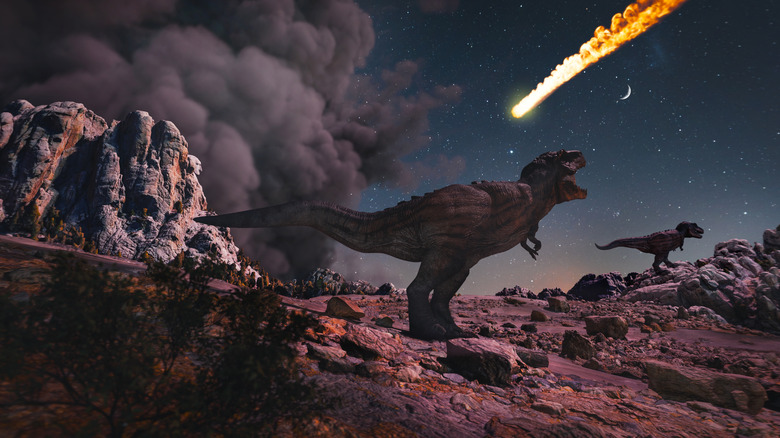
When the asteroid crashed into Earth, it not only decimated its surroundings with the force of ten billion atomic bombs, it also blasted billions of tons of aerosols and gas into the air. This cast clouds around the entire planet that completely blocked out the sun. It is believed that photosynthesis halted on Earth for a full two years. Needless to say, it was cold during this time. The Neornithes were fortunate enough to have evolved denser feathers, and thus were able to weather the harsh conditions, but Hesperornithiformes and other birds were not, perishing with the rest of their dinosaur brethren.