

Scientists Hypothesize The Mystery Behind Why People See Faces On Everyday Objects
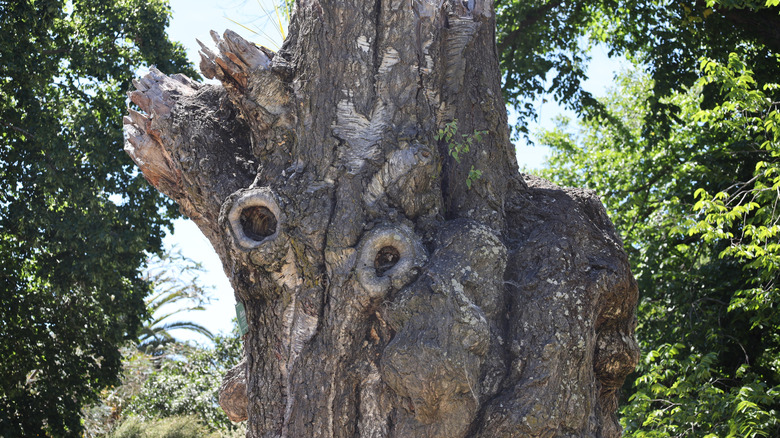
You look into the clouds and see a face winking at you. You reach into a bag of potato chips and see a pair of eyes and a smile. You're driving down the highway and see the facial figures of a giant humanoid in the rocks. If you've ever had an encounter like one of these, then you've experienced what's scientifically known as face pareidolia. Scientists don't know exactly why it happens, but it's theorized that the visual centers in our brains may be pre-programmed to see faces.
The word pareidolia is a broader term for the tendency to see meaningful objects in images where they don't exist. It comes from the ancient Greek words "para," meaning beside, and "eídōlon," meaning image or shape. We may see faces, animals, household objects, or almost anything else we recognize in places like trees, clouds, or even a mound of industrial equipment. Illusion makers often take advantage of our psychological predisposition by purposefully creating images that can be interpreted in multiple ways.
Authors of a 2025 study published in Computational Biology sought to explore the phenomenon of pareidolia by comparing the processing of an AI model to human processing when examining images with patterns that resembled human faces. The researchers found that a network trained on both facial identification and object categorization showed a more human response than models trained on facial identification or object categorization alone. The researchers hypothesized that the results of their study may suggest that face pareidolia could be a natural consequence of learning to identify individual faces and to categorize a wide range of objects.
Theories about why we see faces in inanimate objects
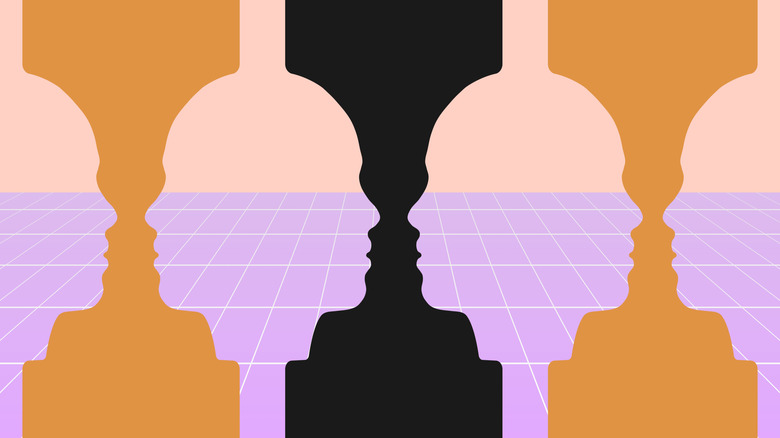
Gestalt theory is a school of psychology in which it's believed that humans perceive images in organized patterns rather than in their individual parts. Principles of Gestalt theory are often used by artists and designers. For example, leaving parts of letters or numbers incomplete, knowing our brain will fill in the gaps. From a psychological standpoint, pareidolia may intersect with Gestalt theory since it may result from the brain's tendency to find patterns and meaningful interpretation.
Although more research is needed to fully understand pareidolia, we know that it happens quickly. Research suggests that the initial neurological response in our brain may occur in under 100 milliseconds. This is literally faster than a blink of an eye, which usually lasts 100–400 milliseconds.
Each person's brain processes information differently. This is obvious when looking at illusions where you might be able to see a hidden image but your friend can't. Individual differences likely come from a combination of our genetics and environmental factors. Previous research suggests that people with more religious or paranormal beliefs may be more likely to experience facial pareidolia, although evidence is based on one small study. In a study published in 2026, researchers found evidence that Chinese and British adults who currently had an imaginary friend were more likely to experience face pareidolia.
Factors that may influence face pareidolia
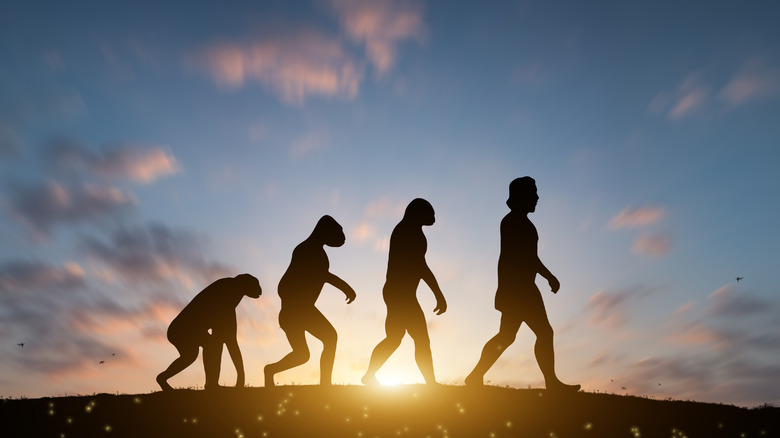
Not all traits seen in modern humans necessarily offered an evolutionary advantage throughout history. Sometimes, traits evolve secondary to other processes that do offer some benefit. It's unlikely that face pareidolia directly influences survival, but likely developed as a byproduct of our affinity for recognizing faces.
Recreating faces in images falls into a grab bag of common phenomena rooted in Gestalt principles that don't have a full scientific explanation, like deja vu. However, we might not be the only animals that experience face pareidolia. Previous research suggests rhesus monkeys also experience a similar phenomenon as humans when shown images resembling monkey faces.
Humans are social animals, and recognizing faces is an important part of maintaining a social structure. Imagine the problems that could potentially arise if a mother couldn't recognize her baby or if you couldn't recognize family members from strangers. Face pareidolia, and other visual phenomena like the Troxler effect from staring in a mirror too long involve a complex interplay of many parts of our brain that scientists are still researching.