

The Deadly Chain Reaction Hippo Poop Can Trigger In Rivers
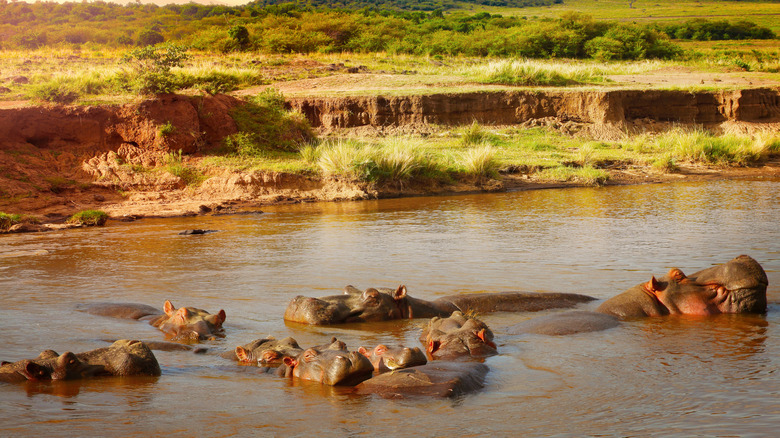
Indigenous to sub-Sahara Africa, hippopotamuses are known for their aggressive nature and enormous teeth. Combined with their enormous size — up to 5.2 feet tall, 16.5 feet long, and 4.5 tons — it's no surprise that they're also one of the world's animals with the strongest bite force. Scientists are still adding to the facts known about hippos, including a study that found their poop, not other pollution, responsible for a fish massacre in the Mara River.
It's well-known that pollution from agriculture and sewage can deplete oxygen from rivers, resulting in the fish suffocating. In a study published in Nature Communications, researchers discovered that hippo poop works similarly. That's because the average hippo can excrete about 38 pounds per day. When you consider that hippos are social animals that live in herds of 40 to 200 individuals, that's a massive amount of feces, and about half of it ends up in Mara River pools. With over 4,000 hippos calling Kenya's Maasai Mara National Reserve home, the researchers estimate that they excrete nearly 9.4 tons into the river every day.
The decomposition of the partially digested plant material in the poop depletes the water's oxygen, while microbial activity releases ammonium, sulfide, and other chemicals. When heavy rain periodically sends the pooled water downstream, the rush of deoxygenated water causes temporary hypoxia (low levels of dissolved oxygen) that can lead to the aquatic life dying. The microbial-produced chemicals make the situation worse because they're toxic to fish.
The hippo poop may kill fish in the Mara River, but it benefits the local ecosystem
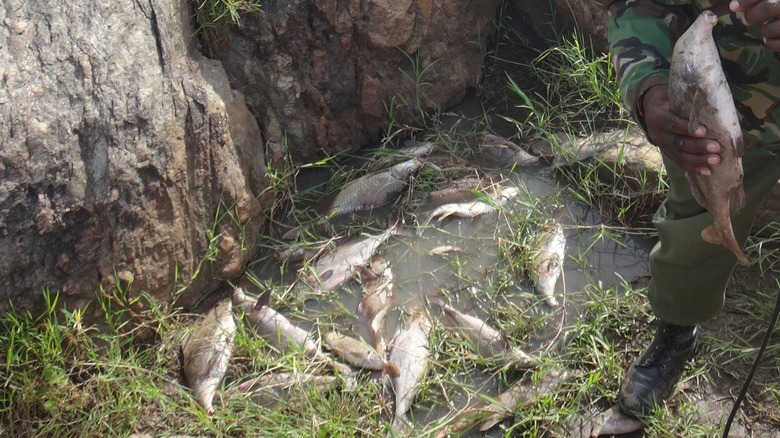
During the three-year study along the Mara River, the researchers recorded 55 rain events that created twice the normal river flows from 171 hippo pools, each of which are a little bigger than a swimming pool. The dissolved oxygen concentrations crashed for eight to 12 hours during 49 events. Of those, 13 events showed hypoxic levels, which resulted in fish kills. While these flushing flows significantly impact aquatic life, there's a silver lining that provides a better understanding of the area's ecosystem.
As the authors explain, scientists are used to studying pristine rivers that aren't exposed to periods of dissolved oxygen because they don't support large populations of wildlife on the same scale as the Maasai Mara National Reserve and Mara River. In this case, flushing flows are essential for cleaning hippo pools of waste. The byproduct of fish kills may not be good for the fish, but it's good for the birds, crocodiles, and other scavengers who feed off of them over the following day or two. At the same time, the flushing sends other nutrients into the ecosystem that other wildlife need to flourish.
Yale University postdoctoral associate and lead study author Christopher Dutton told YaleNews, "This appears to be a natural process that may have been more common in Sub-Saharan African rivers prior to the extirpation of hippos from much of their historical range." What scientists can see at Mara River is a window into how ecosystems potentially functioned before they were impacted by human activity.