

You'll Only Find These Organs On The Left Side Of Your Body
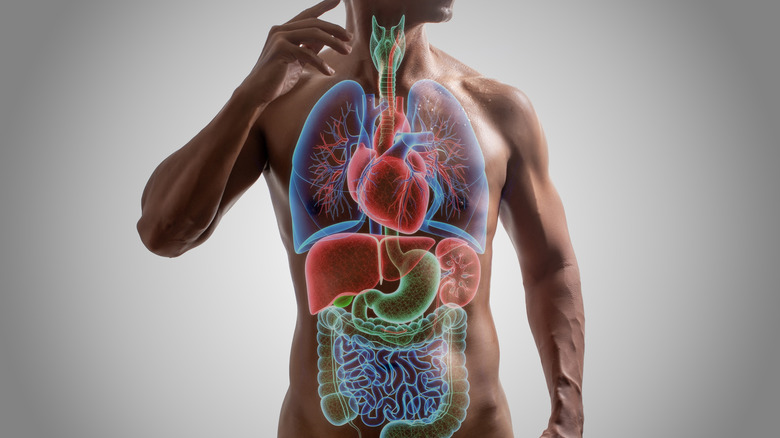
Looking at the human body from the outside, it is mostly symmetrical down the middle, so it would be a fair assumption that the same would be the case under the skin. However, the internal body is not quite as uniform, and there are some organs that are found mainly, or entirely on the left side of the body. Some organs appear in matching pairs, with one on each side that performs pretty much the same function. Lungs, kidneys, and reproductive organs fall into this category, where the left and right side work in tandem.
Other organs, however, have a particular function on each side, and the brain is a famous example of this. The brain has two hemispheres which look similar from the outside, but they differ in the way they work. A long-held belief suggests that most people are left-brained or right-brained, depending on whether they favor logical or creative output, but this has been found not to be true. What does seem to be the case is that both sides of the brain work together on tasks, but the left hemisphere specializes in the processing of language and phonics, as well as some aspects of mathematical processes.
Surprisingly, the left side of the brain is also responsible for controlling and sensing stimuli from the right side of the body, rather than the left. This crossing of sides is a reflection of the cooperation between the left and right of the body, and the same is true of several other organs located toward the left.
The heart and stomach sit mostly on the left
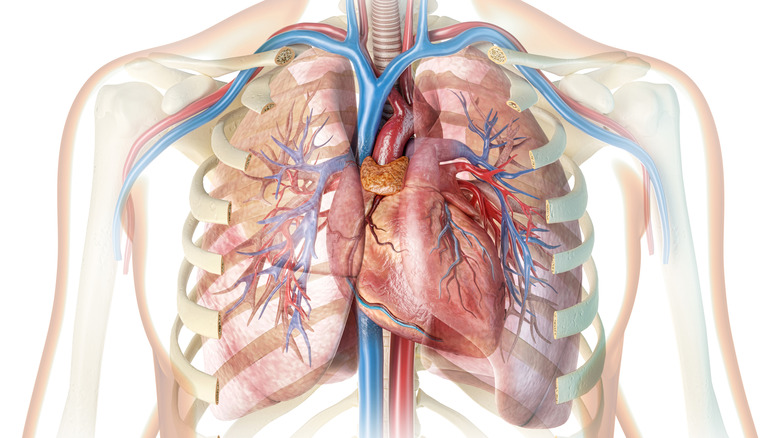
One of the organs that is famous for being located on the left is the heart, though it could more accurately be described as left-of-center. It sits behind the ribcage and sternum, between the lungs, and approximately two-thirds of it is positioned to the left. The reason the heart is slightly off-center is connected to how it functions.
The heart is split into four chambers, two at the top and two at the bottom. The bottom left chamber, the left ventricle, is larger than the right due to its function of pumping blood for the entire body. In contrast, the right ventricle only needs to pump blood to the lungs, so it can be smaller. This difference in size is the reason for the asymmetrical shape, and why your heartbeat may feel stronger on that side of your chest.
Moving down the left side of your body from the heart, you will find the stomach. It is connected to the esophagus above and the small intestine below, and is a crucial stop in the digestion journey of your food. It can change position when it fills, and is capable of holding more than 75 times its empty volume if you decide to challenge it with a particularly large feast. The stomach holds and digests food in preparation for it making its way to the small intestine to be broken down further. Like the heart, the stomach is not located entirely on the left side of the body, as its curved shape carries it toward the midline, but the majority of the organ sits on that side.
The spleen and descending colon are wholly on the right
One of the organs that sits entirely on the left of your body is the spleen. This lesser-known organ is found behind the left rib cage, and it has a crucial function to play in the immune system. While you can technically live without it, and in rare cases it can be absent at birth, it plays an important role in filtering blood and fighting infection. In the absence of a healthy spleen, much of this task will fall to the liver and bone marrow instead.
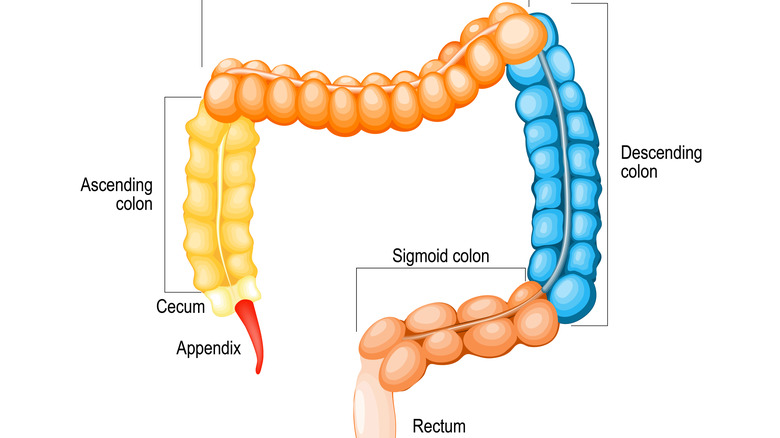
Continuing down the left side of the abdomen will take you to part of the large intestine, known as the descending colon. As the name suggests, it travels down the body, and it carries waste that will become stool down toward the rectum, though it must travel through the last part of the intestine, the sigmoid colon, first. By the time food reaches the descending colon, it is thoroughly digested, and water and electrolytes are removed as it finishes its journey, making the waste more solid as it prepares to be eliminated from the body.
Unlike the stomach and heart which cross the midline, the descending colon is squarely on the left of the abdomen, with no symmetrical equivalent on the right. The arrangement of the organs show that even though the human body is relatively symmetrical from the outside, the inside tells a different story.