

Scientists Just Discovered The First New Cat Species In Over 100 Years

When it comes to cats, looks can be deceiving. The snow leopard, for instance, can weigh 60 to 120 pounds, but this big cat isn't as dangerous as you might expect. Meanwhile, the African black-footed cat (Felis nigripes) is the deadliest cat in the world and smaller than you think but weighs just 2.2 to 5.5 pounds. A deceptively similar appearance, on the other hand, can be why new species (of all kinds of animals) are sometimes overlooked. That's what happened with Leopardus tilcayo. Initially mistaken for a domestic breed, it's the first novel wild cat species identified in more than a century.
The story starts when a man found and took home a kitten that he found on a road near the Yungas cloud forest in Bolivia. A year later, it was clear that what he thought was domestic was actually wild. That's when, in 2017, the man took it to the Senda Verde Animal Refuge, which contacted National Geographic explorer and biologist Paola Nogales-Ascarrunz. Intrigued, she visited the feline and took a lot of pictures. It wasn't until 2019, while comparing the images to reference photos of the species Leopardus tigrinus, that she realized the cat wasn't what she thought.
Working with a team a few years later, Nogales-Ascarrunz was able to investigate the unknown cat's genome, and they published the findings in Current Biology earlier this month. The analysis of dozens of genus Leopardus genomes show that L. tilcayo is actually a tiger cat species that diverged about 1.4 million years ago — similar to the divergence of the modern lion from the now extinct cave lion.
What scientists have observed about Leopardus tilcayo so far
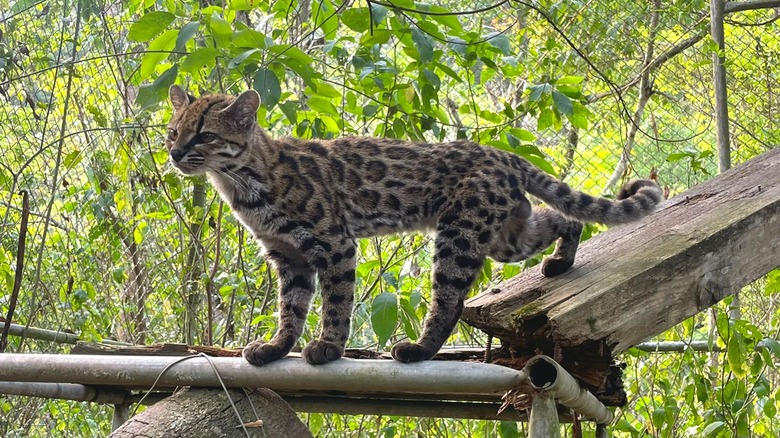
Locals of the Bolivian Yungas region have already been calling the new cat species "tilcayo," which doesn't have a particular meaning but is the basis for the scientific distinction. Although the discovered male is 10 years old now, scientists don't know much about the feline beyond its genome and physical characteristics. They describe it in Current Biology as growing to about 16.7 to 19.9 inches in body length with a tail that extends between 9.8 and 10.4 inches. By comparison, the Maine Coon is the largest domestic cat breed and can reach a staggering size of around 40 inches total (males are often heavier, as well).
The tilcayo's fur is light brown, with the lower part of the body toward the limbs being lighter than the ridge on the mid-back. With that as a background, the feline is distinguished with large, non-coalescent rosettes that are dark brown, irregular, and mostly open. The pattern isn't as contrasted, regular, or open as L. pardinoides, nor is the tail as bushy. Compared to L. tigrinus, the flank markings are bigger and more irregular, while the tail is fuller and longer. The markings are also less contrasted on the back, more diverse, and bigger than L. guttulus, while the tail is longer.
Although scientists don't know about the tilcayo's prey, predators, reproduction habits, and other aspects of their daily lives (yet), the discovery itself is amazing. The last cat species discovered was the pampas in 1923, but the genomic analyses that identified L. tilcayo could be used to recognize existing subspecies as species of their own and to identify new species in the future.