

The 16 Coolest Images From NASA's James Webb Space Telescope
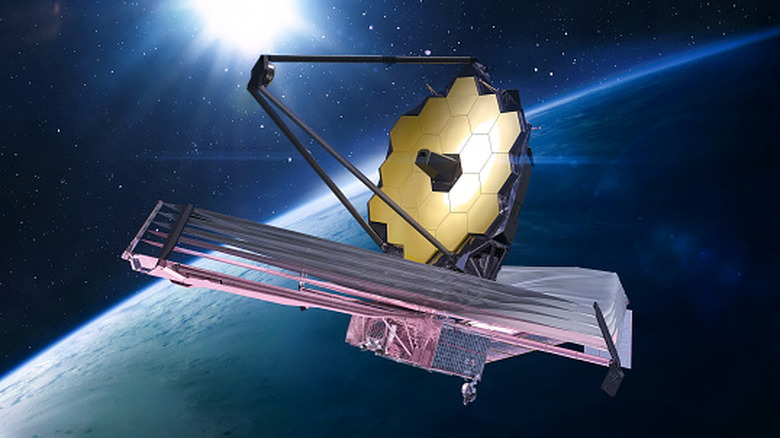
Capturing images of the cosmos is one way NASA scientists explore to better understand the universe. Since the launch of the James Webb Space Telescope (JWST) in December 2021, the agency has been able to make new discoveries and substantiate the presence of suspected phenomena. It caught stunning aurora glows while studying Neptune in 2023 and made observations the following year that led scientists to finally confirm the existence of a runaway supermassive black hole. Meanwhile, it has taken some of the coolest pictures of space.
NASA refers to the JWST as "the premier observatory of the next decade," and thousands of astronomers around the world can apply for time and funding to use it for specific or urgent studies. Like amazing views of the Pillars of Creation, Ring Nebula, Sombrero Galaxy, and Uranus, the observing programs have resulted in some of the coolest images ever captured. Sciencing has featured these and many others in this list and encourages a good stare. Perhaps secondary objects will pop out to you.
Pillars of Creation
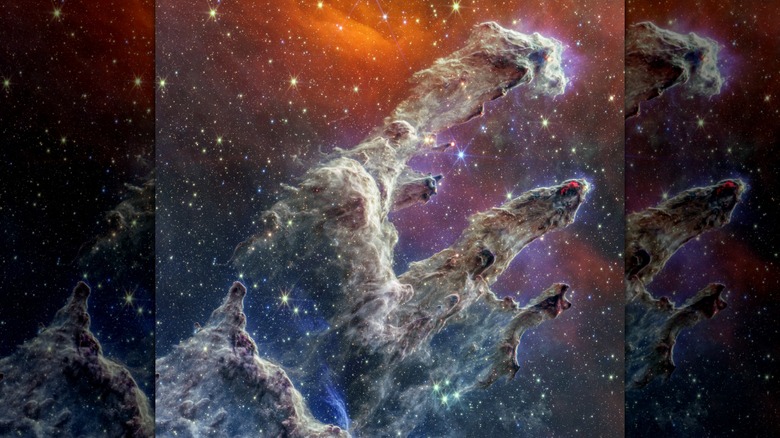
At the heart of the Eagle Nebula (M16), the Pillars of Creation are a group of wispy columns made of cosmic gases and dust that span for 4 to 5 light-years. They're about 7,000 light-years from Earth, but this image is spectacularly clear. It's actually the combination of two images captured with the JWST's near-infrared camera (NIRCam) and mid-infrared instrument (MIRI). Since it looks as though the tendrils are flowing through space, it's reminiscent of the black smoke trails left by flying Death Eaters in the Harry Potter films — with different coloration, of course.
Helix Nebula
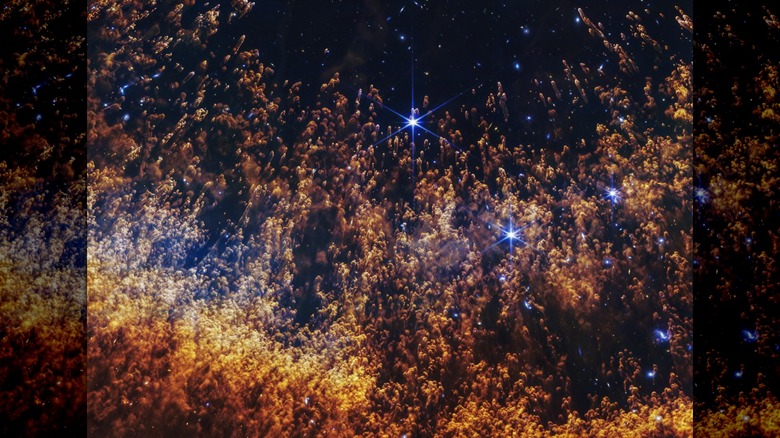
In the Aquarius constellation about 650 light-years from Earth, the Helix Nebula (Caldwell 63) is a huge planetary nebula with a bright ring that spans almost 3 light-years across. Such nebulae are the result of a medium-mass star dying and shedding layers of dust and gas that extend beyond the center. This image from the JWST's NIRCam provides a close-up of the shell around the remaining white dwarf (the stellar core of a dead star), showing the transition between the hottest and coolest gases as they expand. With a little imagination, it looks like bubbling soda pop.
Ring Nebula
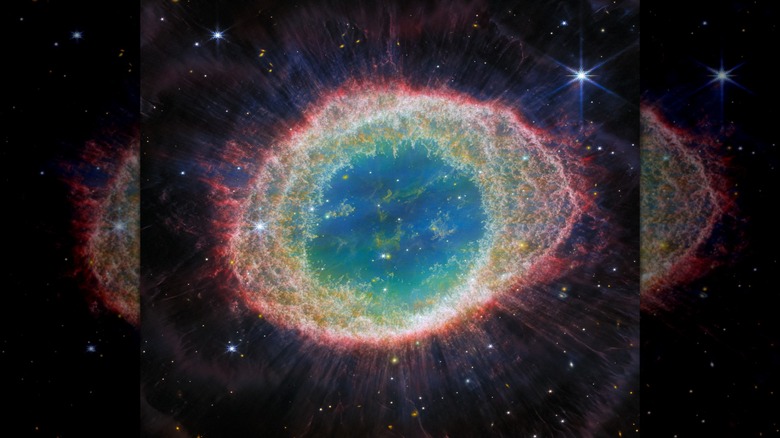
About 2,000 light-years from Earth and located in Lyra — a constellation that's visible seasonally (in summer) — the Ring Nebula (Messier 57) features a blue helium center, a green hydrogen and oxygen inner ring, and a red nitrogen and sulfur outer ring. In this stunning image captured by the JWST's NIRCam, you can see even more details of the inner ring, specifically thousands of hydrogen-rich globules. You can also make out the glowing hydrogen arcs emanating outward. Together, all of these characteristics kind of make the nebula look like an ocean-filled, all-seeing eye with a radiating aura.
Sombrero Galaxy
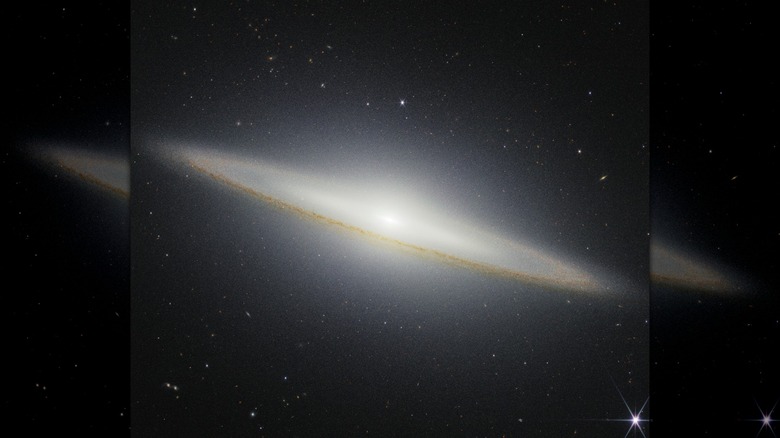
The Sombrero Galaxy (Messier 104) is a spiral galaxy, which is a rotating disc with a dense spiral bulge in the middle, seen at a nearly complete edge-on (side) view. Located about 28 million light-years away in the Virgo constellation, it has a uniquely brilliant white core surrounded by thick lanes of dust where stars form. You can see both of these features well in this image taken with the JWST's NIRCam, with the bright center shining so bright that you can't distinguish its nearly 2,000 globular clusters (thousands of old stars bunched together with gravity).
Rho Ophiuchi
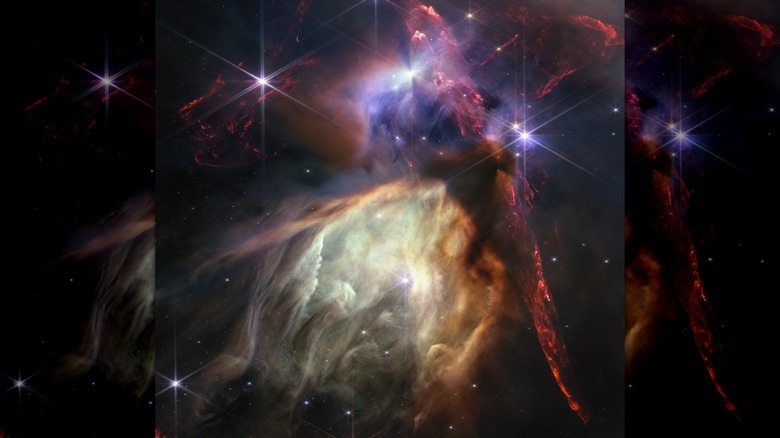
The Rho Ophiuchi cloud complex is a star-forming region about 390 light-years away, making it the closest one to Earth. Contrary to what this JWST NIRCam image depicts, it's relatively small and not very active. What you see in red is the impact of exploding hydrogen jets from about 50 young stars, creating a striking design around the darkest, densest areas of thick dust. Just south of the center, star S1 shines through a cloud of lighter-colored polycyclic aromatic hydrocarbons (PAHs, which are common carbon-based molecules in space), as if it's illuminating the inside of a dusty cave.
Herbig-Haro 46/47
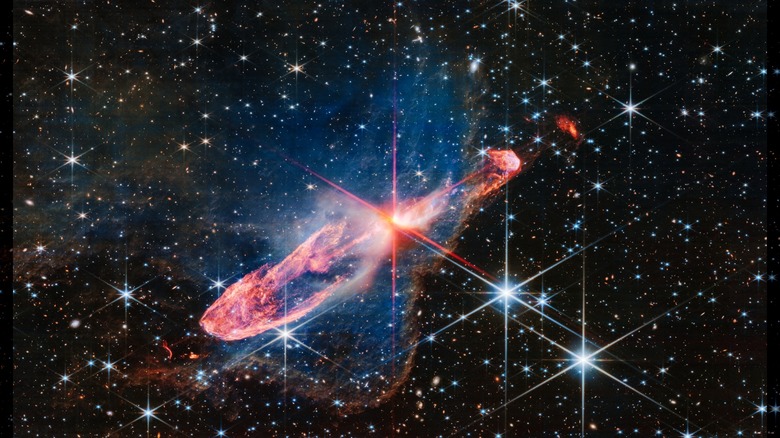
Despite being mysterious bright patches in space, Herbig-Haro (HH) objects form when partially ionized gas jets from newborn stars clash with clouds of dust and gas. This image of Herbig-Haro 46/47 was taken with JWST's NIRCam, capturing the pair of tightly bound, actively forming stars. Only a few thousand years old, the stars appear as orange and white spots at the center of the red and pink diffraction spikes (streaks of spreading waves of light). The cloud mass that you see around them is a disk of dust and gas the stars will eventually consume, leaving nothing else behind.
Uranus close-up
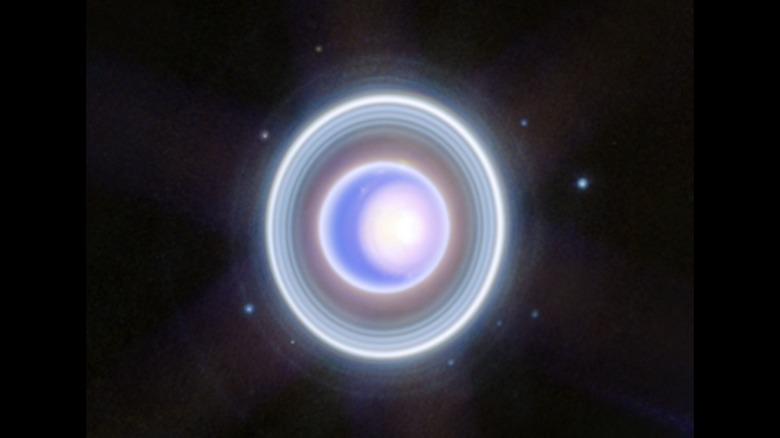
The smelly truth about Uranus is that the cloud deck in its atmosphere consists of hydrogen sulfide, one of the gases that mean the difference between smelly and odorless farts. Fortunately, you can't smell it in this composite of multiple images — all taken with the JWST's NIRCam. It provides amazing detail of the planet's bright white cap in the center, seasonal north polar cap, and rings. You can even see the Zeta ring, the closest and faintest inner ring that's hard to detect. On top of that, nine of Uranus' moons are visible as blue dots around it.
Interacting Galaxies Arp 142
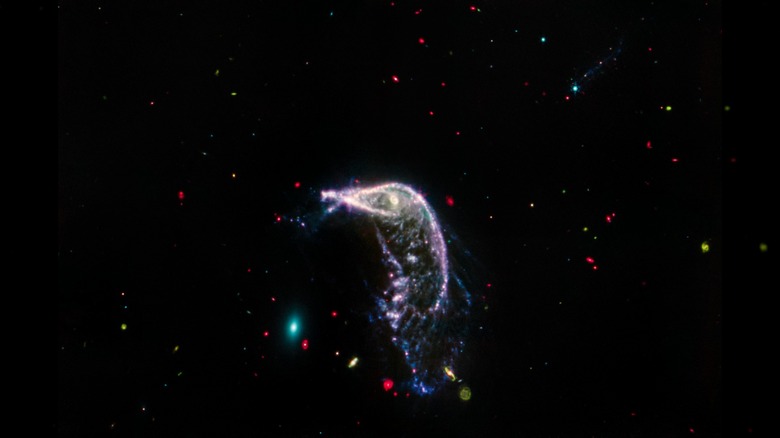
Referred to as the Penguin and the Egg, Arp 142 is a pair of interacting galaxies (NGC 2936 and NGC 2937) located in the Hydra constellation. They're about 326 million light-years from our planet but only 100,000 light-years from each other. This composite image of multiple exposures was taken with the JWST's MIRI. The vivid view shows off the distorted and stretched dust, gas, and PAHs that create the large Penguin shape (some may see a shrimp) in the middle. In front of it, you'll see an exceptionally bright and hazy teal oval, which is the Egg.
Galaxies IC 2163 and NGC 2207
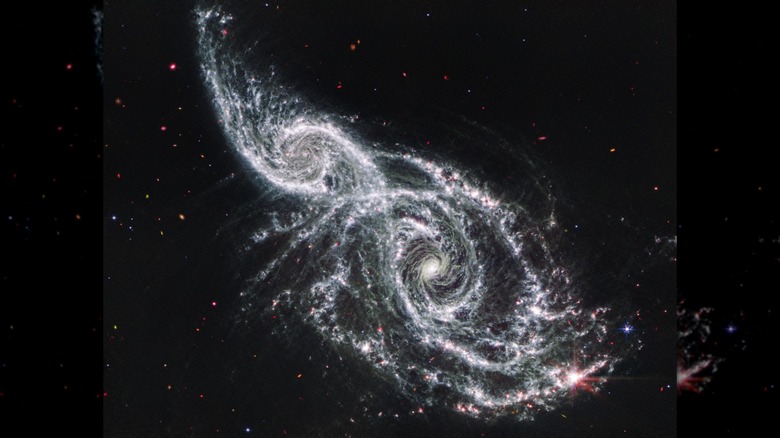
Closer to Earth at 114 million light-years away, IC 2163 (the smaller galaxy on the left) and NGC 2207 (the larger galaxy on the right) are a pair of entwined spiral galaxies. NGC 2207 exerts a gravitational pull on its counterpart. In this icy-looking image captured with the JWST's MIRI, you can see the spiral arms twisting through each other. It's like peering into side-by-side, swirling hurricanes from satellites in space, creating an eerie feeling of eyes at the galaxies' centers staring up at you. In the bottom right corner are diffraction spikes from forming stars.
Pismis 24
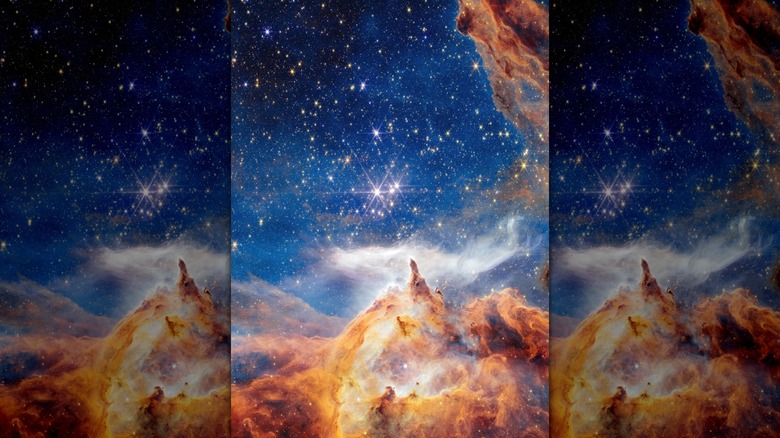
About 5,500 light-years away, Pismis 24 is a young star cluster located at the heart of the Lobster Nebula, which is located in the dark, dense clouds of the Scorpius constellation. The nearby dust and gas captured in this NIRCam image from the JWST looks like a foggy mountain peak with sparkling white stars hanging above and a lone shining star in what resembles a hollow cavern. Illustrating how newborn stars reshape their surroundings, this region is ideal for studying the evolution of young stars as their super-hot radiation and strong winds consume the dust and gas around them.
Jupiter
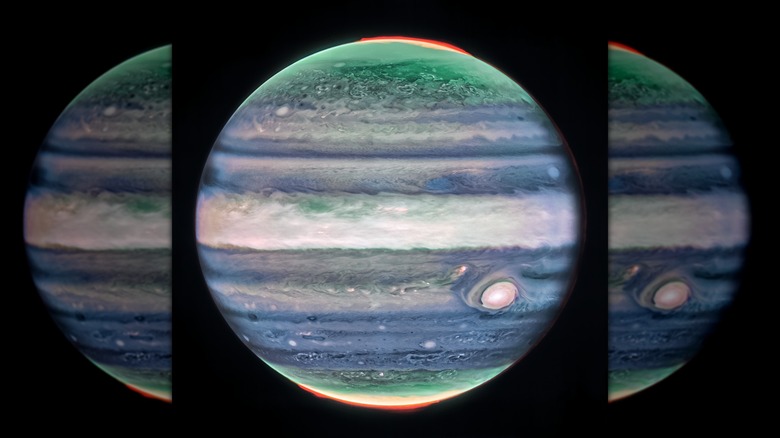
Among the many facts about Jupiter, one is that strong jet streams are created by the planet's fast rotation, which only takes 10 hours. This JWST's NIRCam image provides stunning details of the planet, including a look at the equatorial jet stream wrapping around the center. By contrast, the dark streaks that wrap Jupiter are areas with little cloud cover. There are also numerous white spots and streaks, potentially the cloud tops of convective storms at high altitude. You can even see the northern and southern auroras above each pole, which look like red glowing areas in this image.
Actively forming star system Lynds 483
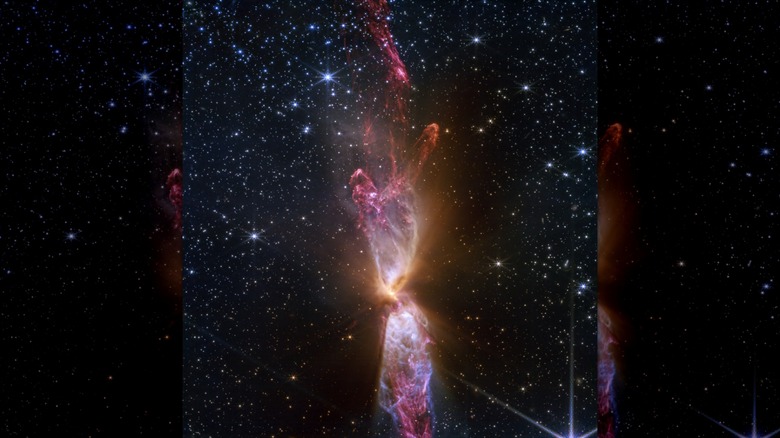
Baby stars (protostars) are born when gravity pulls clumps of dust and gas into a mass that continues to grow. In this image of composites taken with the NIRCam on the JWST, you can see a glimpse into an actively forming star system at Lynds 483. In a horizontal disk at the center, two stars shine through and spew gas jets and outflows in opposite directions in the Serpens constellation about 650 light-years away. When newer ejections travel into older ones, the different densities of materials collide and swirl, creating a beautiful hourglass-like figure.
Stellar jet in Sh2-284
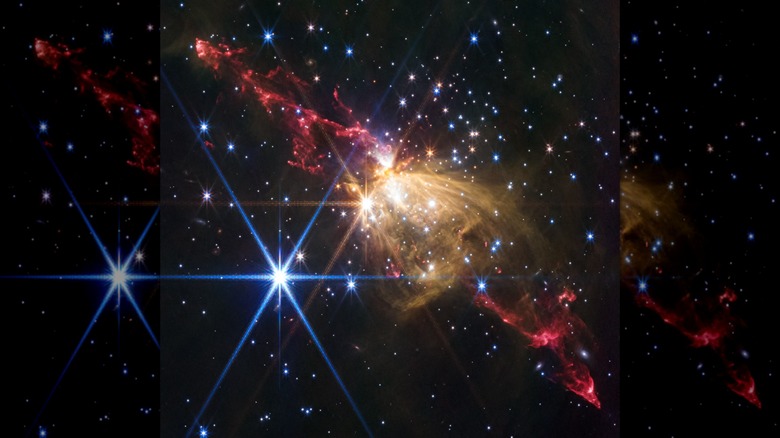
Just 15,000 light-years from Earth, there's a massive star-forming cluster called Sh2-284. It's located in the Monoceros constellation at the end of the Milky Way Galaxy's outer spiral arm. Within that cluster, the JWST's NIRCam captured this magnificent protostellar jet stretching 8 light-years across. That's enormous compared to the afore-"pictured" Rho Ophiuchi region, which is just 1 light-year across, indicating that such jets scale with their star's mass. Notice how the stellar jet's symmetry makes it look like an outstretched professional diver, while the stars around, in, and shining through are like glistening water drops.
FS Tau
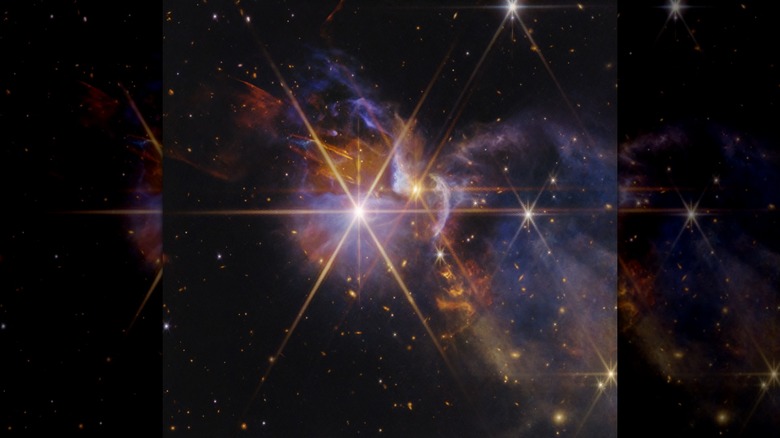
About 450 light-years away in Auriga and Taurus, one of the most common constellations in our sky, FS Tau is a star system with two distinguishable characteristics, which you can see in this JWST image captured with the NIRCam. The image looks like a coiled snake striking with its mouth open. At the center of the mouth is a bright pair of protostars (FS Tau A) that orbit each other, creating the large diffraction that stretches across the image. The protostar (FS Tau B) slightly to the right is believed to be producing the orange and red outflows.
NGC 604
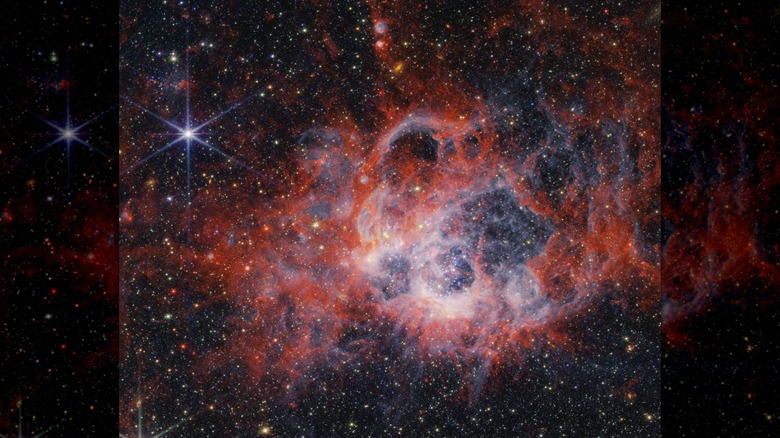
Located 2.73 million light-years from Earth, NGC 604 is a huge star-forming nebula that spans nearly 1,500 light-years across in the Triangulum Galaxy (Messier 33). It contains more than 200 enormous young stars — B and O-type stars, which are the largest types and can exceed 120 times the sun's mass. In this NIRCam image from the JWST, you can see how stellar winds from those stars forge cavern-like bubbles in the dust and gas around them. The bright orange represents PAHs, the darker red is molecular hydrogen, and the eerie looking blue and white glow is UV-ionized hydrogen.
Wolf-Rayet Apep
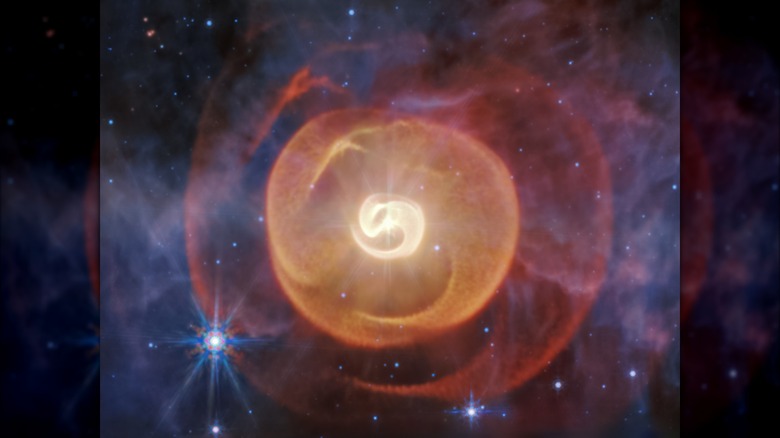
Named for the Egyptian god of chaos, Apep is a star system about 8,000 light-years away in the Norma constellation. It's home to a bubble-looking nebula that stretches at least 4.6 light-years across and consists of two Wolf-Rayet stars, which are relatively rare, and a supergiant star. In this MIRI image from the JWST, you can see four coiled shells around the stars at the center. Each shell consists of carbon-rich dust and forms when the stellar winds from the W-R stars collide for 25 years as they pass each other during each orbit, which takes 190 years.