

Scientists Sealed 15 People In A Cave For 40 Days Without Clocks. They Didn't Expect What Happened Next.
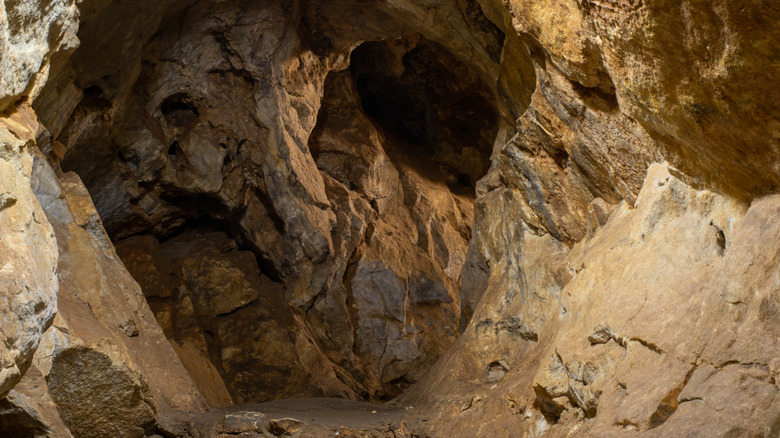
Most people don't give too much thought to their circadian rhythm (what determines if you're a morning person or a night owl), unless something disrupts it enough to lead to sleep deprivation. Understanding how human circadian rhythms are affected by challenging environments, such as those on a flight to Mars, is important for space exploration. This is where isolation experiments come in. The scientists that ran the Deep Time isolation experiment in 2021 took away the participants clocks but didn't expect them to lose their sense of time so completely.
In early 2021, the Deep Time project sent 15 volunteers (seven men and eight women) to live in a cave for 40 days without clocks, phones, or any other way to tell time. The scientists involved wanted to understand how confinement in a small space with limited mobility, such as a space capsule, would affect human physiology and group dynamics. A later analysis published in Chronobiology International looked at data from 13 of the 15 volunteers. At the conclusion of the study, most participants thought that only around 30 days had passed. They wished to stay longer to complete their group projects.
Isolation studies and circadian rhythm
Short periods of sensory deprivation are used as a form of relaxation, but extended periods of isolation cause weird disruptions in the body. When a person's internal biological clock operates without external time cues, they can develop a free-running circadian rhythm. The natural cycle drifts according to the body's own intrinsic period, which is often slightly longer than 24 hours.
The Deep Time study provided a unique model of how humans organize time under complete environmental time isolation. It was the first study to isolate a group of people and observe how their sleep patterns changed collectively. Free-running of the participants' circadian rhythms set in right away. The subjects completed 24 to 31 sleep–wake cycles over the 40 days of isolation. Simultaneously, their group cohesiveness fractured into subgroups with similar rhythms. However, they were still able to cooperate for the important tasks of generating power and collecting water.
One of the earliest records of a person experiencing this phenomenon from voluntary isolation was Michel Siffre, a French geologist and cave explorer. He spent 63 days underground in a cave in the French Alps in 1962. In 1972, he repeated the experiment for six months in a cave in Texas. He found that his natural sleep–wake cycle stretched to 25 hours over the course of his isolation. Eventually he developed a rhythm of spending approximately 36 hours awake followed by approximately 12 hours of sleep.
What isolation studies can teach us about space travel
The Deep Time volunteers will not be the last to subject themselves to isolation. The current record for the longest time spent in voluntary isolation underground is held by Beatriz Flamini, a female Spanish alpinist. In November 2021, Flamini entered a cave in Granada, Spain, and emerged 500 days later, in April 2023. Her loss of the sense of time was so profound that when her team came to get her she thought she had only been in the cave for 160–170 days.
Such extreme variations in the body's circadian rhythm under sensory deprivation are important to understand for determining how maintenance and observation schedules should be allocated on a potential Mars mission. Adjusting the spacecraft's routine to fit the schedules of the astronauts will help to ensure mission success. And understanding the body's reaction to isolation and confinement will help the astronauts prepare themselves for the inevitable hardships of space.